Utawarerumono ZAN (PC) review
Shaping Yamato’s history with Sequences of Slashes

One of the near-inevitabilities for a popular Japanese property is the musou adaption. One Piece, Gundam, Fist of the North Star, The Legend of Zelda, Hyperdimension Neptunia, Dragon Quest, Fire Emblem and Persona have all been reimagined as Dynasty Warriors-style hack-and-slash titles. Undoubtedly, there’s something alluring about taking a cast of familiar characters and letting them tear through legions of foes.
And occasionally, seemingly unlikely franchises get the treatment. Originally released as an eroge in 2002, Utawarerumono has been adapted into manga, anime, and an isometric action game. Outside of Japan, the property is probably best known for Utawarerumono: Mask of Deception and Utawarerumono: Mask of Truth, a pair of Atlus-published titles that fused rich visual novel-style storytelling with tactical role-playing battles. Combined with a healthy appreciation for kemonomimi, Utawarerumono uninhibitedly embraced multiple niches, which might have made for a tough sell in the West.
From Eroge Origins to Hack-and-Slash Spectacle
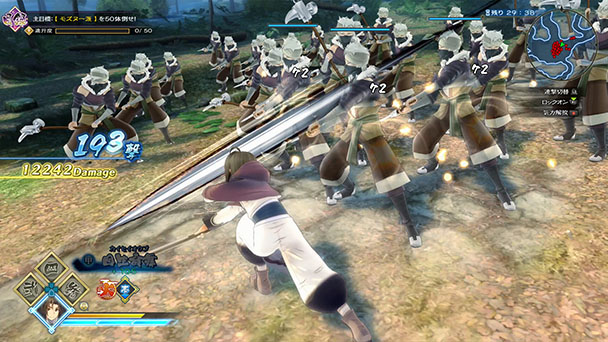
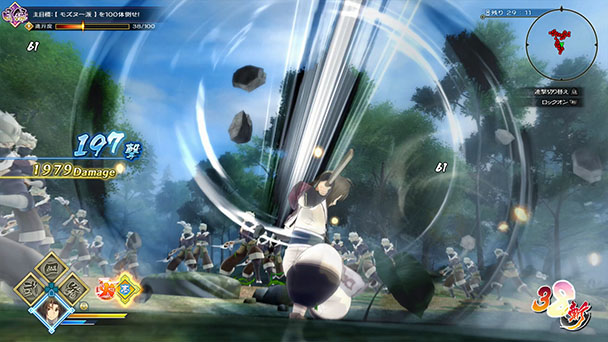
The release of Utawarerumono ZAN for PC demonstrates another attempt at winning over audiences outside of Japan. At first glance, the title seems like an alluring entryway. Here, developer Tamsoft applies expertise gained from the development of Hyperdimension Neptunia U: Action Unleashed and the Senran Kagura series. Even if you’ve never played any of the aforementioned titles and somehow managed to sidestep the whole Dynasty Warriors/Samurai Warriors franchises, play is immediately accessible. By tapping action buttons, you’ll initiate combos that will topple over hordes of foes, making you feel like a near-unstoppable powerhouse.
Yes, even a superficial familiarity with the aforementioned properties will reveal some of ZAN’s divergences. Throughout most of the main campaign’s eighteen-chapter excursion, you’ll be controlling a party comprised of up to four characters. By selecting different directions on your controller’s direction pad, you can instantly switch between playables. Unlike Koei-Tecmo’s prolific property, which often has you switching between generals on different parts of the map, Utawarerumono’s heroes typically work as a cohesive team. Although the AI-controlled obviously characters won’t inflict immense amounts of damage, they also won’t need to be babysat, which is rarely an enjoyable managerial task.
Teams, Not Lone Wolves
Unsurprisingly, the abilities for each of the twelve playable characters often spur you into switching protagonists. Confront a boss with a long combo string in one of the game’s numerous enclosed areas, and you’ll likely desire a defense boost. Here, Haku’s ‘Law of the Lords’ proves assistive, reducing injury when your foe is rapidly revolving with an outstretched weapon. But when he’s spun himself dizzy, you might want to shift over to Kuon, whose ‘Unyielding’ ability can maximize the amount of punishment you can dish out.
A character’s equipment can also be upgraded by slotting in scrolls or using Battle Points (BP). The former are acquired in a gacha-type system, where currency earned on missions can be used to for up ro three tiers of augmentation. The latter are used to purchase character-specific stat boosts. Pleasingly, ZAN rarely requires you to switch to a certain character. Although tedium might stem from repetition or a resistance to certain combos, you’ll eventually squash the adversary. But those who want to delve into ZAN’s recesses can try to gain Spirit boosts, by forming a union with characters who have close social bonds.

12 Legends, or 13 if You Count Uruuru and Saraana
Musuo games typically offer a multitude of combos typically accessed through patterns of two button presses. ZAN diverges with the incorporation of button holds, swelling each protagonist’s arsenal. Sporadically, the genre verges on homogeneity, by offering a myriad of characters based on a handful of offensive styles. Sure, Utawarerumono ZAN’s twelve-character rooster is constrained, but each combatant plays quite differently. From Rulutieh’s attacks, commanded atop her faithful bird, Cocopo, Uruuru and Saraana’s twin-based assaults, to Kuon’s ability to juggle adversaries, there’s a wealth of distinctiveness found here. Pleasingly, Tamsoft reveals a satisfying reverence for the source material, with many offensive strikes referencing the TRPGs.
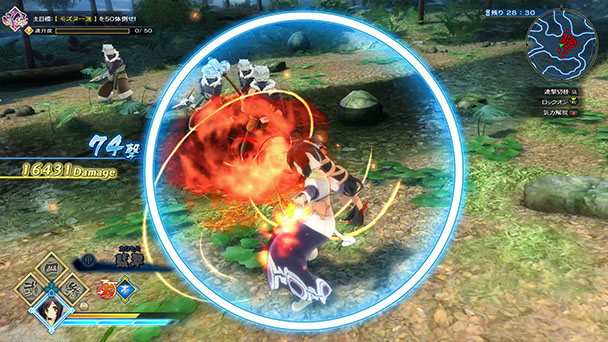
This is especially true for Chains, which are triggered once a character has banked enough Zeal. Much like the Mask games, these task players with precision when circles converge during a quick-time-event. Success not only galvanizes your assault but also refunds a bit of Zeal. Undoubtedly, you’ll want to maintain this resource, as a state called Overzeal increases your attack power, defense, speed, and can provide a Final Strike- the game’s punishing and eye-catching musou-like onslaught.
Far Briefer than the Visual Novels
Yet as enjoyable as combat is, there are two issues with the title that threaten to impair enjoyment. The first stems from the variety of content. Shifting between exposition and encounter, the eighteen-chapter Story mode can be completed in about ten hours. ZAN supplements this with thirteen Battle Recollections (which include side objectives), Free Missions, and a Battle Arena mode, but expect to play through the same mode multiple times on elevated difficulty settings if you’re chasing all the collectables. Sure, combat can be engaging, but sending players through homogenous challenges multiple times is problematic for a full-priced game.
For those who never played Utawarerumono: Mask of Deception, ZAN’s pithy encapsulation of events is poised to cause confusion. Undoubtedly, boiling down nearly forty hours of exposition into the kind of succinct storytelling that complements musou action is a grueling task. If you haven’t played or completed Mask of Deception, expect both confusion and even a few major plot spoilers. But here’s the odd thing: if you did, seeing those treasured characters brought to life in a new format might even make you overlook Utawarerumono ZAN’s playtime padding. But for the rest of us, you might want to wait until Zan is discounted.
Utawarerumono Zan was played on PC with review code provided by the publisher.
Overview
GAMEPLAY - 70%
CONTROLS - 75%
CONTENT - 70%
AESTHETICS - 70%
PERFORMANCE - 70%
VALUE - 66%
70%
OK
Utawarerumono ZAN delivers brisk, skillful musou-style chaos with a loyal nod to its source material, though its content length and story compression may leave some players wanting more depth for the price. If you’re chasing spectacle and quick-hit battles, you’ll find a satisfying confection. But if you’re hoping for a rich narrative, this abridged retelling, your expectations might be soured.


10 year old PS4 game for $40 bucks?
not like this.