Blades & Battles review
Knights of the (Short) Round

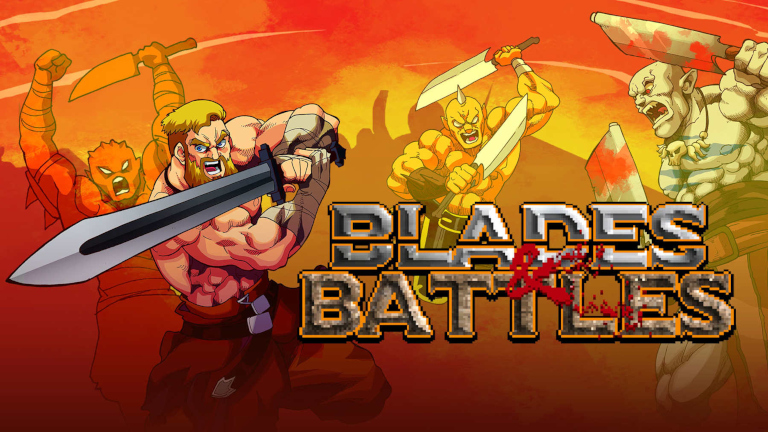
The beat ’em up has evolved quite a bit since 1989’s Golden Axe sent its dwarf, barbarian, and Amazonian on a quest to kill Death Adder. Modern genre efforts habitually supplements the arsenal of punches and kicks with complex movesets, character, upgrades, and different play modes. Blades & Battles takes a decidedly more old-fashioned approach. QUByte Interactive’s Arthurian brawler is short, straightforward, and immediately entertaining, delivering a solid combat system that feels satisfying from the very start. Unfortunately, the game doesn’t do much after a it’s promising introduction.
Battles’ storyline beings with Morgana, the self-proclaimed Queen of Ruin kidnapping Merlin and releasing enemies across Camelot. Expectedly, both Arthur and Lancelot respond by cleaving though the procession of skeletons, lizardmen, floating skulls, and other fantasy creatures. That killing spree sends the fighters through forests, caverns, snowy valleys, leading up to the final confrontations. That said, you won’t see everything in a single playthrough given Blades & Battles’ branching paths and two endings. But the trek won’t take long, with each path cleared in less than a hour.
A Pair of Knightly Movesets
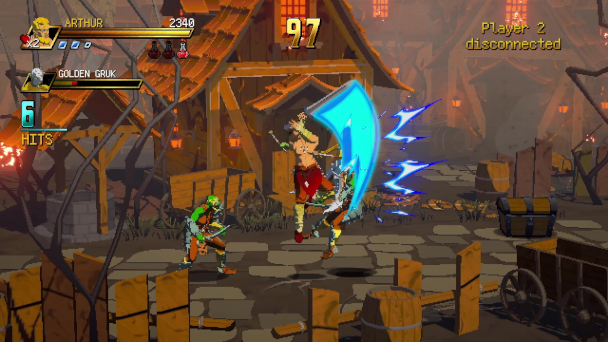
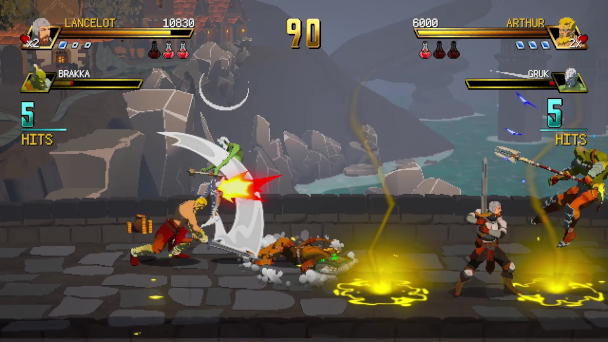
Sadly, knights like Gawain, Galahad, Percival didn’t make the cut, with Arthur and Lancelot serving as the game’s only playable heroes. While they both wield swords, their individual techniques give them different personalities. Arthur is the more conventional knight with a reliance on basic blade attacks. Lancelot has more range with his special moves and adds some physical strikes such as a dive kick. He can also summon stone pillars from the ground, allowing him to strike several enemies at once.
Notably, both characters start with their complete movesets, built around standard attack combos, running strikes, aerial techniques, mana-consuming specials, as well as some potent screen-clearing magic. There are no unlockable combos, replacement weapons, or skill trees waiting at the end of a stage. As such, Blades & Battles is easy to pick up and play although this accessibility means you’ll see a lot of the game by the time you finish the first stage.
Sinuous Swordplay Elevates the Fighting
The good news is that combat is enjoyable. Even basic strikes hit with enough force to interrupt enemies, letting you hit-stun a horde of creatures before they can retaliate. Launchers send unfortunate victims skyward and additional slashes can keep them levitated. With a bit of practice and some shrewd positioning, you can knock an enemy into the air, starting slashing, and continue the assault as another enemy wanders into the chaos. Blades & Battles is generous with the juggling, which helps make Arthur and Lancelot feel like proper badasses.
Like many beat ‘em ups, crowd control is important. Here, your sword swings can strike multiple targets and special attacks can break up tight clusters of foes. If Arthur or Lancelot get surrounded and face a hit-stun, a desperate move provides a welcome bit of relief, provide the heroes with a brief moment of invincibility. This defensive move consumes mana when available and begins drawing from health if the meter is empty, preventing your from abusing it. Another welcome element in your arsenal is the dodge. This has no cooldown, making is especially useful when bosses telegraph AOE attacks across large spaces.
Enormous Chests and Other Treasures
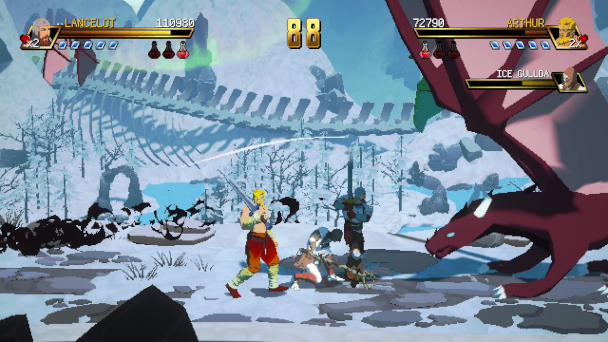
Meanwhile, chests and breakable objects dispenses amenities that range from health-restoring food, mana books, and magic flasks. Expectedly, mana books increase the number of special attacks you can summon across a stage, while the latter strengthen your magic. There’s also gold that can be picked up, which contributes to your score. It would have been nice if this resource was ties to elements like costumes, weapon variants, or additional techniques.
Another issue is the unevenness of boss battles. Although attack highlighting encourages you to dash and a few foes offer some visual rewards, there’s not much depth to these showdowns. Mostly, they’ll just absorb damage rather than goad you into trying out a new strategy. Worse, subordinates tend to spawn during these battles. While they can keep a cooperative pair occupied, when playing individually they often these encounters frustrating.
All Dressed Up, Nowhere Else to Brawl
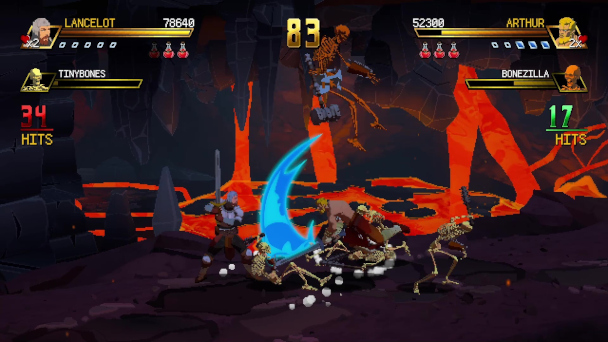
Undeniably, Blades & Battles has plenty of visual personality. 3D environments are paired with pixelated characters, channeling the vibe of a forgotten late-1990s arcade game. The game’s filter is adjustable and can be removed entirely if you prefer raw pixels. The action is complemented by a dark-fantasy soundtrack that provides a rhythm for the Arthurian action. It might not be memorable, but it gets the job done.
Local two-player co-op is the game’s obvious highlight, and Steam’s Remote Play Together provides a way to invite someone who isn’t sitting next to you. But cooperation cannot hide how little there is to conquer. Beyond difficulty selections, alternate routes, and three starting colors for each knight, Blades & Battles doesn’t have many supplemental. There’s no survival challenge, boss rush, wave mode, or big reward for completing the story. Hard mode increases the enemy count, but fighting larger crowds with the same techniques feels too similar.
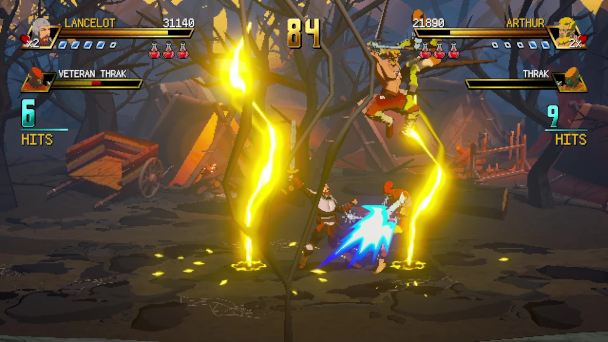
A bigger roster would have helped Blades. Merlin, Guinevere, or another Round Table knight could have introduced magic, heavy weapons, or faster close-range styles. Even one or two unlockable characters would have helped with longevity. But once you’re seen the game’s two endings, there’s not much reason to hunt down Morgana and her minions.
Blades & Battles was played on PC with review code provided by the publisher.
Overview
GAMEPLAY - 80%
CONTROLS - 75%
CONTENT - 45%
AESTHETICS - 70%
PERFORMANCE - 70%
VALUE - 70%
68%
OK
Blades & Battles succeeds where it matters, letting you and an optional partner hack away at creatures. Combat is responsive, has juggling, and just enough defense options to not get brutalized in a crown. But the campaign ends just as things begin to shine, leaving two capable knights trapped in a game that needs more characters and a few more ways to use them.