Deck of Haunts review
Spirited Fun, Now Haunting Switch 2

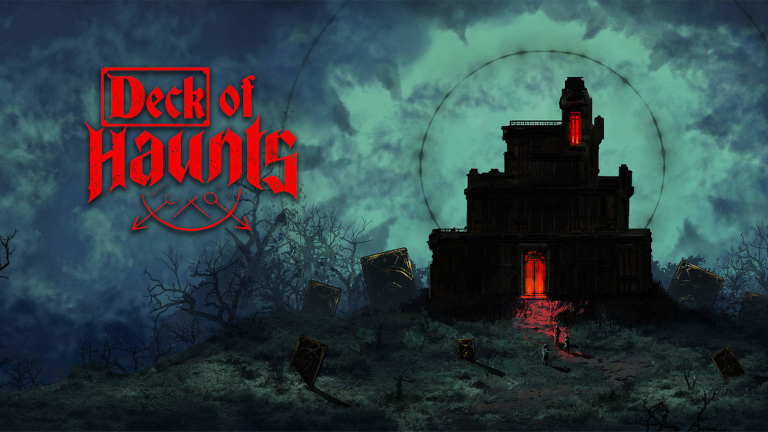
Instead of stepping into the shoes of a stereotypical hero or villain, Deck of Haunts is an imaginative deckbuilder that casts you as a vengeful haunted house. Each turn in the game’s 28-day campaign is split between two cycles. During the day, you’ll expand and customize your mansion, building a labyrinth of deadly rooms and supernatural traps. By night, you’ll use a deck of haunt cards to manipulate, terrorize, and ultimately eliminate nosy intruders, recalling the impish activities of Dungeon Keeper.
Haunts offers a respectable amount of strategic depth as you work to defend your Heart Room against trespassers who grow increasingly aggressive. Initially, low-level horror-movie fodder can be dispatched faster than Michael Myers performing a speedrun massacre on All Hallows’ Eve. But later, larger groups of police officers, priests, hunters, and stone masons arrive. Some break down doors, restore their companions’ health or sanity, or resist particular attacks. Meanwhile, stone masons know the route to your Heart Room, making them the game’s equivalent of rowdy college kids at an Airbnb. Get rid of them as quickly as you can.
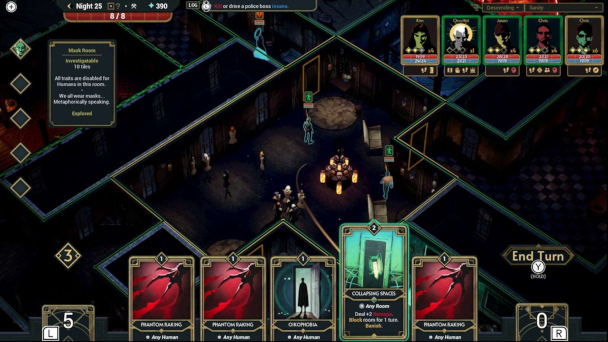
Deplete Their Physical or Mental Health?
Humans have two key attributes: health and sanity. Empty either meter and the intruder is incapacitated, but the game handles each one differently. Corpses frighten anyone who discovers them, potentially causing survivors to escape and return stronger on a subsequent night. Victims driven insane simply collapse where they stand, making madness a cleaner solution when you need to control a crowd. Tension increases the effectiveness of your sanity attacks, while certain cards, creatures, traps, and room effects can steer intruders or wear them down across multiple turns.
Certainly, the core loop of expanding your haunted house, customizing your deck, and stopping anyone attempting to escape is easily absorbed and rather gratifying. If you enjoyed the sadistic satisfaction of torturing your Sims or frightening the Sardini family in Haunting Starring Polterguy (you remember that one, right?), Deck of Haunts provides another outlet for mischievousness.
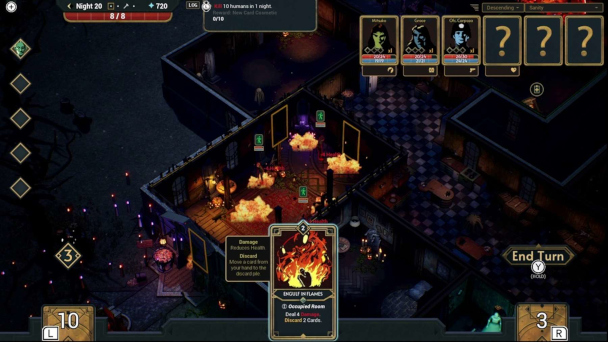
Fright at Your Fingertips
Undoubtedly, Deck of Haunts distinguishes itself from the graveyard of deckbuilders through its humor and strategic options. From the intruders’ amusing speech balloons to the ability to install damage-enhancing rooms, Haunts balances rewarding mechanics with a bit of macabre playfulness. I’m reasonably certain the Belgium-based developers have committed Tim Burton’s oeuvre to memory.
The original PC release lacked adequate controller support, but subsequent updates prepared the game for consoles. On Switch 2, the Joy-Con and Pro Controller inputs handle the necessary functions, from construction, card selection, target cycling, deck inspection, to camera rotation. Building multi-tile rooms is reasonably intuitive once you learn the commands, although selecting a specific victim can require scrolling through everyone in the room instead of pointing directly at them.
The Ghosts of Control Schemes Past
Awkwardly, the interface still carries traces of its mouse-driven origins. Cards sometimes hesitate after being selected, particularly when an effect generates another card, and they can sporadically become misaligned in your hand. Docked play can also produce some odd cursor behavior when cycling through options, while both small text and crowded status displays are easier to view from the Switch 2’s handheld screen than from across a living room. Touchscreen support would have been a natural fit for dragging cards and positioning rooms, but it is conspicuously absent. These are inconveniences rather than deal-breakers, yet they prevent the port from feeling acompletely at home on Nintendo’s hardware.
Pleasingly, each run offers some variation through changing mansion layouts, visitor combinations, card rewards, and starting decks. Success earns experience and expands the pool of available haunt cards, rooms, upgrades, and story fragments. But this meta-progression is less transformative than it initially appears. Unlocking more cards gives future runs additional possibilities rather than providing permanent statistical advantages, and many rewards are too specialized to alter your strategy significantly.
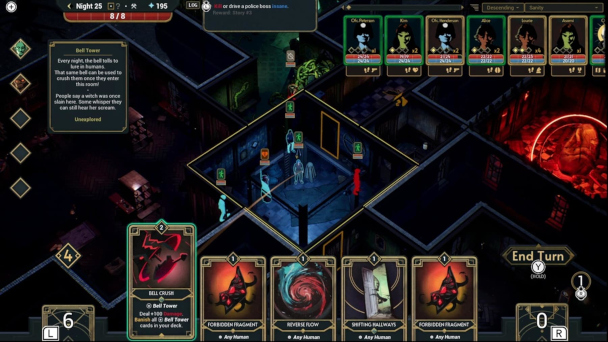
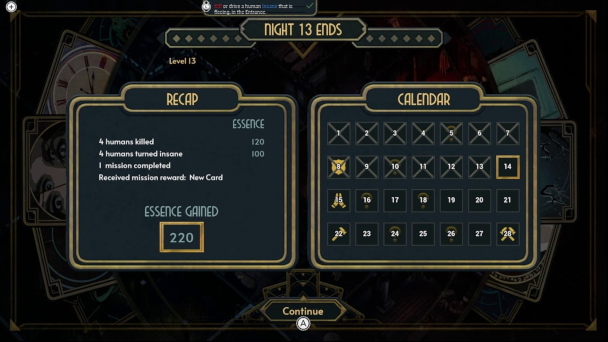
Deck of Haunts could also communicate some elements more clearly. From activating an injurious bell tower to identifying the conditions behind particular objectives and rewards, Haunts is occasionally too taciturn. The standard campaign’s difficulty curve is similarly uneven. Its 28 nights can occupy more than two hours, yet competent players may clear the whole campaign on their first attempt. That makes the threat of losing an entire run seem more intimidating than the actual opposition.
The Irony of Dying in the Living Room
Expectedly, you’re going to encounter moments when it feels like you’ve been cursed by the random-number generator. Such is the nature of a roguelike. Success means you can’t depend exclusively on receiving cards that target physical or mental health. Like a game of poker, you might take calculated risks while waiting for the right draw, or hope the deck produces an unlocked card capable of dishing out escalating damage. However, the best approach isn’t always direct action but the clever manipulation of your victims.
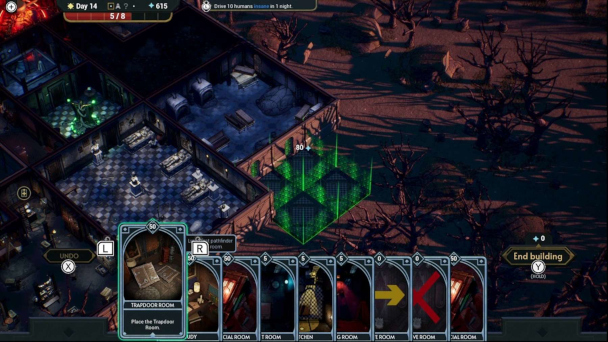
Room construction adds another strategic layer. A crematorium disposes of incriminating bodies, while the Hall of Mirrors allows cards that normally target isolated humans to work even when a victim has company. Creatures provide persistent attackers, hexes alter an intruder’s attributes, and traps turn individual rooms into long-term hazards. Since rooms nearer the Heart are cheaper to construct, you must balance the benefits of a sprawling maze against the Essence required to build it.
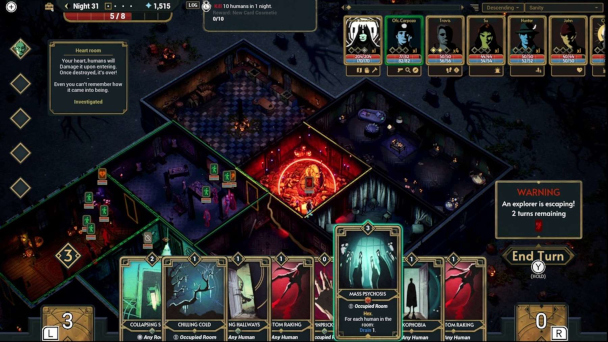
Once completed, the campaign unlocks Nightmare mode, a more compact 13-night challenge that improves the game’s longevity. Themed invasions force you to respond to particular enemy traits, while accumulating totems impose increasingly severe disadvantages. These runs are shorter, tougher, and less susceptible to the snowballing that can make the standard campaign’s closing nights surprisingly manageable. Nightmare mode ultimately feels like the format best suited to Deck of Haunts’ mixture of planning, improvisation, and gleeful cruelty.
Despite a few blemishes, Deck of Haunts offers a compelling mixture of tactical planning, mansion building, and card-based malevolence. The Switch 2 version’s controls could have been refined more, while the absence of touchscreen support feels like a missed opportunity. But the thrill of scaring the shit out of snoops will likely keep you coming back for another run. Whether you’re a fan of deckbuilding strategy or simply long to play as a murderous mansion, Deck of Haunts delivers a spirited good time.
Deck of Haunts was played on Switch 2 with review code provided by the publisher.
Portions where taken from our review of the PC version.
Overview
GAMEPLAY - 75%
CONTROLS - 65%
CONTENT - 70%
AESTHETICS - 75%
PERFORMANCE - 70%
VALUE - 70%
71%
GOOD
Spirited sadism and card-based strategizing combine in Deck of Haunts. The Switch 2 controls occasionally reveal the game’s mouse-driven origins, but building a homicidal house remains an enjoyable exercise in supernatural strategy.