Q&A with XeGrader plus’ Tokihiro NAITO


Few game designers can claim a career spanning the formative years of Japanese action RPGs and the creation of a brand-new title for vintage computers. Tokihiro NAITO made his name as the programmer and designer behind 1984’s Hydlide, later contributing to the development of Hydlide II, Hydlide 3, Virtual Hydlide, and the cult shooter Undead Line.
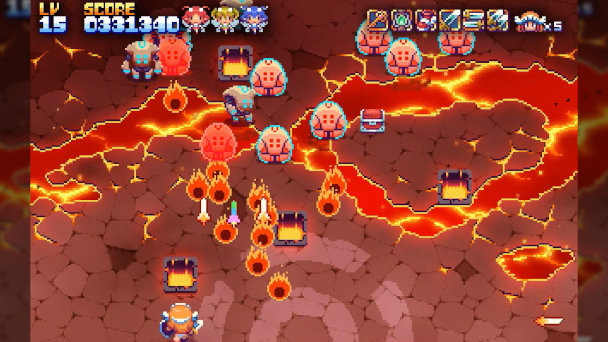
Now a programmer at M2, NAITO has returned to independent development with XeGrader, first created for the PC-8001mkII and MSX2, and now expanded for PC with the release of XeGrader plus. Blending shooting, exploration, puzzles, and carefully concealed secrets, the project reflects both NAITO’s affection for classic hardware and a design philosophy that has remained remarkably consistent across four decades. We spoke with NAITO about his work at M2, the arcade inspirations behind XeGrader plus, his collaborations with Tadahiro Nitta and Skipmore, and the ambitious sequel he would like to make.
Tech-Gaming: Looking back at your work on Hydlide and comparing it with XeGrader plus, which parts of your design philosophy toward games have remained unchanged, and which have evolved the most?
NAITO: As far as game design is concerned, I don’t feel that my philosophy has changed very much since the old days. Both then and now, I want to make games that I myself would enjoy playing.
Because of that, I have absolutely no desire to make a game by myself if I already know all the answers simply because I created it.
T-G: You currently work at M2, a company known internationally for the quality of its classic-game emulation and preservation. Its projects seem driven by a painstaking commitment to honoring the original material. Can you offer any insight into M2’s company culture and approach to its work?|
NAITO: M2 is very particular about the quality and details of the things it creates. However, to be honest, I know very little about projects other than the ones I am personally involved with. The company is based in Abiko City, Chiba Prefecture, while I live in Nagoya City, Aichi Prefecture, and work remotely. Because of that, I have very little insight into what is happening at the headquarters.
Also, every project I have worked on at M2 has had a client. For that reason, there is really nothing I can talk about regarding the projects I have worked on.
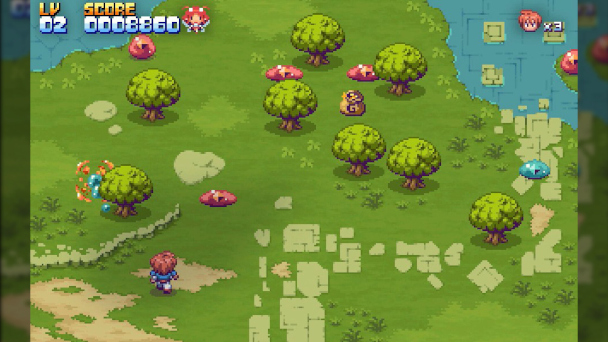
T-G: When I play XeGrader, I see traces of gaming history, with what seem like nods to Space Invaders, The Tower of Druaga, and even Konami’s 1982 arcade game Tutankham. What were some of the specific inspirations behind XeGrader plus?
NAITO: The first time I remember feeling that solving a secret or mystery in a game was rewarding was when I discovered the piercing shot power-up in Gaplus. XeGrader plus contains an homage to that, where the player can obtain piercing shots by solving a similar kind of secret.
Also, in the Japanese Famicom version of Gradius (the NES version overseas), passing through the volcanic tunnel in a certain way awards a bonus. I found that kind of secret—where figuring something out leads to a higher score—very enjoyable. thought that a game design built around collecting those kinds of secrets could be interesting.
“As far as game design is concerned, I don’t feel that my philosophy has changed very much since the old days.” Tokihiro NAITO
T-G: Some of XeGrader plus’ personality comes from Tadahiro Nitta’s FM-synth-driven soundtrack and Skipmore’s pixel art. Let’s discuss the former first: What kind of direction did you give Nitta, and what emotions or atmosphere did you want the music to evoke?
NAITO: My first request to Nitta-san was simply to imagine what kind of music might have been playing in an arcade around 1990 if XeGrader had existed there at the time. The original XeGrader had already been completed on Japanese retro PCs, so the number of tracks and where they would be used had already been decided. I showed him the existing music and screen images, and told him that either completely new compositions or arrangements would be fine.
The main request was that, since the existing tracks varied considerably in length, I wanted the new music to be consolidated to around 30 seconds per track. The decision to use FM sound plus PCM was Nitta-san’s. After that, I recorded videos of the game in development and sent them to him so that he could watch them and expand his image of the game. As a basic principle, I don’t give Nitta-san very many specific requests. I believe that if you give a creator too many detailed instructions, you can end up diminishing the essential qualities of that creator.
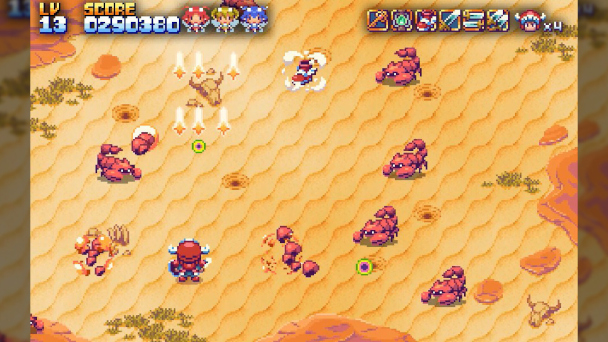
T-G: How did your collaboration with Skipmore unfold? Their work feels like a continuation of the pixel-art tradition rather than an attempt to merely imitate games from the 8- and 16-bit eras. How did you arrive at the game’s visual identity?
NAITO: Skipmore-san had said in their behind-the-scenes discussion of Fairune that the title was an homage to Hydlide. We had been in contact since I first approached them. For the retro PC versions that preceded XeGrader plus, we actually used artwork created by Skipmore-san for Fairune.
At the time, Skipmore-san said, “If only I had more time, I could make something even better…”
So I officially approached them and said, “Since I’m going to make a new XeGrader this time, would you like to work together?” As for the game’s visuals, I left 100% of that to Skipmore-san. I only provided information about the stage structure and things like that. Because of that, Skipmore-san was actually quite puzzled at first.
T-G: The original version of XeGrader was created for the PC-8001mkII in 2024, followed by an MSX2 edition in 2025. What prompted you to design a new game around the limitations of vintage computers?
NAITO: I’m not really sure why… I suppose I simply like these kinds of machines.
There was a kind of challenge involved: I wanted to see how far I could push the technology I have today when developing for machines that I personally like. With the performance of modern PCs, people naturally expect a 2D game to be possible. But if you can make a game run and move smoothly on the hardware specifications of those old machines, that’s something impressive. More than anything, though, I simply enjoy making that kind of thing.
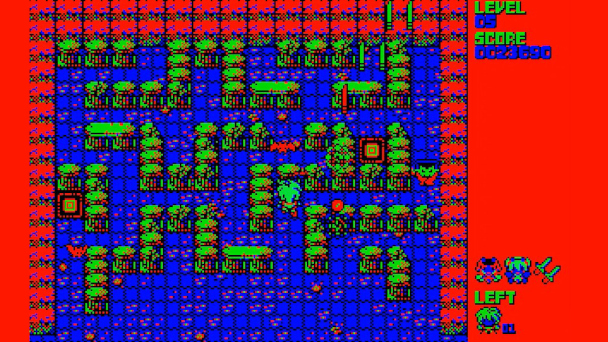
T-G: Rather than simply porting the two earlier editions, XeGrader plus expands their graphics, sound, and design. At what point did you realize that the project should evolve into a fuller release?
NAITO: From the very beginning of production on the Steam version, I wanted to take it all the way and make it feel modern. Skipmore-san’s comment about “if only I had more time…” was also one of the things that prompted this. The sound on Steam would also be played back from sound files, meaning that there were essentially no technical limitations. So… yes, I could do anything. And because I could do anything, I imposed the limitation of “1990s arcade” on myself as a self-imposed constraint.
“Because I could do anything, I imposed the limitation of ‘1990s arcade’ on myself.” Tokihiro NAITO
T-G: The game combines shooting, exploration, and environmental puzzles. How difficult was it to balance those different mechanics without allowing one of them to dominate the experience?
NAITO: From a game-design perspective, I didn’t feel that any part of it was particularly difficult. Before I even started making the game, XeGrader was already running in my head. I was playing it in my head, and I already had a fairly complete image of how I wanted things to work. However, I may have struggled a little when I later decided to add a scrolling map. The reason was that this hadn’t been part of the concept when the project began.
Since I had given it the name “plus,” I wanted to add something that would be an obvious “plus” element. After thinking about it for a while, I realized that if I thought of it as multiple stages connected vertically, it would also make the balancing and adjustments easier. Once I had that idea, development proceeded quite smoothly.
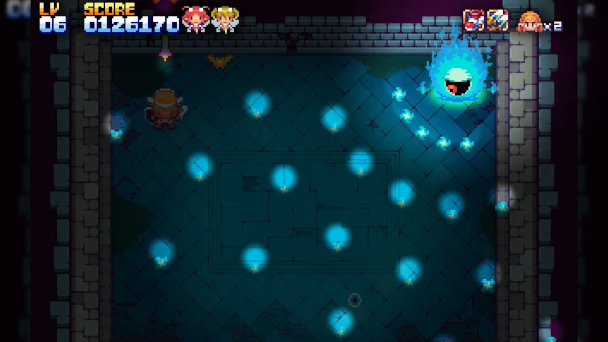
T-G: XeGrader plus lets players choose between a human warrior and an elf. Beyond their appearance, how do the two characters differ, and what encouraged you to add a second playable hero?
NAITO: The elf walks slightly faster than the human, and the elf’s attack shots are also slightly faster. In exchange, the elf receives a slightly lower score in the final bonus calculation. In other words, the human and elf are essentially a small difficulty adjustment. PRACTICE + ELF is the easiest combination, while EXPERT + HUMAN is the most difficult.
T-G: Finally, if XeGrader plus is successful, would you like to expand its world through a sequel, or are there other vintage-inspired projects you would like to pursue?
NAITO: I haven’t thought about it yet. If I were to make a sequel, I think I would have no choice but to design it for modern hardware, such as the kind of machines that run Steam. I have a fantasy of making a shooting-style ARPG where you can freely move around a field with both vertical and horizontal scrolling.
…But the amount of work involved would be far beyond what I could realistically do as an individual developer. If I started making something like that, I might pass away before I could finish it. 😁





You didn’t really talk about any of the older games. 🙁