XeGrader plus review
Learning to Live One Stage at a Time

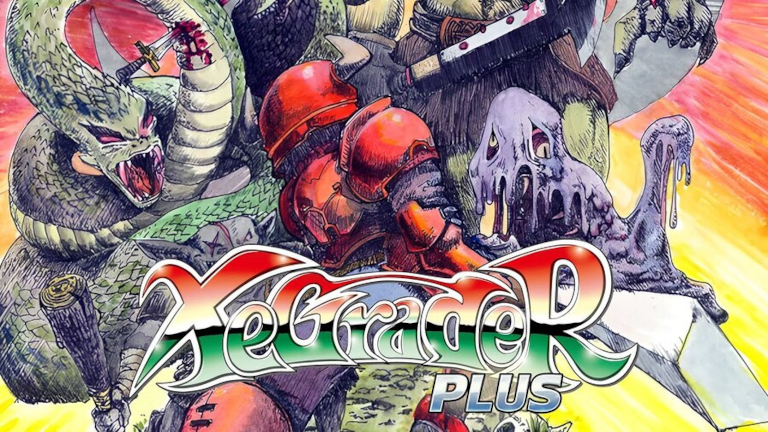
With its pixel art and modest mechanics, XeGrader plus looks like another one of those modern games infatuated with retro sensibilities. But its history is a bit more complicated than that. The title is the work of Tokihiro Naitō and Tadahiro Nitta. The two developers helped define MSX gaming in the last late eighties and early nineties with the seminal action-RPG series Hydlide and notable FM-synth soundtracks for games like Xak and Illusion City.
Naitō, who currently works at M2, isn’t dabbling in nostalgia for its own sake: this Steam release expanded on earlier XeGrader editions built for the PC-8001mkII and MSX2, released in 2024 and 2025 respectively. This version added the option for updated graphics and sound while still providing period recreations as separate downloadable purchases for players who want the hardware-accurate experience. Working with Nitta and indie studio Skipmore (Fairune Collection, KAMIKO) for the remastered visuals, XeGrader plus feels like a compact collaboration, where each contributor’s fondness for vintage gaming is unmistakably evident.
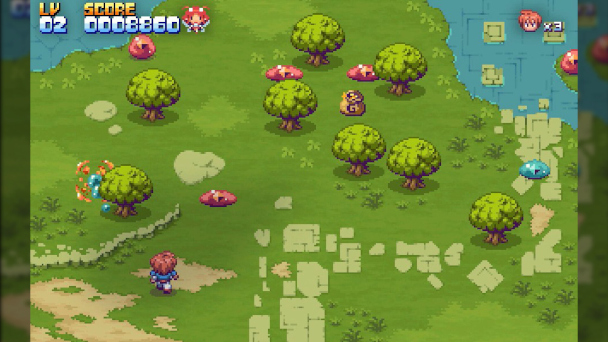
While some might want to pigeonhole XeGrader as a retro shooter, that descriptions is reductive. Yes, there’s plenty of modern games that copy a classic. They habitually change the characters and artwork while leaving the underlying structure familiar. Naito’s game is more interesting. Rather than copying one title wholesale, it gathers ideas from across early arcade and computer history, blending them together to create something less predictable.
Calling it a Shooter in Underselling it
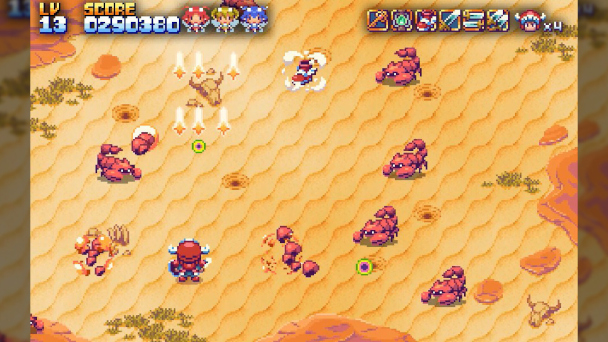
Initially, XeGrader plus resembles a fantasy-themed variation on Space Invaders. Each stage contains a self-contained challenge, with enemies often entering the playfield in formations or crowding the screen until you destroy them. But unlike Taito’s seminal shooter, where your cannon was limited to moving horizontally along the bottom of the screen, your selected warriors can move freely in eight directions. The fixed-screen format and waves of encroaching enemies are familiar, yet the increased mobility makes each encounter feel like they take place in tiny combat arenas. The one distinction is make is that you’re always shooting toward the top of the screen.
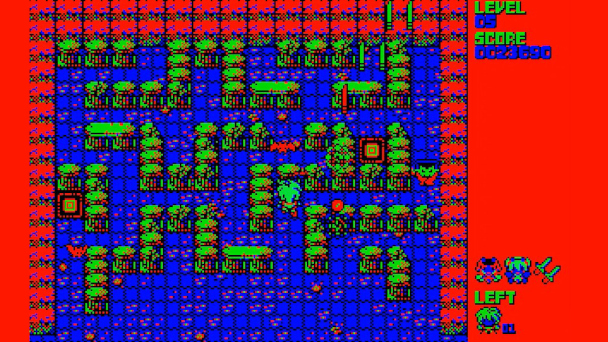
Interestingly, there are traces of nearly forgotten titles like Konami’s Tutankham. That 1982 arcade title (which soon arrived on home consoles) sent an explorer through monster-infested labyrinths, collecting keys and firing horizontally through narrow passages. One of XeGrader plus stages captures the same feeling of being trapped inside a compact supernatural maze, making positioning and planning more important than marksmanship. Instead of the unobstructed playfield, you’ll need to navigate to two pressure switches in the maze which provide a power-up when they’re both activated. Unlike the fields, and forests of preceding levels, you’ll need to consider the layout of the environment.
Most importantly, the game inherits The Tower of Druaga’s captivation for implicit rules. Namco’s 1984 title hid treasures behind cryptic conditions: crossing particular tiles, defeating enemies in a specific order, or performing actions that most players wouldn’t try. Similarly, most of XeGrader plus’ stages contains a ‘mystery’ that can produce an item or power-up. While I serious considered detailing a few of these, I think they’re best left spoken. Just know that sometimes the least obvious action pay dividends. As such, success requires more than reflexively shooting everything. You need to observe, experiment, and occasionally do something that appears completely irrational. And that’s probably not a bad approach to life, either.
Adversity Is the Curriculum
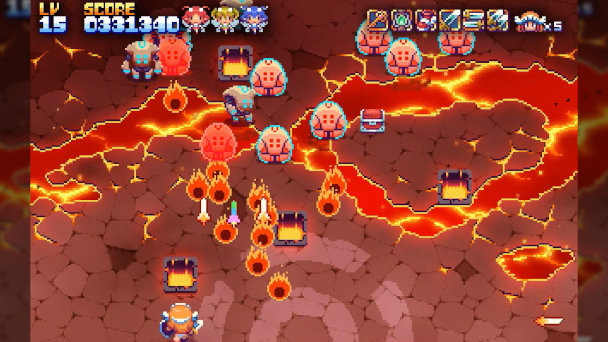
Across 18 stages and a handful of boss battles, XeGrader plus keeps changing the nature of its adversity. The early field encounters establish the fundamentals, letting you become comfortable with movement, firing, and enemy behavior. Later areas obscure enemies and their projectiles in dense forests forcing you to adapt. That fixed screen you’re grown accustomed to? Expect it to scroll, expanding the amount of territory that must be considered. I love a game that occasionally pulls the carpet beneath you, even if a bit of frustration can happen. And yes, occasionally things can flirt with being unfair. Enemies can appear where there’s little room to respond, and some stages can make searching for hidden upgrades unnecessarily hazardous.
The whole learning process is supported by three difficulty settings. Practice is especially useful, allowing you to restart from any previously reached stage after a game over. Average preserves a bit of more of the arcade-style urgency, while Expert is aimed at players craving a truly elevated challenge. Each stage lasts a few minutes (with some early ones lingering too long) and a successful run can be completed in roughly an hour. But things like new discoveries and score chasing to earn a place on the leaderboards provide incentives to return.
Like Zombies, Some Old Habits Should Stay Buried
Unfortunately, XeGrader plus embraces a few antiquated conventions, as well. Notably, you cannot save a conventional run and return to it later. Continues prevent a succession of mistakes from erasing your forward progress, and Practice mode permits stage selection after a game over, but neither replaces a straightforward suspend or save function. A complete playthrough might be relativity short, but learning the game’s nuances can take substantially longer, especially when difficulty spikes repeatedly slow your progress. And maybe I overlooked it, but I didn’t see health meters for bosses.
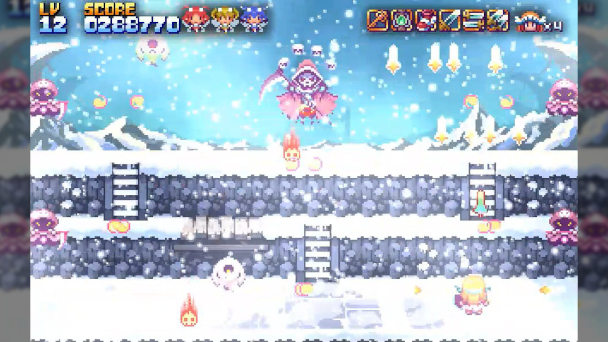
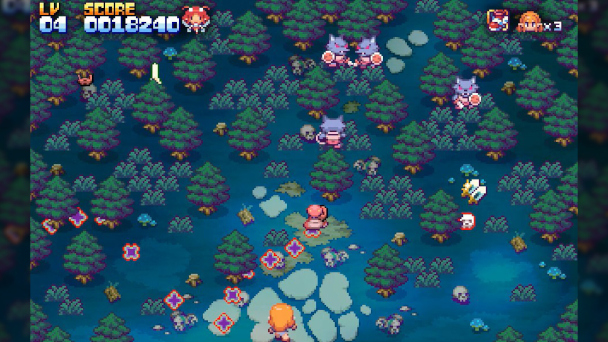
Visually, the standard plus edition is easily the most inviting. Skipmore’s detailed sprites give forests, graveyards, monsters, and stone sanctuaries a looks that recalls 8- and 16-bit adventures, complete with a Ghosts ‘n Goblins-style overview map. Modern lighting and shadow effects add depth without taking away from the spritework. Meanwhile, Nitta’s soundtrack combines memorable melodies with the tactile texture of FM synthesis, providing stage with some additional personality.
DLC Allows You to Play on Simulated Hardware
The two $4.99 DLC packs are more substantial than the usual graphical filters. XeGrader for Origin mode recreates the 2024 PC-8001mkII edition with only four colors and music approximated through the machine’s old BEEP speaker. Its abstract sprites and raw electronic chirps dramatically change the atmosphere. Reading the playfield becomes part of the challenge, and every visual effect feels significant.
Meanwhile, XeGrader for MSX2 mode recreates the 2025 physical release, providing a broader but still restrained color palette and some PSG-style audio. It’s on a remarkable middle ground: more readable and than Origin mode, but far less lavish than plus. The legacy modes also retain earlier design characteristics, with adjusted mysteries and a fixed-screen Sanctuary rather than the modern version’s scrolling layout. As such, they don’t merely change how XeGrader looks and sounds; they alter how stages are read and played.
These editions would have been more generous as unlockables, especially given the base game’s $19.99 MSPR and brief runtime. But taken together, they form an intriguing interactive history. Moving from Origin to MSX2 and finally plus demonstrates how palette, sound hardware, and screen design can reshape the same underlying design.
Flex Your Trigger Finger and Give Your Brain a Test
Thankfully, XeGrader plus isn’t pretending to be an update of a lost arcade game. No, it’s sincere, offering an update that understands why the original games were compelling. Its missing save option, sudden difficulty spikes, and separate DLC pricing can be a bit annoying. But its mixture of shooting, exploration, experimentation, and cryptic discovery gives each stage personality. Like the games that inspired it, XeGrader plus understands that adversity can be an effective teacher. Watch carefully, accept the occasional setback, and eventually, you’ll find a way forward.
XeGrader plus was played on PC with review code provided by the publisher.
Overview
GAMEPLAY - 80%
CONTROLS - 80%
CONTENT - 80%
AESTHETICS - 75%
PERFORMANCE - 85%
VALUE - 80%
80%
VERY GOOD
XeGrader plus blends old-school shooting with exploration and cryptic puzzles. As such, each stage tests your curiosity as much as your trigger finger. The lack of a save system, uneven difficulty, and separately sold legacy modes might vex, but overcoming its quirky challenges makes this retro trek worth taking.





This looks like the kind of game I might like. Is it coming to Switch?
Cool. Just wish there was a demo on Steam.