Novel Rogue review
Building Decks and Stories


Kemco is often known for their formulaic titles, but Novel Rogue demonstrates the publisher’s willingness to experiment. The result is an experience that deviates from their usual cookie-cutter RPGs. Although the dialogue is frequently dull, the game’s battle system provides an accessible yet robust deckbuilding mechanic. With branching progression across four scenarios, Novel Rogue provides a refreshing change from the menu-based, combat that’s typical for the Higashihiroshima-based publisher.
The Wright Stuff
You play as Wright, an apprentice at the mystical Ancient Library. After years of training under Yuisil, the Witch of Portals, your magical talents are put to the test by venturing into four different novels: Exiled Princess Knight, Divine Love, Mirror of Desire, and Hinomoto Conquest. Sure, the storytelling isn’t all that engaging but the variety across the novels helps to offset fatigue.
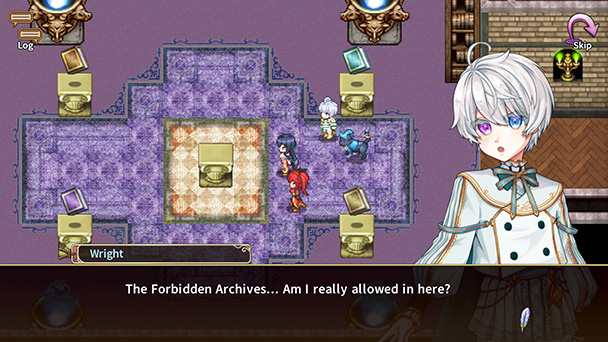
Each book offers a distinct context, that ranges from a fallen kingdom, a comic celestial world, to a feudal-era ramble with a fox girl. Beyond multiple endings for each novel, your decisions influence the characters within each story. That said, the script is typical EXE-Create fare, so it’s functional. But the simple personalities and bland prose can make the storytelling tiresome. But on the upside, different story outcomes might encourage replay for those willing to overlook the writing. Fortunately, Novel Rogue’s detailed recordkeeping tracks your journeys, easing the process of seeing every plotline.
Thinking and Inking
Undoubtedly, the writing takes a backseat to Novel Rogue’s deckbuilding, the game’s real highlight. Combat is turn-based, with players building and customizing decks tailored to each book’s unique challenges. Collecting powerful cards, using “ink” to enhance your deck, and learning when to shift the order of your allies add depth to the battles. Even if you’re familiar with games like Slay the Spire, Monster Train, or Ratropolis, you’ll likely find Novel Rogue’s encounters engaging and fair.
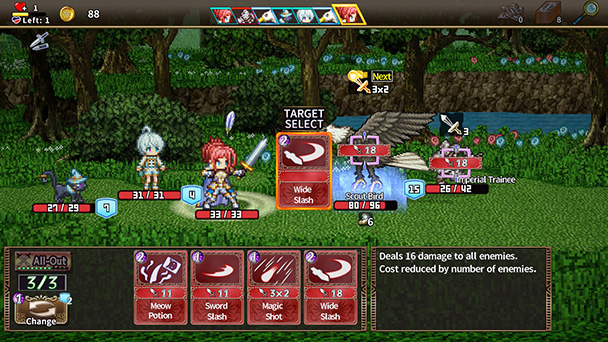
Like the best entries in the deckbuilder genre, the game gives plenty of tactical options. Whether you want to stack your deck with zero-mana cards, chase mana bonuses, build resilient defenses, or just overwhelm foes with heavy damage, Rogue offers flexibility. I typically pursue the best statistical advantage. But here I found myself experimenting with strategies inspired by specific cards. Best of all, it’s always clear how much damage a played card will dish out, with Rogue doing the math and putting the counts on the cards.
The Joys of Synergy—and a Few Snags
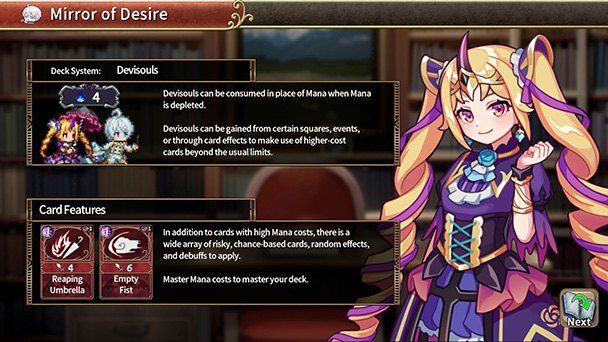
One of Novel Rogue’s best qualities is how well its components work together. Storytelling and gameplay intermingle agreeably, with narrative events often affecting your cards or upcoming battles. When the narrative does stumble, combat kept me engaged. Each novel has its own signature deck, and your cards sometimes reflect the personalities of the characters. One example: a tide-turning ‘all-out attack’ that captures the fiery spirit of an expelled princess.
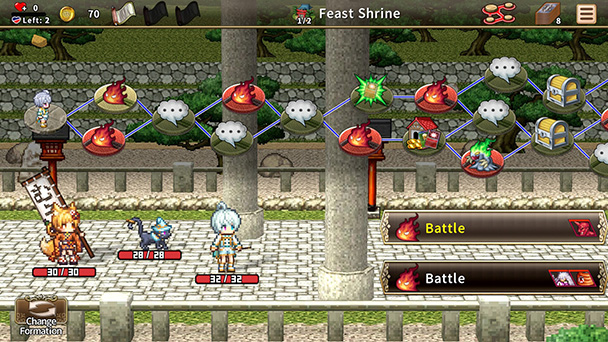
Despite its strengths, Novel Rogue isn’t without some drawbacks. If you’ve played other RPGs with deckbuilding battles, the game may not offer enough novelty to justify a purchase. Outside of combat, the visuals are restrained, with only a handful of sprites and character portraits that display few emotions.
As a port from Android/iOS, controller and mouse-and-keyboard support are surprisingly adept. However, some aspects feel sloppy, such as an ad for ‘premium downloadable content’ that links to the Steam page for Alter Age, another Kemco title. There’s also a currency called ‘witch stones’ used for optional assists. It’s an obvious holdover from the game’s free-to-play, mobile game origins.
A Harbinger of Hope?
Novel Rogue demonstrates what developer EXE-Create is capable of when they step outside of their comfort zone. With gratifying card-based combat and customizable difficulty, this is a diverting role-playing deckbuilder where the combat is good enough to inspire plenty of side-questing. Given that so many Kemco games have been linear treks, Novel Rogue’s push toward experimentation is a welcome change. Certainty, it’s a direction I hope to see more of in the publisher’s future releases.
Novel Rogue was played on Xbox Series X with review code provided by the publisher.
Overview
GAMEPLAY - 80%
CONTROLS - 80%
AESTHETICS - 65%
ACCESSIBILITY - 70%
PERFORMANCE - 70%
VALUE - 70%
73%
GOOD
Novel Rogue’s writing won’t win any awards, but its card-based combat is surprisingly deep and rewarding, marking a welcome creative detour for Kemco. With accessible deckbuilding that doesn’t sacrifice depth, this is certainly one of the publisher’s more engaging efforts.




Never thought I’d see a Kemco game get a good review.