Wild Blue Skies review
Flying into the Familiar

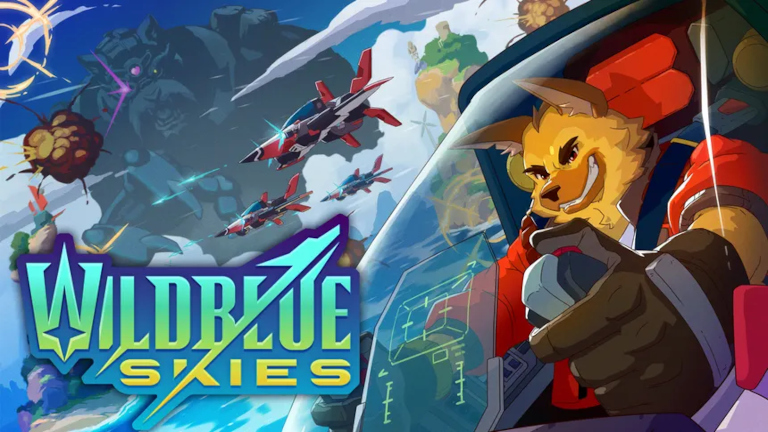
There’s no point in dancing around the obvious: Chuhai Labs’ Wild Blue Skies is unmistakably inspired by Star Fox. That’s not really a coincidence. The studio is led by Giles Goddard, one of the programmers who worked on the original Star Fox for the SNES. From the on-rails aerial combat, to the squad of animal personalities, to the enemy formations and enormous bosses waiting at the end of missions, a comparison with Nintendo’s flight shooter is inevitable.
That isn’t necessarily a problem. In fact, Wild Blue Skies is at its best when it mimics Nintendo’s space shooter, with elements like Star Fox 64‘s arena-style dogfighting sections, which let you break from the rails and maneuver freely within a confined space. After given that the Kyoto-based powerhouse doesn’t seem terribly interested in bringing its beloved properties to PC anytime soon, Wild Blue Skies is as welcome as its namesake.
But instead of using that opening to push the genre toward new horizons, Chuhai largely settled for imitation. What’s here is perfectly fine. But also a bit safe, especially if you’re hoping for a break from the Fox formula.
New Enemies But the Same Flight Path
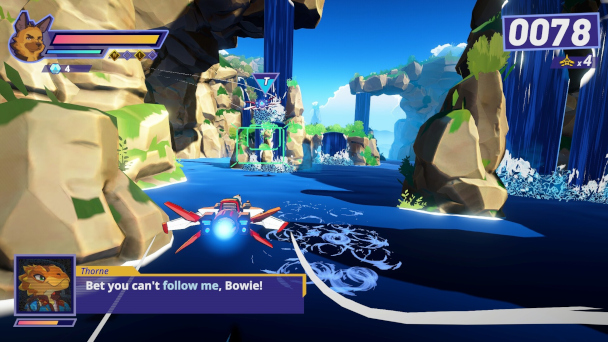
Yes, chances are you’ll find Wild Blue Skies unabashedly familiar. Most of the time, you’ll play as Bowie Stray, whose either a German Shepherd or a furry squad leader. He oversees a team called the Blue Bombers, who trek through largely linear environments. Beyond dodging incoming attacks, Bowie grabs upgrades and shifts between a succession of basic shots (thankfully, there’s optional auto-fire) and a charged shot that can take out a cluster of foes. Missions take you across oceans, deserts, canyons, and caves, with branching paths encouraging repeat playthroughs.
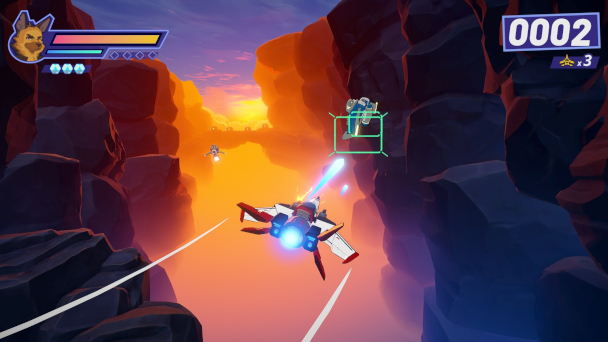
Thankfully, the shooting is rather satisfying, especially once a level gets busy. Enemy formations glide into view, projectiles start filling the screen, while the occasional environmental obstacle demands your attention. Like its inspiration, Wild Blue Skies is more a test of multitasking prowess than shooting precision, testing your ability to juggle flying through fields of fire, prioritize threats, and of course, saving the butts of your anthropomorphic allies, Chuck the bull, Roe the deer, and Thorne the lizard.
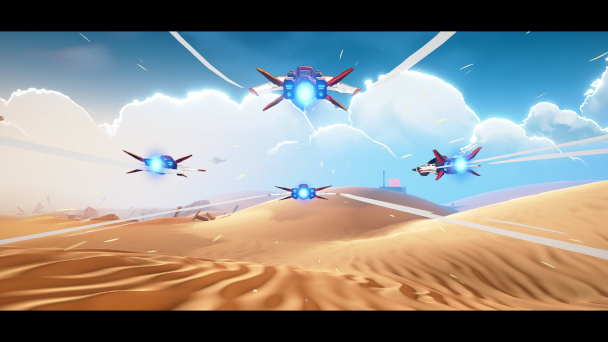
Yes, you need to keep them safe, so they can accompany you in the next mission. Best of all, there’s arcade-style accessibility to the controls, allowing you to boost, brake, and of course, barrel roll to avoid enemy flak. My one control gripe: the game keeps your regular laser and charged shot on separate buttons rather than letting you fire both together, like that Nintendo series.
Do a Barrel Roll, Obviously
And it’s here that the Star Fox comparison becomes interesting. Star Fox 64 understood that an on-rails shooter needs smart pacing. Individual encounters are usually short, enemies fly in quickly, one of your allies asks for assistance, all leading up to an end of stage showdown. Largely, Wild Blue Skies follows this formula, keeping the rhythm lively, but with just enough downtime that things don’t get too hectic. Occasionally, you’ll increase your flight speed to avoid an obstacle while gunning down foes, but it never gets completely chaotic, for better or worse.
Unsurprisingly, Wild Blue Skies favors replayability rather than a long, linear campaign meant to be completed once. Between branching paths and hidden routes, there’s just enough incentive to revisit missions while the scoring system prods you toward improvement. As such, your first playthrough is less about completing the game than reconnoitering its stages. You’ll memorize enemy placements and discover flight paths you overlooked the first time around on subsequent runs. So make sure, you’re up for a bit of repetition before enlisting with Bowie.
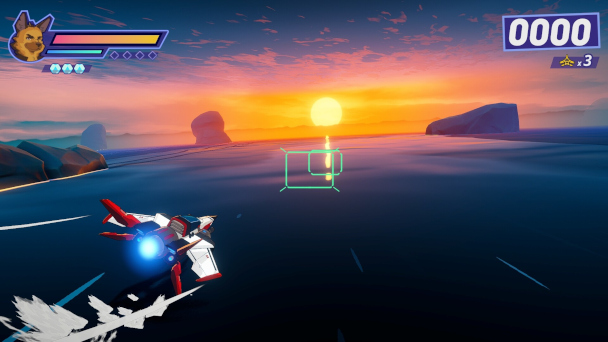
The game’s boss fights reinforce the sense that Wild Blue Skies is more a Star Fox tribute than a sly spiritual successor armed with new ideas. To be fair, these showdowns aren’t lifeless. One standout has you chasing a hulking mechanical dragon that slithers in and out of view through cloud-tops, peppering you with projectiles as you pick apart its exposed weak points. Another riffs directly on Star Fox 64‘s spinning, clock-faced boss design. It’s mostly a matter of shooting until you find the flashing weakness and directing your firepower there. The arena-style confrontations fare a bit better, but they still feel simple and derivative. Here, allies get slaughtered off-screen without much warning, and the added freedom of movement doesn’t come with the kind of thrills that would make these moments special. Mostly, you’re taking shots at whizzing enemies, rather that doing anything that really feels like dogfighting.
Weak Points and Weaker Surprises
One potentially interesting deviation is that Wild Blue Skies strips your laser power-ups after you’ve taken just three or four hits. I’m sure the intent was to raise the tension during heated encounters. But in practice, being left with a weakened main gun puts you at a frustrating disadvantage that I rarely recovered from, especially heading into a boss fight with no upgrades left to find. Sure, it’s not enough to sink the game, but I expected any variation on the formula to improve things rather than just add frustration.
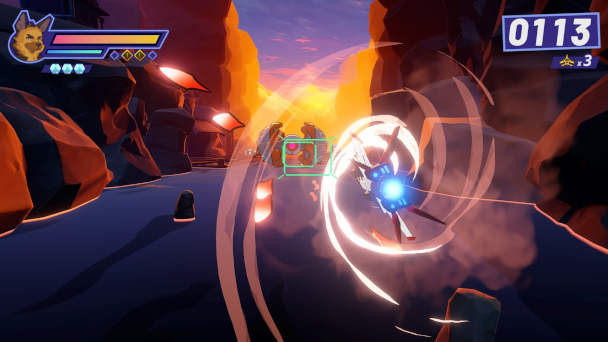
On the upside, Chuhai Labs doesn’t need to apologize for Wild Blue Skies’ vivid visuals. The game’s art direction drenches everything in bright, pastel-soaked colors. From flying up a waterfall inside a canyon while boulders and enemies rain down, to weaving through a hurricane with rain lashing at your ship, to storming an ancient Mayan-style pyramid, each stage summons plenty of colorful personality. Performance is more of a mixed bag: it held a fluid 60 frames per second on my rig, but the Steam Deck version dipped closer to 30 FPS in my time with it, and graphical options across the board are sparse. If the developers make one change, I’d hope your reticle’s perspective gets amended. It can be genuinely hard to judge where your shots will land at times.
That said, it’s difficult to not appreciate the game’s pricing. At less than half on the cost of the latest Star Fox, Wild Blue Skies provides near as much enjoyment. Better yet, its on a system that Nintendo has yet to embrace, so if you’re craving some space shooting, Skies is worth consideration.
Wild Blue Skies was played on PC with review code provided by the publisher.
Overview
GAMEPLAY - 65%
CONTROLS - 60%
CONTENT - 75%
AESTHETICS - 80%
PERFORMANCE - 60%
VALUE - 70%
68%
OK
Wild Blue Skies’ flying feels good, the visuals pop, and there's a real sense of rhythm as missions head toward their boss fights. But there’s a bit too much Star Fox flattery and not enough freshness. The result is a well-crafted tribute rather than any kind of overdue evolution for the on-rails shooter.



Star Fox at $59.99? No.
Nearly Star Fox for $15? Hell, yes.