STEINS;GATE RE:BOOT review
Of Science, Ethical Quandaries, and Nostalgia-filled Time Capsules

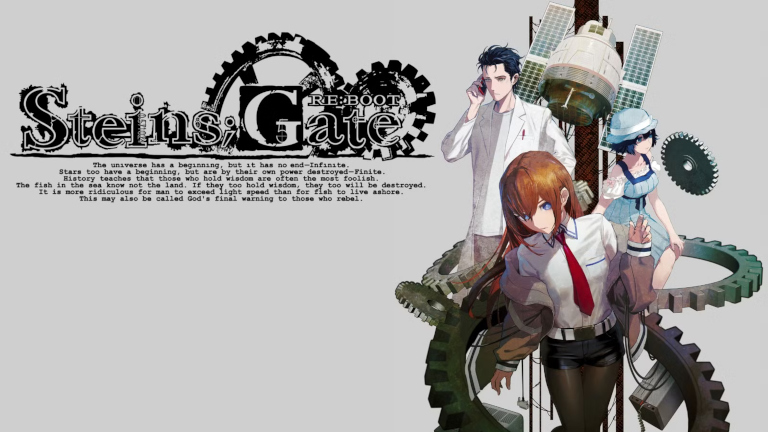
There’s a specific junction in Akihabara where a cramped apartment is stacked above an aging CRT television shop. It’s now been rendered, redrawn, and re-recorded three separate times across a trio of console generations. That apartment is the Future Gadget Laboratory, home to Rintaro Okabe and his invention club.
Interestingly, developer MAGES keeps finding reasons to revisit this place, demonstrating just how durable STEINS;GATE‘s nostalgic slice of 2010 Akiba has proven to be. STEINS;GATE RE:BOOT is the latest attempt to return to that corner of the world. And after spending a considerable amount of time with it, I think it might be the most convincing version yet.

Original or Elite Foundations?
If you played the 2009 Xbox 360 original or its 2018 anime-driven follow-up, Elite, you probably know the basics. Okabe and friends build a phone-and-microwave contraption capable of sending short text messages into the past. What starts as a goofy home-lab experiment spirals into a conspiracy involving everything from the SERN research organization to an exploration of quantum theory.
Expectedly, RE:BOOT doesn’t reinvent this premise. Rather than returning to the original’s rather dense prose, the new script is built around Elite‘s leaner, more streamlined telling of events, then expanded back out. The result is a scenario with new dialogue and narrative text layered onto those pruned foundations, alongside a brand-new worldline and ending scenario. You can tell MAGES has ruminated over STEINS;GATE‘s pacing and plot, and RE:BOOT largely benefits from the tweaks and trimmings.

The notable addition is the so-called Gamma Worldline, and it’s worth being precise about what it actually is. It’s loosely inspired by “Hyde of the Dark Dimension,” a Japanese Drama CD fans have circulated in fansubbed form for years, but this isn’t a straight port of that audio drama.
It’s a new route built specifically for RE:BOOT, centering on the reliably enigmatic Moeka Kiryu, and the bulk of what plays out is original material rather than a re-staging of the CD’s events. It clocks in around an hour, so don’t expect it to rewrite your sense of the whole story. But it’s a legitimately new wrinkle rather than a curiosity being checked off a list. Oh, and there’s also a small nod to STEINS;GATE 0 tucked into Chapter 5, which will please any Science Adventure-head who’s followed Okabe’s story past the original endpoint.

Tampering with the Temporal
One of the more interesting revisions to RE:BOOT are some pacing adjustments. Until you understand why he’s performing them, Okabe’s mad-scientist theatrics can be off-putting. Here, they’ve been smoothed out rather than cut down. The result is a bit more time to reflect on the rest of the cast, from Mayuri, Okabe’s endlessly sunny childhood friend; Daru, the lab’s resident hacker. There’s also Kurisu, the sharp-tongued neuroscience prodigy who gets pulled into the group’s orbit, before things pivot to a darker second half. Largely, it seems like MAGES hopes you become invested in the characters before asking you to watch bad things happen to them.
Arguably, a bigger distinction is found in the game’s new art style. Rather than building on the anime-derived look of Elite, original character designer huke redrew the cast from the ground up, reworking outfits and accessories along with faces and expressions. Although I still favor the slightly unconventional style of the original, I can understand how the more refined look of the cast makes STEINS;GATE a bit less off-putting for newcomers. On top of the redone art, RE:BOOT animated those illustrations with M2’s E-mote technology, also used in Anonymous;Code.

Now, characters can shift expression and posture freely rather than just sitting still during protracted interactions. Backgrounds have been rebuilt entirely as well, and the specificity shows: MAGES used their own location-scouting photography from shooting reference for the original 2009 game and the 2011 anime, since usable photos of 2010-era Akihabara are apparently hard to come by even online now. While I can’t speak for every backdrop, there’s a genuine sense of place here, rather than the typical generic otaku-fied billboards found in similar works.
Meanwhile, event stills, the single-image CG moments that often punctuate dramatic beats, have been redone to more closely reflect the original storyboards. Wew CGs have been added to scenes that previously ended too abruptly. But RE:BOOT isn’t always an upgrade. The number of story-relevant illustrations showing computer and desktop screens has been trimmed considerably compared to the original. Given that these shots need to be localized, it’s disappointing that RE:BOOT doesn’t follow Elite’s lead and render soft subtitles over the Japanese text, a step backward from a game that otherwise strives to be the definitive version. Pleasingly, most of the original’s text-based mistranslations have been fixed. That said, RE:BOOT introduces its own display hiccup: dialogue that runs past three lines gets compressed to fit the text box, sometimes squeezing the text uncomfortably.

A Glitch in the The Attractor Field of Nostalgia
Every voice line has been newly recorded in Japanese, and composer Tsuyoshi Abo has rebuilt the score rather than simply remastering the original tracks. Largely, there’s more underscoring for the novel’s rather emotional second half. The Phone Trigger system, which Okabe uses for answering calls and texts that reroute the story’s branching worldlines, is intact. Best of all, it’s still effective at keeping you guessing about which replies really matter.
But the system is also the game’s lingering issue. The skip and autoplay functions handle phone conversations clumsily, pausing for routine messages as often as crucial ones. Text speed during auto-played phone scenes moves fast, too, so slower readers may need to manually scroll back to catch details they missed. For a third pass at this same system, it’s a strange thing to still get wrong.

Reaching the Definitive Worldline
STEINS;GATE RE:BOOT often feels like a consolidation of MAGES’s alterations, old and new: Elite‘s pacing, huke’s redesigned cast, and E-mote’s animated illustrations. Factor in the Gamma Worldline, and there’s just enough justification to visit that corner of Akihabara one more time.
The novel’s story is still one of the smartest, most emotionally patient time-travel narratives the industry has produced. Even though one interface issue should have been ironed out by now, and the new route may be thinner than some fans hoped, (re)visiting the Future Gadget Lab still feels thrilling.
STEINS;GATE RE:BOOT was played on PC with review code provided by the publisher.
Overview
STORY - 95%
INTERFACE - 80%
AESTHETICS - 85%
ACCESSIBILITY - 80%
PERFORMANCE - 80%
VALUE - 95%
86%
VERY GOOD
STEINS;GATE RE:BOOT doesn’t radically rewrite a classic, but its sharper pacing, expressive new artwork, rebuilt audio, and fresh Gamma Worldline make this trip back to 2010 Akihabara feel worthwhile. A single lingering interface quirk and a few still image cutes keep it from being definitive, yet the Future Gadget Lab remains as clever, charming, and emotionally affecting as ever.





Can you tell me what the “Octet of Shifting Space” is all about?
Decent review. Wish there was a loyalty discount.
I was just researching this exact topic and found your review insightful. The way you analyzed the character development and narrative mechanics of STEINS, GATE RE:BOOT truly highlights its strengths and weaknesses. It’s fascinating how remakes can evoke nostalgia while also challenging our perceptions. For those interested in tech aspects, I recommend checking out best gadgets and tech reviews. What do you think makes a remake successful in the eyes of fans?
I was just researching this exact topic and found your review insightful. The way you analyzed the character development and narrative mechanics of STEINS, GATE RE:BOOT truly highlights its strengths and weaknesses. It’s fascinating how remakes can evoke nostalgia while also challenging our perceptions. For those interested in tech aspects, I recommend checking out best gadgets and tech reviews. What do you think makes a remake successful in the eyes of fans?
The Gamma Worldline sounds like the most interesting addition here. I like that the remake seems to improve the pacing and presentation without trying to replace the atmosphere that made the original memorable. The updated backgrounds and animation should make Akihabara feel more alive, while keeping the Phone Trigger system intact was probably the right choice.
Agree with you about everything but the Phone Trigger.