Eternal Palace Sakura review
Sharp Blades, Fleeting Thrills


Back in 2004, Ninja Gaiden demonstrated how thrilling action could be when a careless attack led to vicious punishment. Knowing when to block, evade, and resume your assault was every bit as important as landing the next slash. Denneko Yuugi’s Eternal Palace Sakura offers a modest reminder of that kind of taut gameplay, with its dual-blade attacks and precisely timed defensive maneuvers. But it veers from Team NINJA’s approach by placing a roguelite framework around its arena-based fights. Here, randomized rewards and tempting detours reshape your chances of survival on each attempt.
Eternal Palace’s premise sends protagonist Retla in pursuit of a divine relic. But upon arriving at the dream-like palace, she finds herself imprisoned. The focus here is on play rather than plot, so there’s little more than this basic setup. That said, our heroine provides plenty of personality. Her cat-eared hood, minimal body armor, and jiggle physics convey cuteness, while her high-spirited sword animations, victory poses, and adorable quips ensure she’s the star. A cast of enemy slimes, goblins, samurai, archers, and massive oni all move about, but they’re no match for Retla’s charisma.
The Tools of Yokai Busting
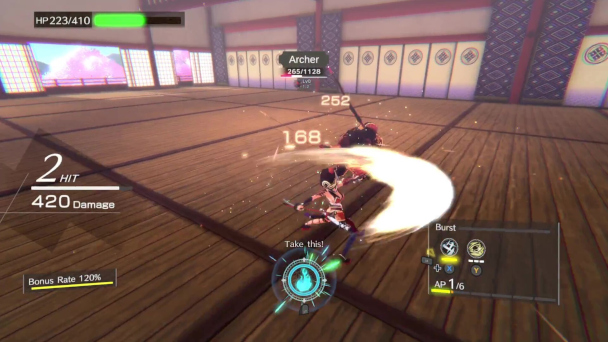
Her moveset has light and heavy attacks augmented by four equipped Arts that draw on your supply of AP. Basic hits replenish that resource, encouraging you to punctuate sword combinations with Retla’s more spectacular skills. Savage Claw supplies a flurry of close-range strikes, while Ice Rend sends a cutting wave along the ground. Attacks can cancel into Arts, and Arts into one another, allowing for some flexibility with combos.
Sakura might channel the intensity of a musou game, but with the trigger key-based combinations needed to activate abilities, you can’t just hammer on the face buttons. Meanwhile, filling the Tension Gauge enables Over-Tension and access to an Over Art finisher. That probably sounds like a lot to remember. And it is at first, until you find Eternal Palace’s rhythm.

Arguably, defense is where the Ninja Gaiden comparison works best. A Perfect Dodge briefly slows nearby threats and restores AP. A well-timed block can also replenish your AP, while a Shield Burst creates some breathing room if Retla finds herself surrounded. As such, evasion and guarding feed back into your offense, tasking you with prioritizing targets, reading attacks, and selecting an opening. One notable difference is that Retla doesn’t have a dedicated jump button. Still, play focuses on balancing aggression with restraint, with the randomized upgrades injecting just a bit of variety into the series of room-based showdowns.
Palace Sightseeing Has a Price
Yes, the roguelite system comes to the forefront between battles. You navigate a palace layout that reveals connected rooms as you advance, with icons signaling battles, treasure, shops, and recovery opportunities. Layouts and rewards change between runs, with more than 50 kinds of enhancements and skills available to shape your build. These can improve everything from health and damage to attack speed. Individual stat boosts can feel muted against tougher enemies, although a focused build can turn Arts into fairly devastating attacks.
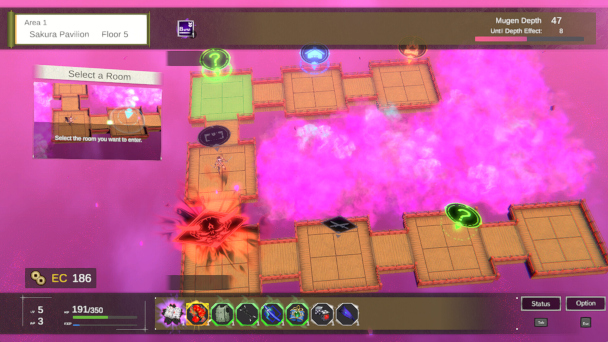
Mugen Depth is the game’s one clever gimmick. Moving around the map and taking certain actions increases a meter that strengthens enemies and introduces negative effects. As such, a tempting detour can make the rest of the floor more dangerous, while certain events let you sacrifice health to remove penalties. You can also obtain perks in exchange for raising your Mugen Depth. In theory, the system is intended to make you weigh your route through each palace floor. But some tough encounters leading up to a boss can leave you ill-prepared for the showcase fight. Sporadically, Retla even remarks on how the last fight really kicked her ass.
Don’t Give Up, Retla!
On the upside, there is some metagame progression. Death resets Retla’s current level and Attributes, but completing challenges in Sakura Trials can unlock lasting benefits that range from additional Arts to better starting stats. Because these rewards are tied to meeting specific objectives, not every death provides an upgrade. And there were a few periods when progress grew stagnant for me.
Other problems hempen responsiveness and readability. Occasionally, unclear attack warnings and performance dips proved just as deadly as any enemy. On PC, version 1.0.2 improved attack-direction assistance and increased the battle camera’s maximum zoom-out distance. An earlier update addressed a camera-related stutter, although its still a remaining issue. Occasional hiccups in crowded fights can still disrupt your rhythm. As Tomonobu Itagaki taught us, a game that expects split-second reactions needs controls, camera, and responsiveness that can keep up. Eternal Palace is almost there, but still needs a bit more care. And if you’re playing on Steam Deck, expect details like the Mugen Depth gauge to be cut off.
Pretty, Graceful, but Also Short-Lived
But the biggest issue is repetition. Familiar ninjas, goblins, and slimes reappear, while increasingly resilient enemies can bog down a run. Rather plain venues also diminish the incentive for another attempt, even when new Arts serve as lures. Retla’s charming looks and the taut battles make Eternal Palace Sakura easy to like, but they struggle to sustain its long-term appeal. Like real sakura, it’s attractive enough to make you stop and admire it. Unfortunately, its season of fun is just as fleeting.
Eternal Palace Sakura was played on PC with review code provided by the publisher.
Overview
GAMEPLAY - 70%
CONTROLS - 65%
CONTENT - 70%
AESTHETICS - 80%
PERFORMANCE - 65%
VALUE - 70%
70%
GOOD
Retla’s charm and flashy Arts make Eternal Palace Sakura easy to enjoy for a few runs. But if you stick around longer the repetitive enemies, uneven difficulty, and occasional hiccups start wearing down the appeal.