Muchi Muchi Pork! & PinkSweets Boosted review
“A Pig That Doesn’t Fly Is Just a Pig” — Porco Rosso

CAVE might not have invented the vertically scrolling shooter, but the studio helped turn the subgenre into an art form. Formed by former Toaplan staff, CAVE established their reputation with games like DoDonPachi, Ketsui, Mushihimesama, and Deathsmiles. Remarkably, the brilliance of their STGs isn’t just rooted in the myriad on-screen bullets that fall like raindrops in a powerful storm.
Everything from the tiny hitboxes to the sophisticated scoring systems rewards risky play, habitually transforming the chaos into taut choreography. Once you adjust your perceptions and begin learning the meticulously crafted projectile patterns, a CAVE game stops feeling impossible. Instead, it feels like you’re learning to read a new language.
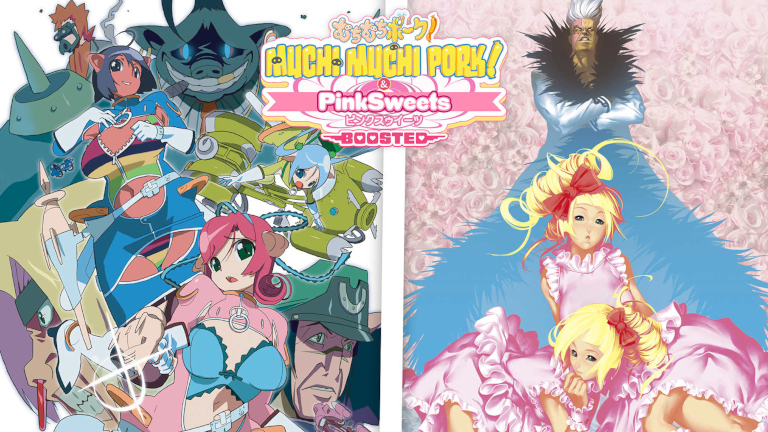
2006’s PinkSweets and 2007’s Muchi Muchi Pork! are part of a curious place in the CAVE catalog. Arriving around the same time as Mushihimesama Futari and Deathsmiles, there are some basic similarities to be foiund. Both were helmed by Shinobu Yagawa, the programmer behind Raizing’s Battle Garegga. Unsurprisingly, they reflect his fondness for chained medals, cycling items, and systems that grow steadily more sadistic. Each rewards determination while punishing the slightest instance of carelessness. But there is also plenty of distinction between the two efforts.
Bringing Home the Bacon
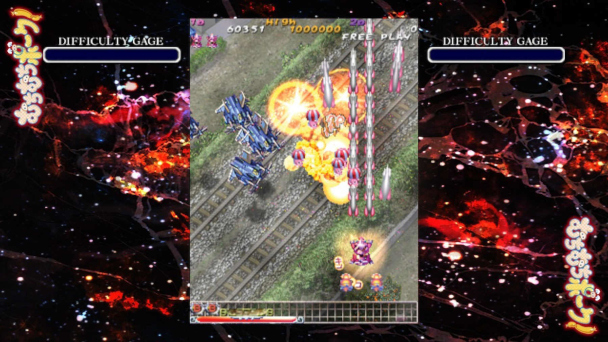
Muchi Muchi Pork! offers a trio of heroines transformed into pig girls by General Pork Fillet, who then forces them into battle riding on flying exercise bikes. Yes, it’s a ridiculous premise, but one that’s far removed from the conventional flying warships that have long dominated the genre. Like the old fairy tale about pigs with different building preferences, each heroine brings her own specialty. Momo uses a widening spread shot and a broad, rectangular buzzsaw for her Lard Attack. Ikuo fires a narrow stream backed up by lock-on laser options before unleashing an enormous drill-like beam. The speedy Rafute supplements her forward shot with ricocheting spike balls, while her Lard Attack sends a chained spike into anything unlucky enough to be in front of her.
Destroying enemies releases little Buuton pigs that refill the meter powering each girl’s Lard Attack. Meanwhile, a full Bombuu summons a giant robot that charges across the screen, wiping away bullets and turning them into parachuting pigs. You could accuse a lot of STGs of not having enough personality, but those charges wouldn’t stick with Muchi Muchi Pork!. This is one well-greased shooter that’s as tasty as late-night diner food.
Frying with Lard
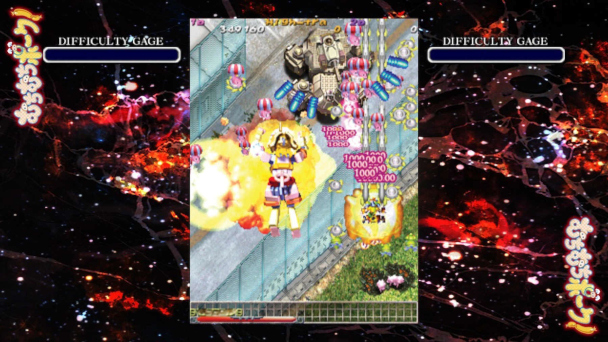
Yes, you could claim that the game’s terminology is a bit too frivolous. But beneath the eccentric nomenclature is a pretty sophisticated scoring system. Enemies killed with a Lard Attack release pig-head medals called Kinton. Collecting every medal raises their value from 100 points toward a tidy 10,000-point bounty. However, if you let the last medal on-screen escape, its value is divided by ten. Yes, greed literally kills and I have lost track of how many times Muchi Muchi Pork! has reminded me this.
Switching from the Lard Attack back to your regular shot magnetically pulls the medals toward you, creating a rhythmic recipe: gather pigs, weaken enemies, apply lard, and then consume the payday. Muchi Muchi Pork! Also has a rank system, but it is softer than the one in PinkSweets. You can reasonably survive the five-stage first loop without obsessively trying to manage it. As such, this remains one of Yagawa’s more approachable works. Cetrtinaly, the colorful mechanical livestock and busy comic-book effects are memorable, even if the game’s cheesecake fixation isn’t quite realized. Still, a succinct playthrough of Muchi Muchi Pork! remains one of my favorite snacks, just behind Deathsmiles’ cute-goth eye candy and schlock-horror bosses.
Every Rose Has Its Thorns. This One has Rank
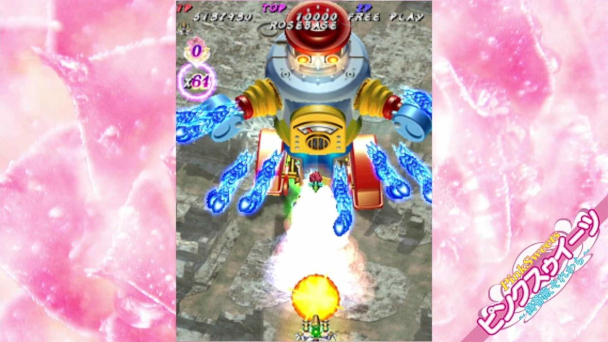
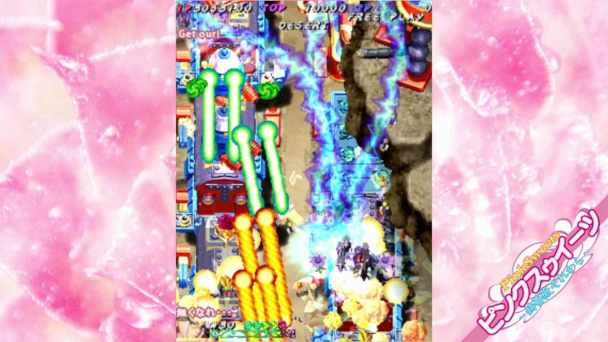
Quite literally, PinkSweets is a thornier game. The five Rose sisters are trying to rescue their mother, Dr. Teresa Rose, from Big Burn and a forced marriage. But the key relationship here is between attacking and brief periods of pacifism. Release the fire button and the shield in front of your craft begins charging. It can only absorb certain kinds of bullets, so hiding behind it isn’t a fail-safe tactic.
When you resume firing after a full charge, you’ll unleash a character-specific Rose Cracker. This small, reusable bomb damages enemies while erasing every bullet it touches. A second button adjusts your Rose Hip options, changing their formation or making them fire while your main gun rests. Given that most STGs are built around unrelenting fire, intentionally taking your finger off the trigger feels unnatural. But it’s hard not to appreciate a genre entry that flirts with vulnerability.
Plenty of Filling, Save One Notable Omission
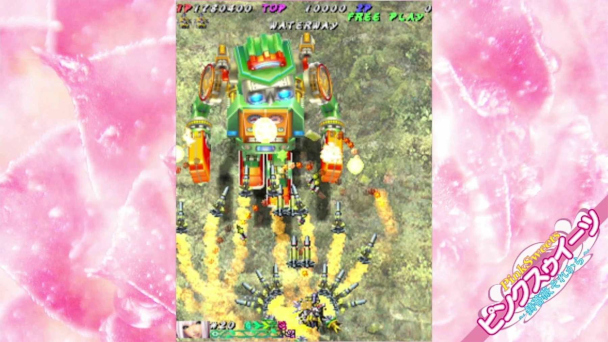
PinkSweets’ scoring is layered like a flaky pastry. Order of Rose medals increase in value when collected in succession, while different enemy types provide their best dividends when destroyed with the correct weapon. Then there’s the rank system. Firing, collecting medals, powering up, stockpiling lives, surviving for long stretches, and leaning too heavily on your Rose Cracker all contribute to the escalation. As rank increases, enemies become tougher, fire more frequently, and eventually add revenge bullets to their attacks.
The balancing becomes truly hostile during the later stages. Version 1.01 offers some relief: enemy health no longer scales with rank, partially charged Rose Crackers can be fired, and deliberately dropping maximum-value medals can lower the difficulty. I appreciate how the Boosted collection includes both the original Version 1.00 and the rebalanced Version 1.01 for each title. However, the most conspicuous absentee is Ibara, Yagawa’s 2005 predecessor, which introduced this oddball mixture of steampunk machinery, candy-hued heroines, and wind-up robots.
A Few Extra Servings
Rather than being built from the ground up, Boosted is based on CAVE’s 2011 Xbox 360 double pack. Fifteen years later, its assortment of versions and modes still feels generous. The genuinely new attraction is a set of arranged soundtracks, with Daisuke Matsumoto handling Muchi Muchi Pork! and Yosuke Yasui, Hagane, and Sean Bialo contributing to PinkSweets. Pleasingly, original and arranged music can be selected separately for each stage.
The Xbox 360 Arrange modes also alters how the games are played. In Muchi Muchi Pork!, destroying enemies and gathering score items builds a Fever counter. Once it reaches 10,000, using a bomb activates Fever, intensifying enemy fire while allowing Lard Attacks to transform certain bullets into showers of Kinton. PinkSweets’ Arrange separates shooting from shielding, adds the Hadou Gun, and tasks you with maintaining a multiplier that can climb as high as 64x.
More HARAHARA Than DOKI DOKI
There are some specialized courses as well. Muchi Muchi Pork! offers MANPUKU, where destroyed enemies retaliate with revenge bullets, and HARAHARA, which begins at second-loop difficulty. PinkSweets includes the suitable titled HARDER, the two-loop EXTENDED, and S-ATTACK, a timed assault on Stage 6 with infinite lives. Separate options for overall difficulty and bullet speed provide additional flexibility. Just know that both Arrange modes currently run without slowdown, making the most screen-congested moments more demanding.
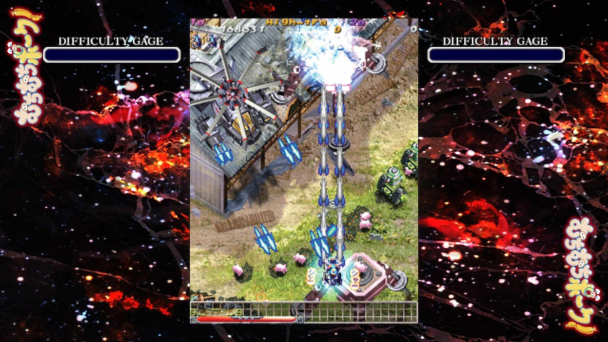
Undoubtedly, many of the extras will be welcome to STG devotees. Optional information panels use the empty borders to chart rank in real time and expose other helpful statistics that the arcade games normally conceal. Since the vertical playfield occupies well under half of a modern widescreen display, TATE support is welcome whether you are rotating a handheld or using a pivoting monitor. Training options, online rankings, and replay recording also provide room for practice. Each title has several different wallpaper options, but the artwork looks recycled and low-res, rather than created new.
Some Launch Issues Mended, But No Matsuri DLC
On Switch 2, this expect the standard Switch release running through backward compatibility rather than any kind of upgrade. Before the launch update, some menu lettering displayed some edge artifacting on both consoles, but the launch patch cleaned most of this up. The larger shortcomings are the absence of slowdown in Arrange mode, the lack of an in-game museum or other substantial historical material, and the omission of Ibara. The limited Xbox 360 Matsuri DLC, which inserted PinkSweets bosses into Muchi Muchi Pork!, hasn’t returned either.
Yes, these blemishes keep Muchi Muchi Pork! & PinkSweets Boosted from being truly definitive. That said, this is still a long-overdue return for two STGs whose only previous home release was a Japan-only, region-free Xbox 360 double pack that now commands collector prices. A few shortcomings aside, this is a great way to explore Yagawa’s design philosophy, an approach that continues to influence shooters long after the original releases. At its best, Boosted demonstrates why CAVE’s games remain so revered.
Muchi Muchi Pork! & PinkSweets Boosted was played on Switch
and Switch 2 with review code provided by the publisher.
Overview
GAMEPLAY - 85%
CONTROLS - 80%
CONTENT - 80%
AESTHETICS - 75%
PERFORMANCE - 80%
VALUE - 80%
80%
VERY GOOD
Muchi Muchi Pork! & PinkSweets Boosted brings two of CAVE’s quirkiest shooters back with dense bullet patterns, sophisticated scoring systems, and plenty of personality. A few omissions and quirks keep it from being truly definitive, but this remains a fantastic showcase for Shinobu Yagawa’s wonderfully sadistic approach to the STG genre.