Pop! Pachinko review
I'm Just Playing Games, I Know That's Pachi Love

Pangolin Interactive and Robot Lion Games’ Pop! Pachinko isn’t the first title to mix gambling-inspired mechanics with roguelike elements. Balatro turned poker hands into scoring puzzles, while CloverPit tasked you with modifying the payouts of its slot machine. Both games began with familiar games of chance, letting you stack perks that bend the odds. Pop! Pachinko follows this template, offering a rather relaxed score chase wrapped in neon lights, Japanese pop, and the therapeutic clatter of steel balls.
Each run lasts 18 rounds, with every stage challenging you to reach an escalating minimum score. Expectedly, levels send your ever-growing inventory of balls through different arrangements of pins, pockets, and moving obstacles. Collectively, they feel like an assortment of different pachinko machines.
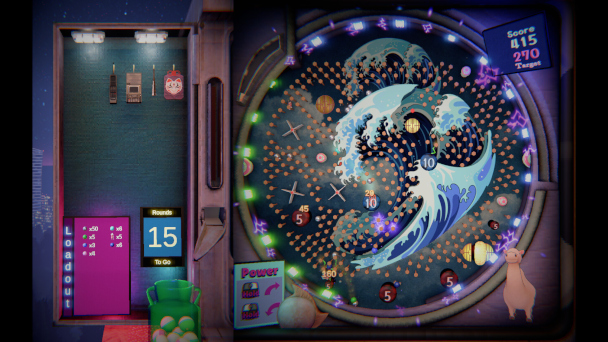
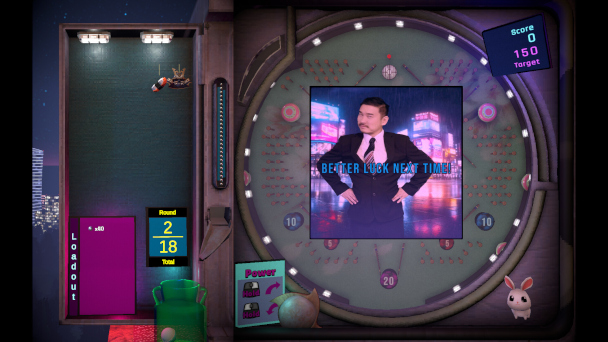
Wisely, the developers keep the playfield layouts largely rooted in the late-analog era of pachinko. Save for amusing full-motion video clips and a few kakuhen-inspired fever states, Pop! Pachinko evokes the bygone era of smoky parlors. Like the actual machines, you want as many balls as possible to tumble into valuable openings, especially the central start chucker, rather than vanish through the bottom.
Of Elementals, Exorcisms, and Lightning Storms
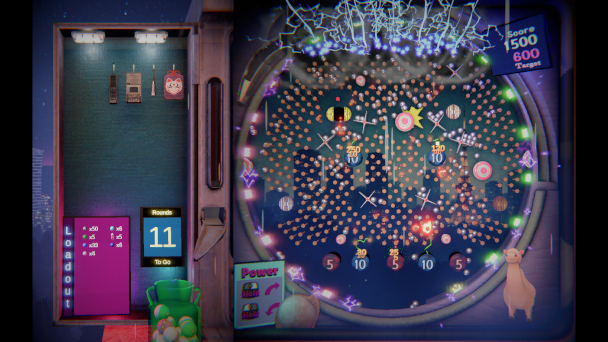
Input is rooted in the simplicity of real-world machines. Left and right inputs adjust your launch strength, giving you some influence over the trajectory of your stream of steel orbs. However, once those balls are launched, physics take over as they cascade down the playfield and bounce across a plethora of pins. You can favor one side or aim toward a gimmick that releases additional balls, but you’ll only have the broadest degree of control.
There’s none of that Peggle-style precision Pop! Pachinko. Holding the control releases your inventory in a steady stream rather than allowing you to place and fire each ball separately. Most of the time, you simply soak up the satisfaction of creating a clinking little avalanche.
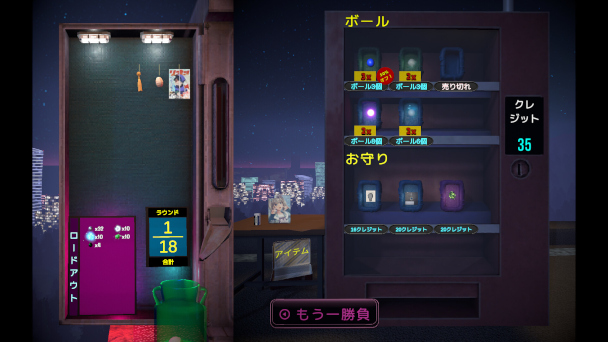
Most attempts begin with 50 ordinary steel balls. Between rounds, a shop lets you spend credits on additional specialized balls. These range from orbs that set pins ablaze or soak them to ones that grow vines capable of pulling other balls toward scoring opportunities. Others accumulate after draining and are reborn as a storm cloud that rains down additional orbs near the end of a level. One glowing Void Ball offers a last-ditch chance to earn a healthy multiplier, and it has saved my ass on several occasions. Nicely, there’s always a 50-percent discount available in the shop, helping your inventory grow as you approach the final few stages.
Semi-Charmed Life
Charms are the passive half of the in-run store inventory. They add multipliers, augment specialized balls, or introduce conditional triggers. A lightning ball becomes considerably more valuable when a few charms reward electrical activity or create additional balls from its effects. Occasionally, however, a purchase won’t complement your current inventory and becomes little more than a useless decoration.
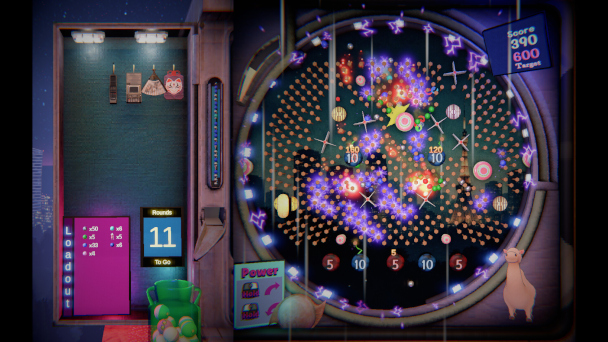
It’s here that Pop! Pachinko is at its most interesting but also its least communicative. Basic shop descriptions explain each item’s function, and you can view explanations of ball attributes, but there’s little help with understanding how two or more effects interact. I was left wondering whether soaking negated fire and if water helped spread the effect of lightning.
There’s no way to test a combination before purchasing it, so each acquisition can feel uncertain. Since you cannot slow the firing rate or release balls individually, your experiments can also be difficult to read. When dozens of balls are ricocheting around the board, triggering flashes and multipliers, it can be hard to determine which purchases are helping without studying the final score tally. Even then, the results aren’t especially intuitive.
A Relaxed Fever Worth Catching
Pleasingly, stages regularly swap in different playfield layouts. Some emphasize side bumpers, targets shaped like ramen cups, or an especially tempting central chucker. Others incorporate kakuhen-inspired fever states that reflect the excitement of actual pachinko machines. One particularly enjoyable novelty has a formation of Space Invaders raining down balls instead of bullets. That said, I wish there were more flourishes like this because they give individual boards a much stronger identity.
Variety also comes from different starting ball collections and randomized shop inventories. You’ll unlock new records that add Japanese pop and city-pop tracks to the soundtrack. Although the broad succession of playfields remains familiar across repeated runs, each record brings its own starting inventory, introductory sequence, and rule changes.
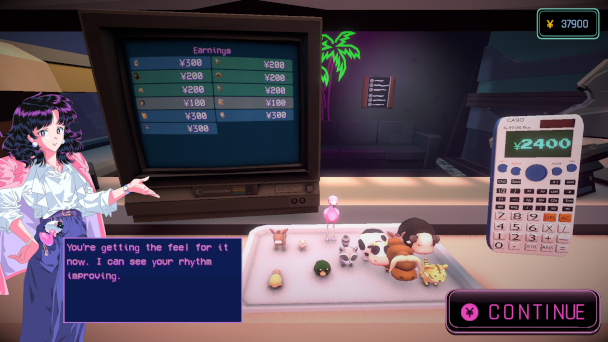
The music production is solid, evoking the polished city pop associated with artists such as Mariya Takeuchi and Taeko Ohnuki without imitating them. However, the unlockable records are singles rather than full LPs, so expect to hear some repetition during longer sessions.
Gacha Without the Guilt
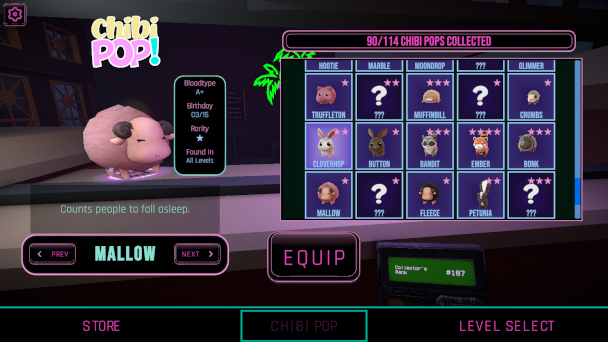
Each successful stage rewards you with a gacha capsule containing a random Chibi Pop. These cute animal figures fill out the game’s collection, and a selected character can sit beside the machine to cheer on your runs. Duplicates can be sold for cash.
That money can be spent at the konbini on new stages, songs, rare Chibi Pops, and consumable drinks or snacks. These items provide useful bonuses such as additional ball credits or a second chance after a failed round. As your Chibi Pop collection grows, it also provides gradual bonuses that make subsequent runs more manageable.
At present, Pop! Pachinko’s balance is definitely lenient. While I’ve lost plenty of money in real-life parlors, I’ve completed the game’s 18-stage run about 75 percent of the time. But score chasing is clearly the point. I’ve been playing during my train commutes, letting the clatter of steel orbs bookend my workdays.
Sure, Pop! Pachinko doesn’t have the strategic transparency of Balatro or CloverPit. But instead of constantly trying to outwit the house, there’s comfort in watching a current of steel balls obey the laws of physics. Here, serenity beats strategy and occasionally, we all need that.
Pop! Pachinko was played on PC with review code provided by the publisher.
Overview
GAMEPLAY - 75%
CONTROLS - 70%
CONTENT - 75%
AESTHETICS - 75%
PERFORMANCE - 65%
VALUE - 80%
73%
GOOD
Pop! Pachinko turns pachinko’s clattering balls and neon lighting into a surprisingly soothing roguelike score chase. It lacks the strategy of games like Balatro, but its colorful playfields, creative ball effects, and relaxing arcade vibe offer a great way to pass an hour or two.