Flamecraft review
Dragons Without the Destruction

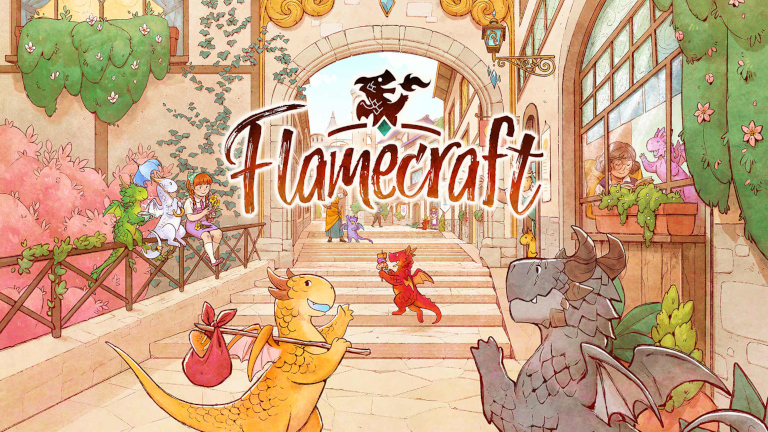
Video game dragons are usually frightening creatures. They habitually guard mounds of gold, turn villages into smoldering rubble, and transform reckless adventurers into lunch. The dragons of Flamecraft have less destructive desires. They bake bread, forge iron, brew potions, and help small businesses prosper. We have all encountered the scaly monster waiting at the bottom of a dungeon, but a reptile capable of baking a decent pastry offers an appealing twist on the usual role. It’s difficult not to appreciate that.
Originally released as a tabletop game in 2022, Flamecraft was designed by Manny Vega and illustrated by Sandara Tang. Now, Monster Couch, the studio behind the versions of Wingspan as well as Quilts and Cats of Calico, has adapted the analog game’s roll-up town mat, cards, and tokens into an animated shopping district.
How to Manage Your Dragon
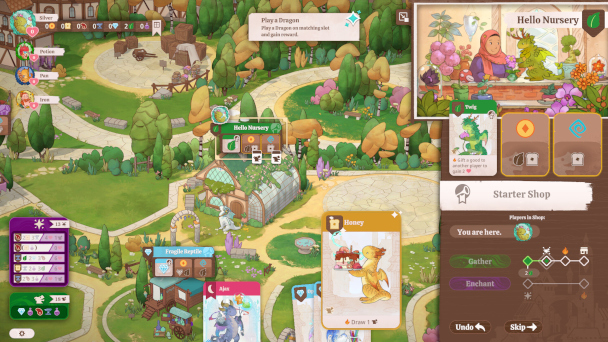
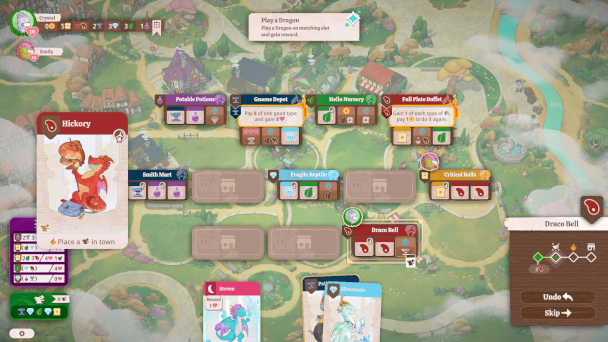
Pleasingly, it’s a rather faithful adaptation that preserves the worker-placement decisions, resource management, and playful shop name puns such as Draco Bell and Gnome Depot. But Flamecraft also understands why you might always want to play the tabletop original. There’s no setup or cleanup, CPU opponents are always available, and the computer handles every rule and point calculation. Disagreements over a forgotten loaf of bread aren’t a concern here
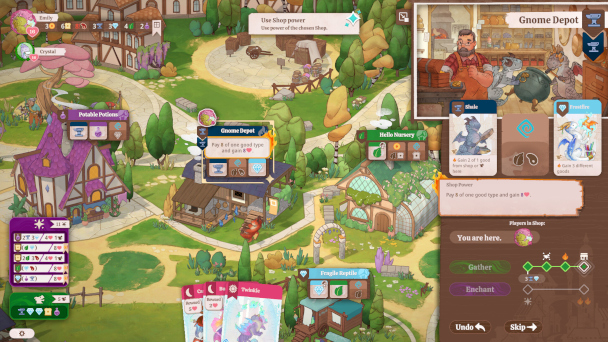
You’ll step into the well-worn boots of a Flamekeeper, who’s skilled at communicating with dragons and finding suitable homes for these tiny artisans. Every turn, you must move to a different shop and choose between gathering goods or casting an enchantment. The initial choices are pleasantly straightforward. Visit Drake of Cakes for bread, collect iron from Gnome Depot, or stop by Draconic Tonic for a potion. However, if other players are already at your destination, you must give each of them a good or coin before handling business. Even in this wholesome town, coveted retail space carries a premium.
How Enchanting!
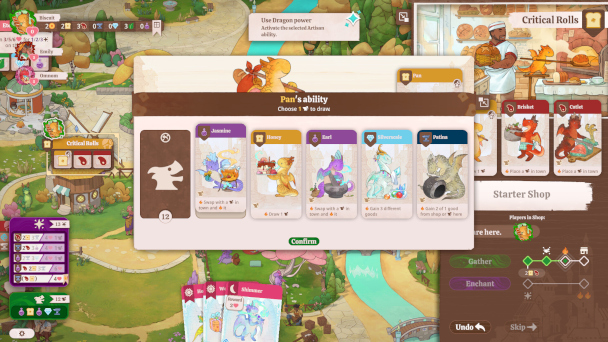
Gathering provides you with the shop’s basic resource along with the additional goods generated by every Artisan Dragon and enchantment located there. You can then place an Artisan Dragon into a compatible empty slot, claim the slot’s reward, fire up one dragon’s special ability, and optionally use the shop’s power. These little workers specialize in bread, meat, iron, crystals, plants, or potions. Their abilities can turn modest storefronts into miniature industries.
Enchanting lets you convert accumulated ingredients into reputation. Pay the requested combination of goods, place the selected enchantment at a compatible shop, and its output permanently increases. Better still, you may fire up every dragon working there rather than activating only one. With the right arrangement, a single visit can yield goods, cards, coins, and a satisfying surge of reputation. Flamecraft might be filled with soft colors and happy lizards, but assembling one of these combinations is as gratifying as watching a carefully constructed assembly line whiz to life.
A Rising Hoard Lifts All Shops
Nearly everything happens on a shared board, and that’s where many of the game’s strategies emerge. Improving a shop might benefit you immediately, but its increased production is subsequently available to everyone. Filling its final dragon slot also adds another business to the town, potentially creating an opportunity that somebody else will exploit first. As such, every investment involves a tradeoff: you strengthen your position while possibly creating better options for your rivals.
That said, Flamecraft isn’t as cutthroat as many of its tabletop-born contemporaries. Most competition comes from occupying valuable shops and collecting an entry fee when rivals visit, or from claiming a face-up dragon or enchantment that somebody else needs. No, you can’t burn down another player’s bakery or send a dragon to steal their crystals. Instead, the game generates tension through timing. The best move isn’t always the one that produces the most resources. Sometimes it’s worth making a rival’s next visit more expensive or grabbing a card before they can complete a lucrative combination.
Trial By Controlled Fire
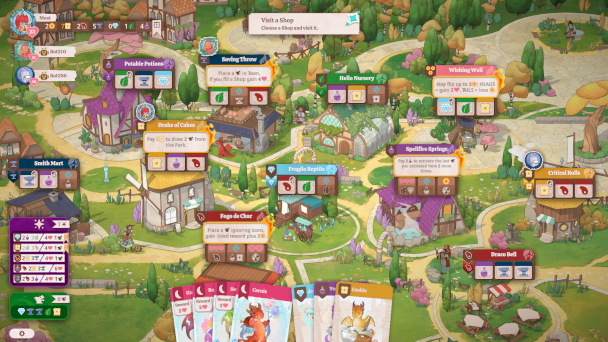
Fancy Dragons add another wrinkle by presenting specialized scoring goals. Sun Dragons can be scored once during the match when their conditions are satisfied, while Moon Dragons are evaluated during final scoring. Their objectives can involve collecting particular goods, placing certain types of dragons, or creating specific patterns around town. This nudges each ‘Keeper toward a slightly different plan. Since shops, dragons, and enchantments all appear in a randomized order, strategies have to be flexible. Some arrangements generate more interesting synergies than others, and a fortunate display can occasionally make one route feel unusually efficient.
Despite the thoroughly cozy presentation, there’s more happening beneath the surface than you might expect. Fortunately, a narrated interactive tutorial introduces each phase through guided play. It’s a friendlier teacher than a dense rulebook, with the digital version automatically enforcing placement rules, tracking production, and handling final scoring. After completing the multi-step tutorial and challenging an easy bot, the cycle of gathering, enchanting, and firing up dragons should feel fairly intuitive.
A B(e)acon of Solo Hope
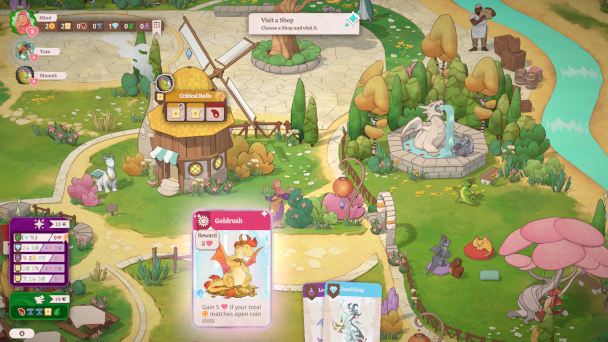
Solo play also offers more than a succession of isolated matches. Completing achievements gradually unlocks pieces of an original story about the town’s residents constructing a lighthouse that can guide distant Artisan Dragons toward a new home. Sure, this isn’t a sprawling narrative campaign, but it provides a welcome sense of progression and gives solitary ‘Keepers another reason to improve their scores.
Sadly, the interface isn’t quite as welcoming as the tutorial. Shops, character portraits, dragon cards, resource counters, and several displays all compete for space, so the town can look busy during the first few sessions. Some actions require an additional confirmation that isn’t always obvious. For example, when paying another Flamekeeper to enter an occupied shop, selecting a resource is only part of the process; you must then choose its recipient. The necessary information is available, but checking a Fancy Dragon and returning to the board can involve more menu shuffling than it should.
Scaled Models
Monster Couch delivers a handsome presentation. Tang’s illustrations have been translated into a colorful, hand-painted 3D town populated by more than 70 animated dragons and 30 distinct shops. The small creatures work behind counters, laboratories, and kitchens while maintaining the personality of the original analog game. Yes, the animations might only be decorative, but watching these diminutive workers practice their trades really completes the cozy vibe. Meanwhile, Paweł Górniak’s score complements the atmosphere without needlessly drawing attention to itself.
Flaming Your Friends
Best of all, the digital version provides several welcome amenities. Custom local matches can mix human participants with bots across three difficulty levels, while as many as five Flamekeepers can share a single PC. Online options include short and long matchmaking queues, cross-platform play, and custom games. The Steam version supports mouse and controller input and has a modest 2GB footprint. It’s also Steam Deck Verified, thanks to readable text and unexpectedly solid performance at the default settings. In my testing, a fully charged LCD model provided about three hours of play.
The digital version of Flamecraft can’t completely replace the pleasures of using physical pieces and passing tokens around a table. But it provides considerable convenience, capable CPU opponents, cross-platform play, and a patient tutorial. Sure, the interface could use a little taming. Once the shops start producing and a carefully planned enchantment activates an entire row of dragons, however, that shortcoming becomes easy to forgive. Flamecraft demonstrates that dragons don’t always need to incinerate a kingdom. Sometimes they just need to relax and bake a loaf of bread. You probably deserve some relaxation as well.
Flamecraft was played on PC with review code provided by the publisher.
Overview
GAMEPLAY - 80%
CONTROLS - 65%
CONTENT - 75%
AESTHETICS - 80%
PERFORMANCE - 80%
VALUE - 80%
77%
GOOD
Flamecraft turns the cozy tabletop game into an accessible digital strategy experience filled with adorable dragons and satisfying combinations. Its interface might be a bit scaly, but the game’s tutorial and flexible multiplayer options make these dragon-powered shops well worth visiting.




Great tabletop game. Sadly, that version costs $50+ dollars.