Spica Adventure review
A Curious, Kind of Clever Platformer That Never Quite Soars to Greatness

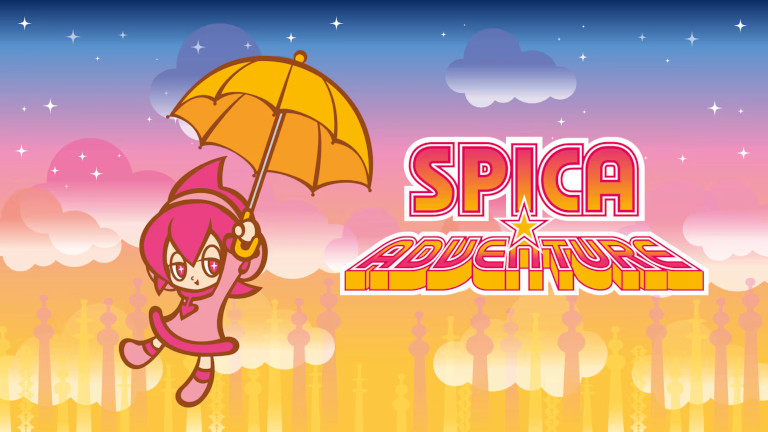
To appreciate Spica Adventure, it helps to have a bit of background on Taito. Founded in 1953 by Michael Kogan, a Ukrainian-born entrepreneur operating out of Tokyo, Taito began its life importing gum ball machines, vodka, and jukeboxes before shifting to amusement hardware. By 1978, the company had changed the entertainment industry with Space Invaders, triggering the first global arcade boom, and generating revenues estimated in the billions of yen in the process.
What followed over the next two decades was an uninterrupted catalog of hits with Bubble Bobble in 1986, Darius in 1987, Puzzle Bobble in 1994. Flanked by titles like Arkanoid, Twin Cobra, Rainbow Islands, and Cameltry, Taito helped define the golden age of arcade gaming, which is why my expectations are so high for their compilation tributes. Spica Adventure arrives much later in that timeline, when the company was expanding into the world of mobile gaming, and struggling to adapt to an evolving market.
From Phones to Game Centers
Spica Adventure debuted in 2003 for Japanese mobile phones, placing it a rather forgotten chapter of gaming history. In the early 2003s, Japan’s mobile game market was truly distinct from what existed anywhere else in the world. Here, NTT DoCoMo’s i-mode platform had been online since 1999, enabling downloadable games on handsets years before most of the world would have even have smartphones.
Taito, along with several other established arcade developers, used this platform to experiment with scaled-down versions of their developmental concepts. While arcades were still flourishing, there was something thrilling about being able to download and play a game on the way home without standing in line at Sofmap.
Spica Adventure was one of these experiments, developed for small screens and constrained control schemes before being adapted into an arcade cabinet, reversing the trend where arcade games were ported down to lesser hardware. While there are hints of Taito’s rich legacy (and several in-game references to their works), Spica feels born in a time of transition. Still, it’s interesting curiosity and I’m glad that the game is available again.
I Need Rocket Liftoffs When I Garden
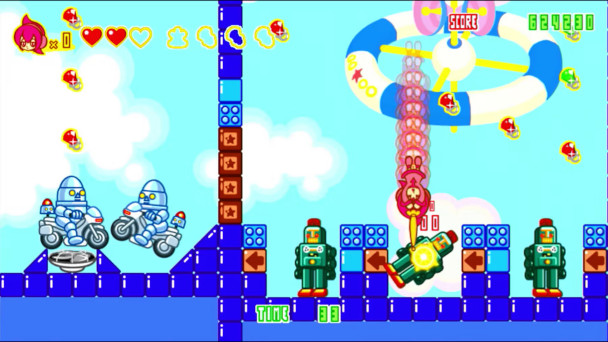
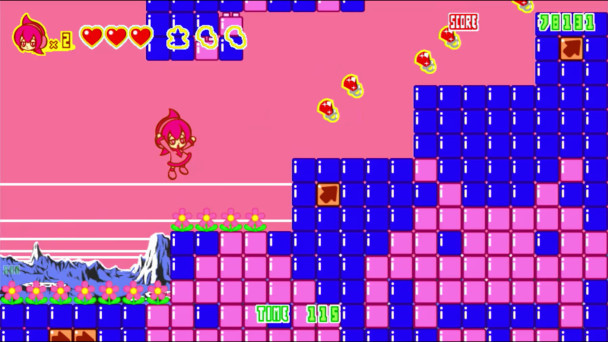
The game’s protagonist is Nico, a young girl whose carries a large umbrella with her. Interestingly, the umbrella has several functions that are all immediately available, without the manual device switching of most games. Planting the tip into a wall allows Nico to use the shaft’s flexibility to propel herself upward or downward, working as a tool for vertical traversal. Contact with water causes the umbrella to automatically invert and expand into a small boat, eliminating the need for swimming mechanics entirely. Raised as a shield, it intercepts incoming star-shaped projectiles fired by enemies, converting them into homing missiles that redirect automatically attacking their source. Finally, a direct poke at an enemy triggers a chain reaction through nearby foes.
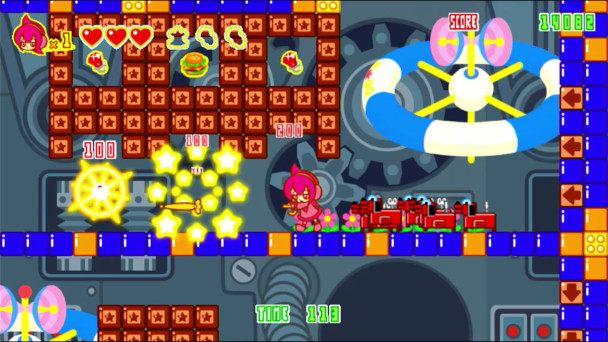
You’ll soon discover will at walking across flat, unoccupied ground causes Nico to plant flowers as she moves. Given the generosity of end-of-stage bonuses for picking up collectibles like ring-pops, you’ll probably want to do a bit of digital planting and level explorations. Just don’t squander too much time. Once the level timer depletes, a loud and quite horned robot comes to ruin Nico’s day.
Fighting Wind Boss Kind of Blew
Given the game’s branching stage map, a single play-through won’t reveal all of Spica’s 28 stages. Unexpectedly, the start off easy and get progressively more dangerous. But save for the last two rather frustrating boss battles, the game delivers a rather accessible trek to the ending animation and credits, thanks to Nico’s three hearts of health and the sporadic restorative power-up. Yes, there’s some inconsistently hazard signaling (wiener dogs pose no threat but Gumby heads do?) and umbrella-shielding lacks the speed taught by modern parries. But rarely did I ever need to curse out Ms. Nico.
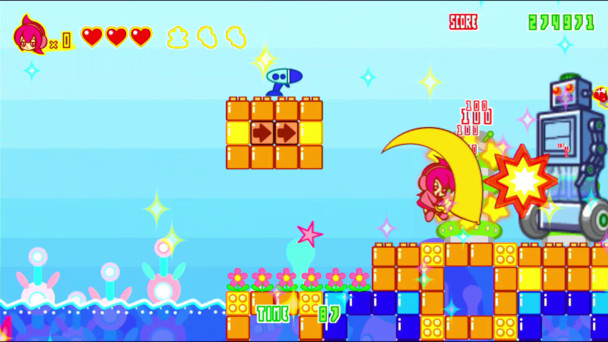
For better or worse, Limited Run provides several ways to platform through Spica’s LEGO-esque planets. Arcade Mode provides the most direct way to experience the original coin-op. With a 4:3 ratio, and in-game tutorial that explains Nico’s movesets and goals. Meanwhile a Standard Mode lets you enjoy modern amenities like widescreen output, modernized controls, and optional cheats. In between those extremes, a Challenge Mode provides online leaderboard chasing across a quartet of difficulties.
Best Moment: The Space Invaders Boss Battle
Spica Adventure comes from a disregarded time in Taito history. As a mobile-first title that made its way into arcades long before Doodle Jump or Angry Birds went coin-op, its certainly one of the earliest medium jumpers. But as a game it’s merely competent and occasionally inventive. It’s probably worth a play-through or two for comparison with Umihara Kawase, but I would see myself doing much more with it. For a studio whose output includes some of the most-loved arcade games ever manufactured, Spica Adventure is a curious footnote, but not much more.
Spica Adventure was played on Switch with review code provided by the publisher.
Overview
GAMEPLAY - 70%
CONTROLS - 70%
CONTENT - 70%
AESTHETICS - 75%
ACCESSIBILITY - 75%
VALUE - 65%
71%
GOOD
Spica Adventure is a quirky, transitional gem that shows flashes of Taito’s creativity. Undeniably, Nico’s multi-purpose umbrella provides a few twists to traditional platforming. But despite its inventive moments and historical curiosity, it feels more like a competent experiment than one of yesteryear’s must play classics.