70s-style Robot Anime Geppy-X review
Faux Mecha Anime, Reborn

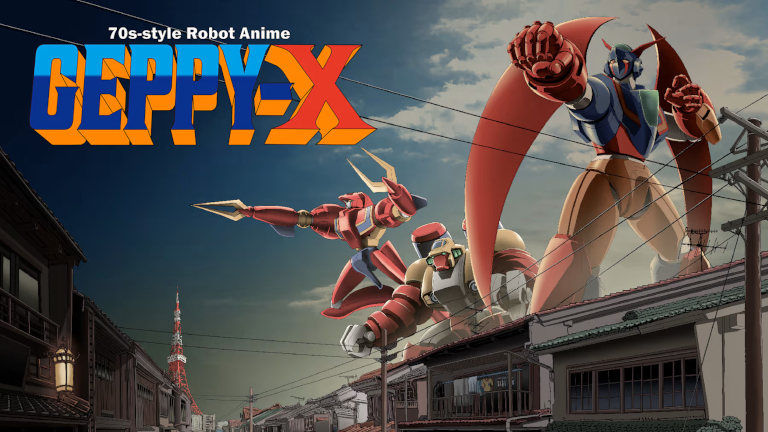
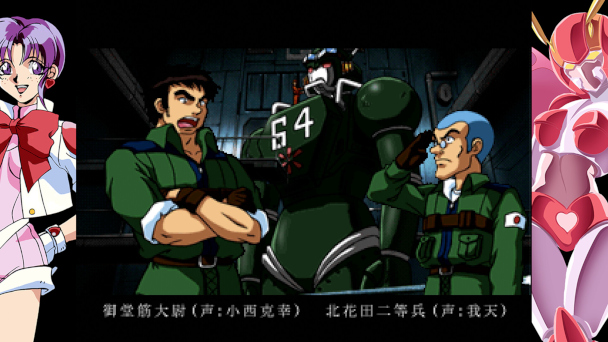
Some games are inspired by anime. But 70s-style Robot Anime Geppy-X thinks it is one. Originally released for the PlayStation in 1999, developer Aroma structured each stage as if it were an episode of a Shōwa-era animation. With its opening themes, eye catches, farcical ads, ending themes, and even next-episode previews, much of Geppy-X could have been mistaken for Mazinger Z or Getter Robo by unsuspecting onlookers.
The premise leans just as hard into the bit. It’s the year 197X, and Earth is under siege by the alien Space Demon Empire and its army of monstrous Space Beasts. A scientist named Professor Kureishi answers the call with the transforming super robot Geppy-X, a machine that requires three pilots, Kei, Jin, and Riki, to combine their individual craft into one towering unit. Sure, it’s a tropey super robot setup, but that’s precisely the point. Geppy-X is obsessed with meticulously recreating fighting robots.
An Anime Disguised as a Shooter
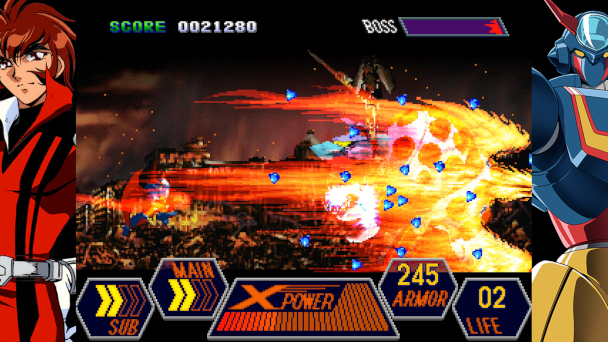
Undoubtedly, this likeness wasn’t easy to achieve. The original game was spread across four discs and featured over 8,000 hand-drawn animation frames shot on 35mm film, which was an unprecedented production for what’s essentially a scrolling 2D shooter. With professional voice acting and song composition from veterans who worked on the anime it parodies, it was an expensive undertaking that gives Geppy-X a genuine sense of authenticity. In a perfect world, it just might have spawned its own animation, bringing the property full circle.
The remaster wisely treats those animated sequences as archival material rather than filler FMV. Originally compressed to 320×240 at 15 frames per second on the PlayStation, every scene has been re-digitized from the original Betacam masters and restored to its intended 24 fps. The improvement is noticeable, with cleaner line work, smoother animation, and richer color reproduction. Better still, players can instantly switch between the original and restored video, making Implicit Conversions’ preservation work easy to appreciate.
Commercial Break!
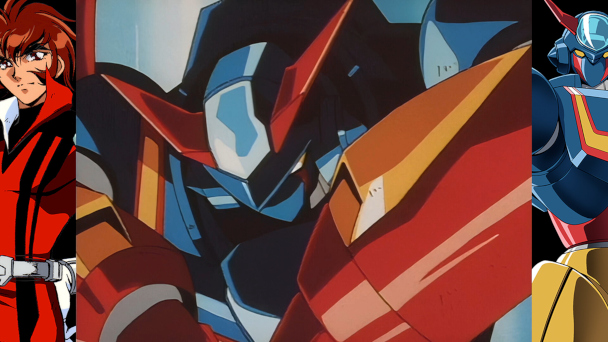
More than a quarter-century on, it’s the fake commercials with their infectious theme music that will likely fascinate fans. Some hawk merchandise like toys tied to the in-universe show. As someone who owned one of Mattel’s Shogun Warriors (a toy line that brought Mazinger Z stateside), this was probably some of the purest nostalgia around. But I’m an old guy, so I wonder if younger players will feel the same. Either way, knowing at least a bit of Japanese pop culture helps, since Geppy-X also parodies Ashita no Joe, a classic boxing anime that was Rocky’s counterpart across the Pacific.
But if you were ever a fan of Sunrise or Toei’s robot shows, the original voice-over performances from Akira Kamiya, Sho Hayami, Shuichi Ikeda, Ichiro Nagai, and Goro Naya, alongside theme songs from Isao Sasaki, Akira Kushida, and Hironobu Kageyama, make Geppy-X hard to resist, even if you’re not a devoted fan of STGs.
Three Robots in One
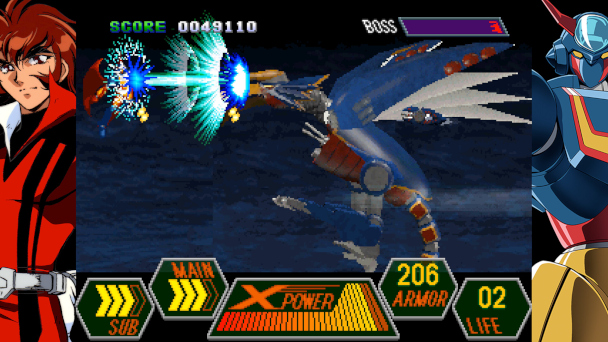
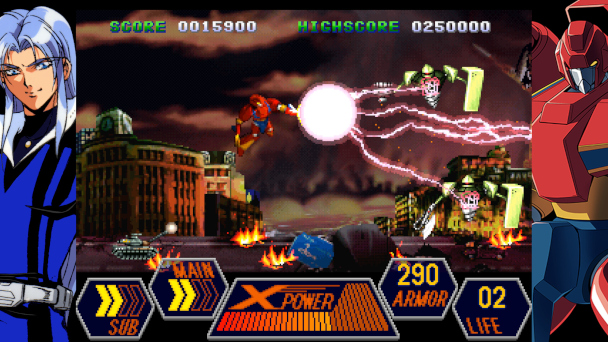
Geppy-X can transform between three forms: X-1, a balanced all-purpose unit; X-2, a speed type built around the screen-clearing X-Seeker; and X-3, a power type built around the close-range X-Slap and the devastating X-Cannon. During episode five, your mech is upgraded into Geppy XX, which offers its own trio of attack forms favoring balance, speed, or power.
Finishing the campaign unlocks a surprisingly generous collection of extras. Alternative story modes let players tackle the game using entirely different mechs, each offers unique weapons, armor, and difficulty balance. The standout is Star Geppys, a laugh-out-loud parody of American anime localizations from the 1980s and early ’90s. Characters receive exaggerated English names, Tokyo inexplicably becomes New York, and every line is delivered with gloriously hammy voice acting. It’s historically accurate, surprisingly affectionate, offering another reminder that Geppy-X is committed to the set-up.
A Super Robot Love Letter Preserved
Largely, it’s a competent horizontal-shooter that’s closer to late-’90s arcade STGs than modern bullet hell. The remaster smooths the rough edges with rewind functionality, rapid-fire options, quick save, a CRT filter mode, and achievements. The remaster also lets players scale down the rather challenging difficulty. Between that and the rather generous rewind window, most players should be able to see the game’s ending even if the original game’s bullet density can still test your dodging prowess.
Geppy-X’s combination of being reverent to a fault, but skirting needless additions is what makes this remaster work. By focusing on preservation over reinvention, the remaster ensures that Geppy-X remains exactly what it always was: a wonderfully earnest love letter to 1970s super robot anime.
70s-style Robot Anime Geppy-X was played on PC with review code provided by the publisher
Overview
GAMEPLAY - 70%
CONTROLS - 70%
CONTENT - 75%
AESTHETICS - 75%
PERFORMANCE - 75%
VALUE - 65%
72%
GOOD
70s-style Robot Anime Geppy-X wasn’t just a shooter with anime cutscenes. It's an entire super robot series that was packed onto four PlayStation discs. A quarter-century on, the gameplay is mostly solid, but it’s the animation, voice-work, and hilarious extras that make this a recommendation for fans of classic mecha anime.



I remember seeing this as a PSX import. I think they wanted $70 for it at the time.
Is the game upscaled at all or just the video?