Biomechanical Toy review
Seagal Meets Toy Story in This Coin-Op Curio

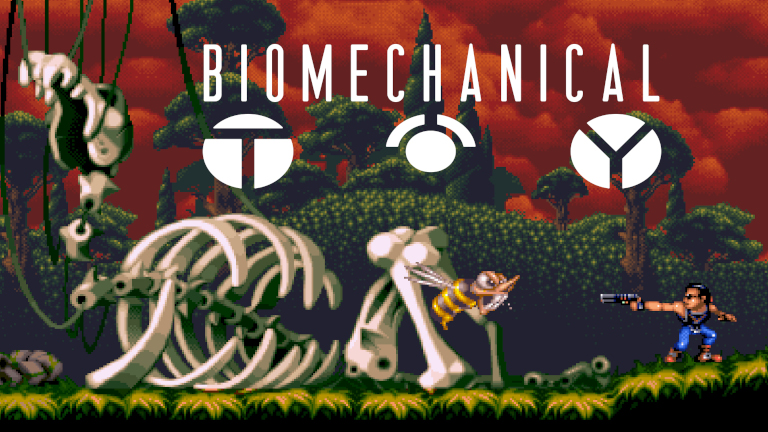
By 1995, the run-and-gun was surging in popularity. Contra had initiated the genre eight years prior, Metal Slug was just months away, and numerous developers were delivering their own take on the genre. Spanish developer Zeus Software and publisher Gaelso responded with a blend of action and absurdity known as Biomechanical Toy.
Rather than suppressing alien invasions or taking on General Morden’s Rebel Army, the coin-op dropped players into a toy kingdom where giant chess pieces swing axes, cacti tower over the landscape, teepees are built from playing cards, and a Steven Seagal lookalike fought to save enchanted playthings from an escaped clown criminal. Sure, the game feels like a ‘90s action movie stuffed with a toy-box worth of product placement, but that ridiculousness is all part of Biomechanical’s charm.

Toys-To-Live, Before Skylanders
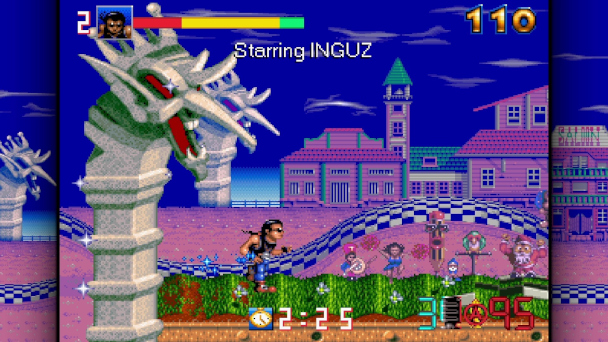
Expectedly, the plotline is nonsensical. After escaping, a thief named Scrubby steals the Magic Pendulum, an artifact that can bringing toys to life. But without it, the kingdom’s existence is threatened. Naturally, the best person capable of stopping him is Inguz, an action hero sporting a black tank top, sunglasses, fingerless gloves, and a ponytail right out of a direct-to-video action flick. It’s equal parts Under Siege, Saturday morning cartoon, and the fever dreams that arcade developers sporadically produced before the turn-of-the-century. I miss the days when games didn’t habitually feel like the product of focus groups.
Just don’t try too hard to make sense of Biomechanical Toy. One level resembles a giant chessboard filled with murderous rooks and living pawns. Another mixes western themes with over-sized toys before delivering a parody of Disney’s Aladdin. Elsewhere you’ll leap between cartoon machinery, haunted castles, and fantastical landscapes that feel rather arbitrarily stitched together.
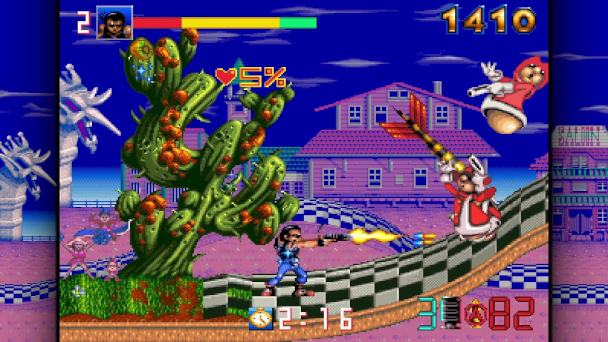
But there just might be a connective tissue to be found, with Toy appreciating pop culture references. Some, like the aforementioned Genie sprite that nearly looks lifted from the 1993 Aladdin game, but others are musical. Notably, one stage uses Wang Chung’s “Every Big City,” which was originally featured on the soundtrack to William Friedkin’s To Live and Die in L.A. It’s an unusual choice for a toy-themed platform shooter, but it fits the game’s unpredictable spirit. Plus, it’s just a really cool nod.
Bring the Noise, Toys
While pixelated, the game’s visual are endearing. Backgrounds showcase a wealth of details while striving (and sometime loosing) the battle of visual clutter. Sprites are large and relatively well animated, while enemy designs rarely repeat. One minute you’re shooting animated dice, the next moment you’re battling bizarre mechanical monstrosities gathered from fairy tales, cartoons, and literature. Rather than adhering to any unified artistic style, the game simply keeps throwing ideas at you, and that remains intriguing thirty years on.
Mechanically, Biomechanical Toy doesn’t veer far from early run-and-gun traditions. Inguz moves through horizontally scrolling stages, shooting at of enemies while collecting health pickups, ammunition, and temporary weapon upgrades. Rather than carrying an arsenal of different firearms like Metal Slug or Contra, your primary weapon evolves through ammunition pickups, eventually becoming fully automatic and quite useful against more resilient enemies. One mechanic that gives the game a bit of additional personality occurs on each level. Hidden on each stage are imprisoned toys that Inguz can rescue. Once freed, these companions follow, providing additional firepower.
A Leap of Faith
But there’s more to Biomechanical Toy that just shooting up everything to bits. Inguz can also hop on enemies Mario-style, and some sections require some painstakingly precise platforming as you bounce across a chain of enemies. If you can do it, hopping across six or seven moving enemies without touching the ground feels immensely satisfying, but only when the controls cooperate.
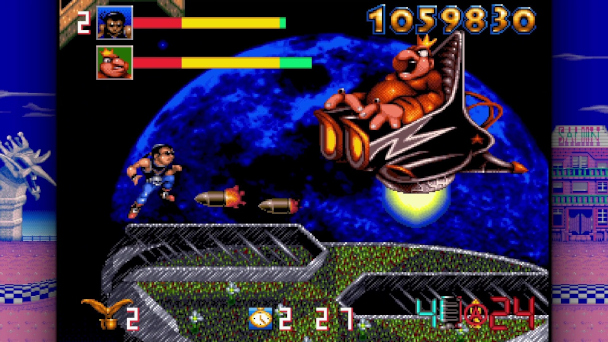
Unfortunately, this is where the title shows its age. The game’s controls scheme allows you to lock Inguz’ position while firing upward or diagonally by holding the fire button. In theory, the system provides more ways to gun down foes without any additional buttons. But in practice, it can feel awkward, especially during frantic encounters like boss fights. Largely, I wasn’t a big fan of these showdowns, where encounters required Inguz to wear down a health bar while performing repetitive maneuvers with faultless precision.
Switching between movement and directional aiming isn’t as seamless as you’d like, especially during platforming sections. Automatic weapon upgrades can make things more manageable, but Biomechanical is never quite as fluid as its genre peers. Newcomers might find themselves fighting the controls almost as often as Scrubby’s mechanical army. While I eventually got used to Inguz’s movement, jumping definitely has a bit of floatiness. And while QUByte Interactive’s Bleem-powered emulation is solid offering modern conveniences like rewind, save states, and visual filters, part of me wishes they would have tried to add a cooperative mode.
Perfect? No. Memorable? Definitely!
Originally released thirty years ago, Biomechanical Toy has aged a bit. The aiming mechanics, tight playing perspective, and slightly floaty jumps can make Inguz control like a toy. That said, the game’s oddball style make it one of the more fascinating arcade curiosities of the 1990s. I can’t think of another coin-op that references 90’s actors, Alice in Wonderland, and Wang Chung, making Biomechanical worth a look if you appreciate interactive eccentricity.
Biomechanical Toy was played on PC with review code provided by the publisher.
Overview
GAMEPLAY - 70%
CONTROLS - 60%
CONTENT - 65%
AESTHETICS - 70%
PERFORMANCE - 75%
VALUE - 75%
69%
Quirky
Weird and occasionally wonderful, Biomechnical Toy is a coin-op curio that mixes run-and-gun action with a procession of pop culture references. Slightly floaty jumping and some awkward aiming keep it from reaching Contra or Metal Slug levels of greatness, but its eccentric personality helps to make it memorable.





What’s a Wang Chung?