Little Rocket Lab review
A Game About Machines Possesses Some Soul


Little Rocket Lab brings a poignant premise to the cozy automation genre. Here, Winnipeg-based developer Teenage Astronauts’ tasks you with repairing your childhood house, assisting the town of St. Ambroise, and ultimately, carrying on the family legacy of building a rocket. You play as Morgan, an aspiring engineer, whose adventure fuses factory building, resource management, and warmhearted community interactions. The result feels a lot like the smalltown charms of Stardew Valley mixed with the intricate industrialism of Factorio.
Automation Without Intimidation
At its best, Little Rocket Lab succeeds in making automation approachable for anyone that’s overlooked the sub-genre that revolves around the creation of assembling lines. The game’s tutorial pop-ups are concise but effective, while recipe systems are clear, and the game’s lenient pacing favors curiosity and experimentation.

Rocket Lab early hours are brimming with a sense of discovery as you start plopping down conveyers and assemblers, forming production chains at an untroubled pace. And if factory construction without the typical timers or external threats sounds appealing, Teenage Astronauts’ effort can feel therapeutic.
Comfort Food for Tinkerers
Obviously, it’s challenging to maintain that sense of wonder. And after eight or so hours, new mechanics and surprises slow to a trickle. Rocket Lab’s midgame becomes more about scaling up existing systems than unlocking novelties that make you think in different ways. So, while the game offers a heartfelt and accessible inroad into the automation genre, it’s an experience that shines brightest during its opening hours.

Much of the game’s accessibility comes from the way Teenage Astronauts approaches user interface design. Building and modifying production lines is a painless process, flaunting smart snapping tools and compassionate placement options. These let you adjust conveyor routes or rearrange workstations without much penalty. As such, it’s going to be difficult going back to automation games that aren’t as lenient.
Meanwhile, the game’s camera and zoom controls are tuned to so you can easily pan out and appreciate your factory as a whole. I’ve played quite a bit of the genre on Steam Deck and really appreciate it when it doesn’t feel like you’re wrestling the UI. And if you’d rather not use a controller, Rocket Lab’s mouse-and-keyboard controls are fantastic for contraption building.

Of Wrenches and Warmth
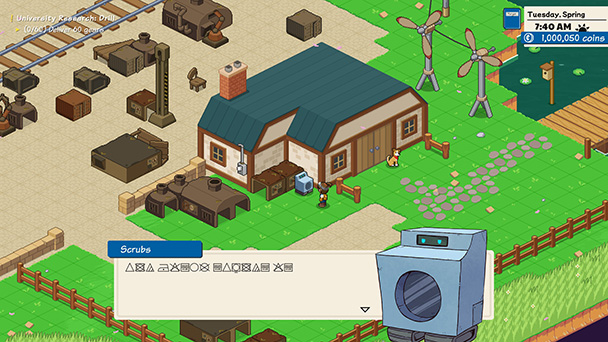
Beyond busting your brain on the factory floor, you spend time chatting with townsfolk, fulfilling small requests, and restoring your family home. These narrative-driven moments are intended to give the logic of engineering an emotional complement. And undoubtedly, they often work. Morgan’s conversations with her long-time neighbors add warmth to the setting. But sporadically, the pacing can be uneven, as if the game can’t decide to have you in the workshop or wandering the streets.
Expectedly, resource management plays a role throughout the campaign, although it’s more forgiving here than the game’s assembly line-making peers. Pleasingly, raw materials are plentiful, and production chains rarely face exasperating bottlenecks. Best of all, there are no significant economic constraints, so Little Rocket Lab lets you screw around without the fear of coming to a crashing halt. Unfortunately, this can reduce the sense of urgency. Unlocking advanced machinery or rocket parts feel like progress rather than major accomplishments given its laid-back approach. That’s not really a criticism but more of a warning for those who require tension.
Folksy Flavor in St. Ambroise
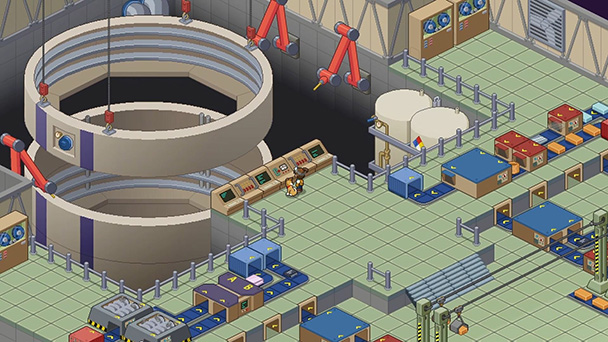
While Rocket Lab’s art direction embraces simplicity, the style isn’t without charm. St. Ambroise is rendered in an isometric perspective, with the town’s evenings offering variety from an otherwise vivid palette. The factories themselves are wonderfully tactile, with machines that whir, and belts that loop around in hypnotic processions. Meanwhile, a folksy soundtrack bustles in the background, helping to unite the game’s mediative and mechanical personalities.
A Laid-Back Launch Worth Taking
By the final stretch, Little Rocket Lab still offers enough charm and polish to leave a positive impression, even if its systems settle into predictability sooner than they should. For newcomers to automation games, this is a welcoming starting point. It’s low on stress, encourages creative thinking, and cares about player comfort. Thanks to these qualities, Little Rocket Lab offers a town well-worth visiting, even if its mechanics need a bit of grease across the game’s concluding hours.
Little Rocket Lab was played on PC with review code provided by the publisher.
Overview
GAMEPLAY - 80%
CONTROLS - 85%
CONTENT - 80%
AESTHETICS - 75%
ACCESSIBILITY - 75%
VALUE - 85%
80%
GOOD
Little Rocket Lab is the kind of game that makes factory building feel more like a hobby than hard work. It’s cozy, clever, and charming—just don’t expect high-stakes drama once your conveyor belts start humming.




DEI cast. No.
Imagine not playing agame because the cartoon characters are drawn in a different shade than your skin. I dont understand people like you.