Gurei review
Pick the Order of Your Problems

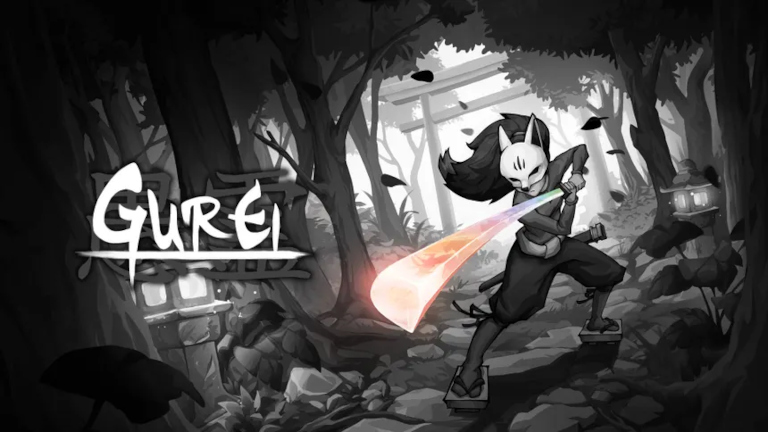
Let’s face it: it’s becoming really difficult to get excited about new metroidvanias. There was a time when I had to play each promising new genre entry. But that was many interconnected maps and a countless ability gains ago. Sure, I still play the standouts like Hollow Knight or Blasphemous, but there are a lot of efforts that feel more like competent exercises in imitation rather than real innovation. Bare minimum, I need one really good hook.
Gurei’s distinction is rooted in borrowing one of Mega Man’s familiar systems. Rather than leading players through a mostly fixed sequence of upgrades, the game’s major bosses surround a central hub and can be challenged in nearly any order. Each victory grants against a Kami awards a new ability or augmentation. But there’s a catch: every remaining boss grows stronger after defeating each one. Suddenly, deciding where to go next is almost as important as mastering combat.
Largely, it’s a effective system that immediately distinguishes Gurei from many of its peers, even if it doesn’t always produce perfectly balanced results. Best of all, the structure encourages experimentation. You might pursue a defensive upgrade first, hoping it’ll make later encounters more manageable. Alternatively, you can tackle a difficult kami early while it’s comparatively weak, even though you’ll have fewer tools at your disposal. Just like the NES era, no two players are likely to follow exactly the same route taking down the ten kami. Don’t follow a FAQ, Brazil-based development duo Lobo Sagaz seems to dare.
A Semi-Precious Life
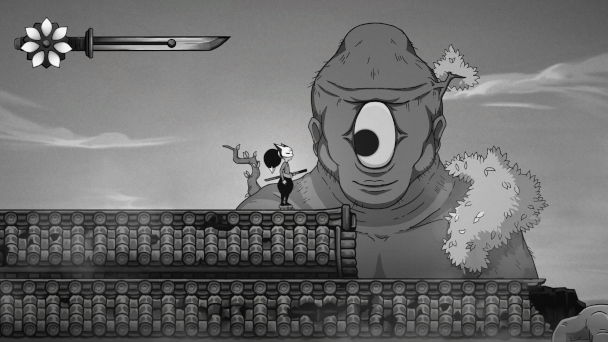
Unfortunately, cutting your way through Gurei’s scaling without assistance can be a double-edged sword. Depending on your chosen path, some late-game encounters can become noticeably more punishing than they should be. While the system promotes replayability, it occasionally feels like you’re being arbitrarily penalized for selecting certain routes though the game.
Gurei’s approach to player lives adds another layer of complication. Rather than offering retries without consequence, lives are a limited resources that encourages careful exploration and calculated aggression. Given that you’ll earn bonus lives by defeating kami, it raises the stakes without being prohibitively punishing. That said, there will some who will wish that the game offered a more traditional check-pointing system. There might be different approaches to Gurei, but they’ll all grow demanding after downing your first Kami.
Boss Fights Bolster Enjoyment
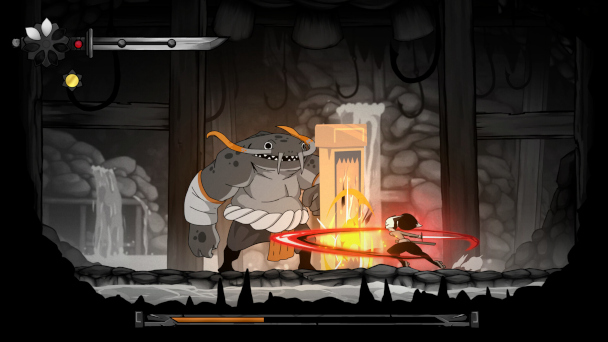
Pleasing, the game’s controls are consistently responsive, providing you with an intentionally sparse moveset. You’ll start with a basic melee attack, a jump, and an evasive dodge. Gradually, you’ll obtain tools like a protective shield capable of absorbing attacks. Another unlocks explosive abilities that serve both offensive and environmental purposes. Smartly, the pacing of new tools keeps Gurei from being overwhelming. You’ll gain something new after defeating each Kami and given time to master the new addition to your arsenal.
For better or worse, exploration doesn’t veer far from metroidvania formula. Hidden passages, optional upgrades, and ability-gated secrets reward observant players willing to retrace their steps. While the level design is generally solid, some backtracking can feel more obligatory than exciting. Revisiting old areas after unlocking new abilities is satisfying the first few times, but later returns don’t provide the same sense of discovery as some of the genre’s better outings.
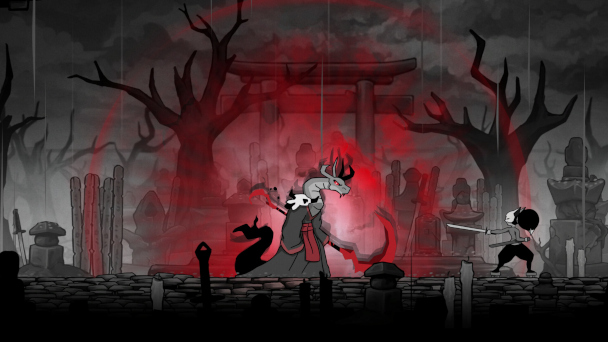
As with most metroidvanias, combat can be a bit lopsided. Subordinate enemies try to introduce some of the mechanics that will appear later during boss battles, but they don’t flaunt the same level of creativity and energy as the game’s signature showdowns. Instead, it’s the kami who are the real stars of Gurei, requiring mastery of movement, patience, and pattern recognition. Here, success rarely comes from simply mindlessly dishing out damage. You’ll have to learn attack timing, recognizing openings, and to resist trying to get an extra hit in before retreating. But once everything clicks, defeating one of Gurei’s godly guardians is truly gratifying.
Git Gud at Gurei
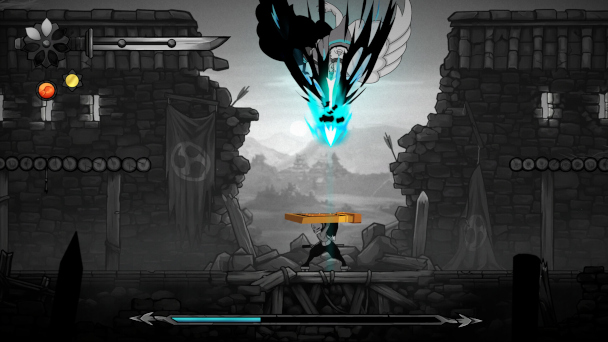
At the same time, difficulty can flirt with frustration. Some encounters drag on long enough that a single mistake can feel disproportionately punishing. When combined with the difficulty scaling, some certain bosses can become endurance contests where persistence matters almost as much as pure skill. If you appreciate demanding action games you’ll probably like the challenge. But if you’re used to grinding to help overcome an impasse, Gurei offers little bend.
The game’s presentation is competent but not exceptional. Mostly monochromatic pixel art creates an appropriately bleak atmosphere, and character animation is fluid enough to support combat. Enemy attacks are fairly easy to read, which is essential quality for a game like Gurei that demands split-second reactions. Meanwhile, the soundtrack is a bit less memorable, complementing the action rather than truly elevating it.
Similarly, the game’s narrative favors minimalism. Some environmental storytelling does a fair amount of work, with characters and a light plotline providing a light impetus for your succession of showdowns. Given the intensity of some of Gurai’s fights, favoring atmosphere over dialog sequences was the right decision.
The Hook and the Hardship
Ultimately, Gurei demonstrates that originality doesn’t require complete reinvention. By borrowing Mega Man‘s progression system, the game injects some decision-making into a genre that’s over-reliant on formula. Unfortunately, that hook can’t completely smooth over the game’s rougher edges. Some uneven boss scaling, obligatory backtracking, and a handful of overly drawn-out encounters keep Gurei from joining the upper tier of modern metroidvanias. Still, if you’re looking for a genre entry with a fresh idea and don’t mind a healthy dose of punishment along the way, Gurei is worth the challenge.
Gurei was played on PC with review code provided by the publisher.
Overview
GAMEPLAY - 70%
CONTROLS - 75%
CONTENT - 70%
AESTHETICS - 70%
PERFORMANCE - 70%
VALUE - 70%
71%
GOOD
Gurei finds a way to stand out in the crowded metroidvania genre by borrowing Mega Man's nonlinear boss progression, intensifying the decision of who to tackle next. But that hook is offset by some uneven difficulty scaling and some truly grueling boss fights, but players who enjoy demanding action will find plenty of hearty challenge.




Is there a version for Switch?