Fairy Tail: Dungeons (Switch) review
A Deckbuilding Well Worth Delving Into


Typically, the most popular manga are adapted into either modest mobile games or epic-sized role-playing experiences. Given that Hiro Mashima’s Fairy Tail has received both kinds of interpretations, it’s refreshing to see an effort that straddles these two extremes. Solo developer ginolabo (SOULVARS) imagines Fiore’s most powerful guild employing deckbuilding to defeat a succession of aggressors. And while that might sound like yet another Slay the Spire-derivative, Fairy Tail: Dungeons is more than just a clone with a recognizable cast. Best of all, the Switch port transports a wealth of new content, fleshing out the experience even further.
Like many non-canonical works, the storyline is straightforward, using a mysterious portal to steal the prowess of each playable guild member. While there’s a mystery surrounding a disappearing person, Dungeon’s emphasis is on rebuilding the abilities of Natsu, Grey, Erza, Lucy, and Wendy across roguelike runs. Once individual members are strengthened, you’ll get the opportunity to take the guild out, as team-based battles test your synergistic strategies.
Stack Up the Punishment
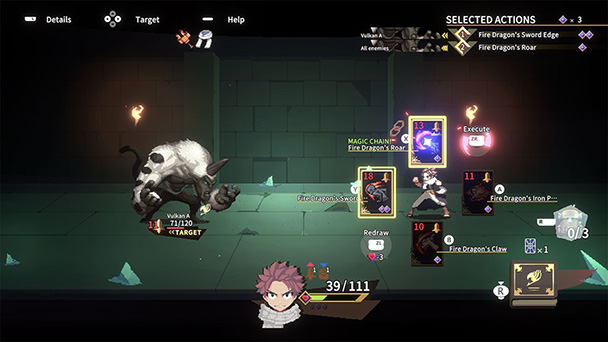
And while collaborative combat is a definite highlight, you’ll probably relish the swift speed of taking single characters out for dungeon exploring. Like many of its peers, each turn provides three or so action points to spend on picking offensive, defensive, and support-based abilities. Pleasingly, Fairy Tail: Dungeons maps its four selections to the face button on a controller, making for a fast and accessible play.
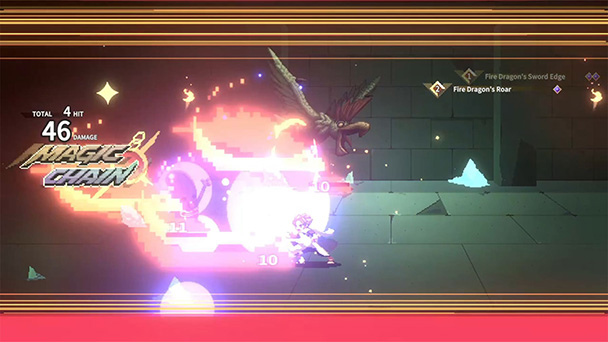
Remarkably, card sequencing makes a difference thanks to an ample supply of buff cards and magic chains. The former might provide a stat boost for all subsequently played cards while the latter are linked cards that give vigorous boost to your damage output. Factor in the ability to redraw cards, blocking, status effects, enchantments, and equippable amulets, and there’s a wealth of variables. Yet, after a few battles, it’s all quite easy to understand. Dungeons’ difficulty is quite lenient, making the game ideal for deckbuilding apprentices.
Getting the Guild Back Together
But those with experience in the sub-genre know that repetition can dull successive runs. Dungeons does its best to offset this by offering a healthy amount of character cultivation. Obviously, you’ll add new cards and augment your existing ones. But you can also use a currency called Lacrima to purchase items or unlock assistances from a randomized skill grid. Periodically, you’ll be presented with the offer for a HP-rejuvenating rest or be able to augment one of your cards.
And while the game’s playables could have been diversified a bit more (give me a high-risk build, please), each guild member does tackle the dungeons differently thanks to their distinctive decks. And while defeat can seem inevitable, Fairy Tail: Dungeons provides plenty of opportunities to improve your odds. I didn’t encounter as many demoralizing losses as most deckbuilders, which helped to keep me hooked.

A Hint of Exploration
Although you’ll undoubtedly spend the bulk of your time in combat, watching pixelated party members confront a procession of monsters, Fairy Tail: Dungeons does its best to eschew visual fatigue. Between battles, you’ll see an isometric perspective of the procedurally generated dungeon, where you’ll reconnoiter across each floor. Icons reveal the position of opponents, treasure chests, lacrima deposits, and ‘Choose Your Own Adventure-style dilemmas, while each step counts down toward a showcase boss battle. It might look a bit simple, but Dungeons does provide autonomy as you opt to play it safe with your resources or build up your character.
The Switch release benefits substantially from the latest update, which adds new dungeon modifiers, 170 cards, five new post-game guild members, and quality-of-life refinements that smooth out long-term play. Expanded difficulty options give seasoned deckbuilding fans more room to experiment with riskier builds, while balance tweaks help underused cards feel more viable across repeated runs. Best of all, the update deepens the mechanical variety, augmenting an already distinguished deckbuilder.

While Dungeons doesn’t deliver much in the way of exposition or character development, there are succinct conversations between characters like Natsu and Happy that inject a bit of personality. And between the spite-art interpretations of Fairy Tail’s cast and Hiroki Kikuta’s (Secret of Mana) Gaelic-influenced soundtrack, the game captures several of the anime’s signature qualities.
Conclusion
Given its lightweight storytelling and accessible but engaging battles, being a fan of the source material isn’t a requisite for enjoying Fairy Tail: Dungeons. As long as you are up for some balanced stat farming, ginolabo’s latest effort is a thoroughly engaging affair and one of this best deckbuilders of the past year.

Fairy Tail: Dungeons was played on Switch 2 with review code provided by the publisher.
Overview
GAMEPLAY - 80%
CONTROLS - 85%
CONTENT - 85%
AESTHETICS - 80%
PERFORMANCE - 80%
VALUE - 90%
83%
VERY GOOD
Fairy Tail: Dungeons blends approachable roguelike deckbuilding with the franchise's familiar charm, delivering fast, flexible battles that are easy to grasp without feeling shallow. Bolstered by a content-rich Switch update, it’s a surprisingly deep dungeon crawler that stands apart from other Slay the Spire-inspirations.