Death end re;Quest: Code Z review
Sayaka’s Mystery Dungeon


Death end re;Quest: Code Z is third installment in Compile Heart’s dark and gory RPG series. The latest entry ventures into a parallel universe of World DE-1.5, injecting roguelike mechanics and introducing a new lead. Pink-haired Sayaka Hiwatari is a heroine who find herself in a world where allies and enemies are nearly indistinguishable. The narrative unfolds as Sayaka confronts a mysterious antagonist directing doppelgängers that resemble former heroes, plunging her into a precarious realm fraught with danger and uncertainty.
The storyline builds upon the lore established by the two previous games. After restoring her goodwill, Iris creates World DE-1.5, a seemingly perfect simulation of Earth in the 2000s. But the reproduction is contaminated by the emergence of a new threat, obliging Sayaka to seek out the source of this chaos. The game’s narrative, overseen by Makoto Kedouin (Corpse Party) sporadically delves into thought-provoking concepts. One of the most interesting explorations examines the nature of reality when the tools of misinformation are readily accessible. But other qualities are shrouded by a five-year gap from the previous entry.

Better Brush up on Luden Lore
You see, I played through both Death end re;Quest in 2019 and the sequel that appeared the following year. I remember being engrossed by the concept of AI developed through the brainpower of thousands of unwilling individuals, mirroring the real-life data acquisitions methods of scummy tech executives. But occasionally, I found Code Z’s plot hard to follow. Sure, the game attempts to summarize previous plot points, but recapping more than 60 hours of exposition is an extraordinarily lofty hurdle.
To make matters worse, you don’t play as Sayaka, but as an observer, resulting in fourth-wall breaking moments that can be confusing. And at times, Code Z’s futurism became a bit too cryptic and was further convoluted by the requisite melodrama. That said, Code Z shines when it’s meditating on everyday life like when a surly boss gently reminds a subordinate that some questions are best answered with a search engine.
The Precariousness of Sanity
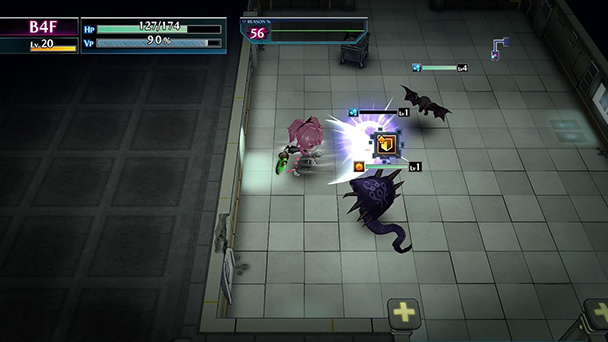
Mechanically, Code Z abandons the detailed 3D environments of its predecessors. Instead, the game favors Mystery Dungeon-style exploration and combat in what’s known as the Strain Area – dynamic dungeons that reconfigure with each entry. Here, players must strategically navigate these treacherous zones, where a wayward move could trigger a Death End, the franchise’s trademark gruesome endings.
But instead of only being a punishment, Death Ends are an essential part of Code Z’s formula, providing Sayaka with skill points that augment her base stats. So, if you’re unenthusiastic about grinding, know that you’ll likely need to replay dungeons, so Sayaka isn’t completely overpowered by bosses. When exploring these procedurally-generated labyrinth, the game swaps the traditional hunger meter for a sanity gauge. Traps can have a devasting hit on your lucidity and the frequency of sanity-restoring items is low. Given that Ether Codes aren’t consistent sold at the in-game store, expect an amble amount of frustration across Code Z’s campaign. I’ll all for requiring strategizing and unflinching difficulties, but when design decisions induce infuriation, the urge to quit is strong.
Vanquish Style vs. Glitch Mode
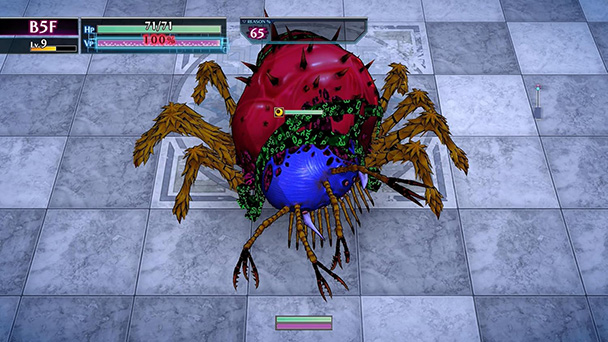
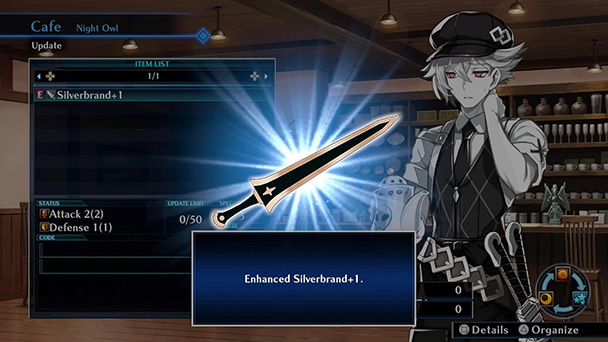
Yet, despite the incomprehensible annoyances, exploration isn’t without a few enjoyable traits. Sayaka has access to a Vanquish Form after slaughtering enemies. Not only does this significantly increase her attack power, but the temporary change nullifies basic ailments. Like any respectable Mystery Dungeon-type game, a constrained inventory forced tough decisions. Do you empty a slot by using a potent ranged attack to eliminate a foe from a crowded room? Or should you play it prudently and save it for a boss? Finally, weapon customization is adept, offering the ability to improve stats or add abilities. Like any respectable roguelike, you’ll periodically need to evaluate your arsenal and giving up custom-built arms is suitably difficult.
Although Code Z’s explorational change might be contentious, few will find fault in the game’s visuals. Kei Nanameda’s (Mugen Souls) character designs are undoubtedly eye-pleasing, with detailed portraits complementing dialog sequences. Meanwhile, CGs mix splashes of crimson viscera with mutating character fonts, giving game with a distinctive look. These carry over to the chibi-fied dungeons. While the labyrinths don’t reveal much graphical detail, essential details like item descriptions and status are easy to read.
Death end re;Quest: Code Z adopts a bold new direction for Compile Heart series. The third entry preserves the premise of high-tech simulation gone awry. However, the shift to Mystery Dungeon-style exploration and combat might not please series supporters, especially given the inclusion of several perplexing irritations. That said, the experience isn’t devoid of enjoyment, especially when the script instills a bit of playfulness.
Death end re;Quest: Code Z was played on PlayStation 5 with review code provided by the publisher.
Overview
GAMEPLAY - 65%
STORY - 70%
CONTENT - 75%
AESTHETICS - 80%
ACCESSIBILITY - 65%
VALUE - 55%
68%
Mediocre
Much like its lead character, Death end re;Quest: Code Z commits a few missteps. From near-obliged grinding to stinginess with a key resource, you will encounter frustration nearly as often as witnessing one of the franchise’s Death Ends. Players with limited patience might be better off revisiting the previous two entries.