Atomic Owl review
This Sharp-sighted Metroidvania Soars Above the Flock


With thousands of metroidvanias available on Steam, the genre is on the cusp of oversaturation. As such, any aspiring upstarts need to inject some ingenuity into the overcrowded genre. And largely, Denver-based indie developer Monster Theater wastes little time signaling that Atomic Owl offers some of those indispensable divergences.
Sure, you’ll be offered the chance to watch a rather auspicious opening credit sequence. With its parallax scrolling, detailed pixel art landscapes, synthy chiptune melodies, and a finish that ends with a striking pixel-art cityscape, there’s certainly plenty of promise and just a little bit of justifiable pride. Atomic Owl might not be perfect, but it’s definitely more interesting than many of its peers.

A Bird’s-Eye View to a Kill
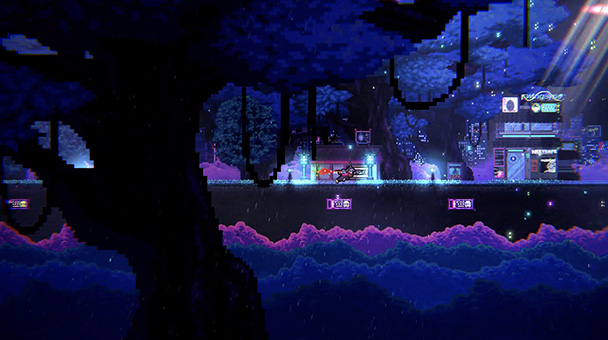
One of the more immediately interesting design decisions was to pull back the game camera. As such, revengeful avian Hidalgo Bladewing is tiny when compared to the sprite size of most metroidvania protagonists. And yes, if you’re playing on portable PCs like the Steam Deck or ROG Ally, it’s easy to mistake an NPC for an enemy. But the real benefit here is that you can see much more of the environment around you. And what’s helpful given Atomic Owl’s increased emphasis on platforming.
Wisely, the emphasis on platforming is not just a stylistic flourish. Hidalgo’s journey frequently demands precise jumps, mid-air course corrections, and the adept chaining of these abilities to reach otherwise inaccessible areas. Platforms crumble underfoot, moving ledges require perfect timing, and enemies are often placed in spots that require quick decision making. Although the need for precision might recall 16-bit platforming, Monster Theater wants you to adapt, rather than memorize levels. And that’s critical, since dead for Hidalgo means starting over, albeit with some meta-game unlocks.

Chains, Hammers, and Eagle-eyed Caution
Similarly, combat shirks the tap-and-kill minimalism found in many metroidvania titles. When combat occurs, it’s driven by a clear and deliberate rhythm. Hidalgo’s primary attacks are swift but limited in range or widely arced, in range, forcing you to approach adversaries with caution rather than rashly rushing in. Best of all, Atomic Owl gives you access to a quartet of different offensive tools. You can freely switch between them, opting to use your chainwhip to bound back projectiles or using your hammers to take out floating bullet launchers.
Meanwhile, a cooldown system governs the use of special moves. While the constrained use of a powerful, semi-homing ranged attacks is a good design choice, I’m not sure a stamina system is the best method here. Too often, I’d take a breather to recharge, slowing the pace of Hidalgo’s retribution.

Expectedly, boss battles deliver spectacle, as you face multi-phase encounters that test both your reflexes and your pattern recognition. While some subordinate skirmishes sometimes feel a bit repetitive, Owl’s showdowns are consistently memorable. If you have a mere mortal’s reflexes, you definitely need to spend gather green and blue currencies to acquire enough upgrades to have a chance again these mighty challenge.
Visuals and Soundtrack That Soar
Visually, Atomic Owl is quite the looker. Backgrounds are layered with detail, from cities filled with glowing neon billboards to shadowy, vine-infested ruins deep underground. Monster Theater clearly understands how to build stages without overcrowding the screen, using colors and contrast to direct the player’s eye. The soundtrack is equally notable, mixing retro-styled synthwork with atmospheric ambient tracks that vary across the different biomes. Somehow, they manage to feel coherent, even when the tone swings between sinister stillness and high-octane action.
Of course, Atomic Owl isn’t without a few rough edges. Hit detection can occasionally feel a touch unforgiving, and a few late-game platforming sequences push the level of precision a bit too far. Navigation, too, can be a little clunky. And while the plotline of the last uninhibited Bladewing and his sentient sword tracking down a crow sorcerer offer promise, some of the dialog seems tailored for a younger demographic. Sure, it’s on par with Teenage Mutant Ninja Turtle banter, but I like most vengeance on the stoic side of things.
A Game Worth Taking Under Your Wing
Even with those minor blemishes, Atomic Owl manages to distinguish itself in a genre saturated by competitors. By embracing a pulled back POV, leaning into platforming, and surrounding its core mechanics with polished aesthetics, Monster Theater has delivered a title that’s worth exploring for players craving a bit of divergence. It’s not a reinvention of metroidvania formula, but it’s a sharp reminder that a few creative risks are as welcome as a new spring plumage.

Atomic Owl was played on PC with review code provided by the developers.
Overview
GAMEPLAY - 75%
CONTROLS - 80%
AESTHETICS - 80%
ACCESSIBILITY - 70%
PERFORMANCE - 70%
VALUE - 75%
75%
GOOD
Atomic Owl mixes precision platforming, roguelike progression, and a bird's-eye perspective to keep things fresh in an overcrowded metroidvania scene. It’s not flawless, but its creative risks and polished presentation make it worth swooping in on.