Telenet Shooting Collection review
A Tempting Time Capsule That’s Missing Historical Context

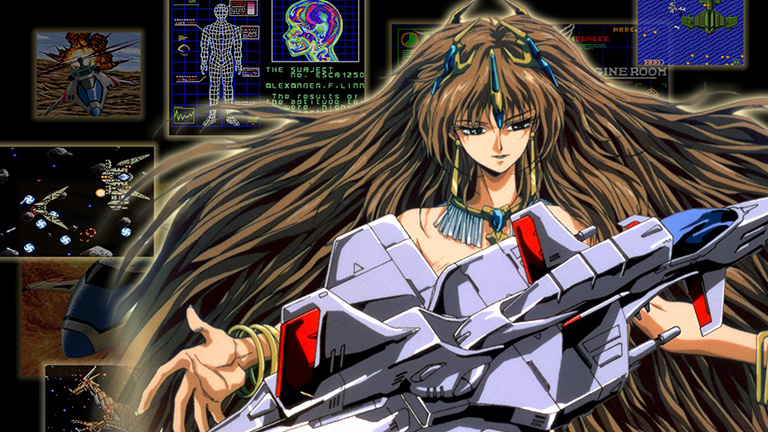
Toshima, Tokyo-based Telenet Japan was one of the quiet powerhouses of the 16-bit era. Although Kazuyuki Fukushima’s studio didn’t achieve the brand recognition of Sega or Capcom, they left a deep imprint on hardcore fans through their technical ambition and arcade-rooted design philosophy.
Comprised of various divisions such as Renovation, Wolf Team, and Lasersoft, Telenet spent the late ’80s and early ’90s delivering fast, mechanically involved action games that pushed the Mega Drive/Genesis hardware to its limits. The Telenet Shooting Collection serves as a historical snapshot of some of the company’s notable works. But those expecting a proper curation that details Telenet’s legacy will be disappointed by how barebones this compilation is.
Reclaiming VOLOS
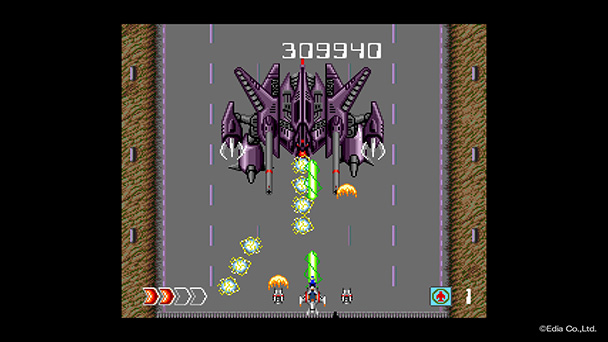
Avenger represents Telenet’s more traditional side, with the PC Engine CD title delivering a vertically scrolling shooter clearly inspired by Toaplan’s coin-op offerings. You’ll pilot a single futuristic helicopter through swarms of tightly packed enemies and bulky bosses, relying on twitch reflexes and a gun that can shoot at three angles as well as strafe. Power-ups alter weapon spreads and shot density, but survival depends more on dodging projectiles and pesky homing missiles that offensive might. Compared to the other titles in this collection, Avenger showcases Telenet’s early mastery of pacing, with a relentless enemy pressure that rarely lets up.
Taking Down Queen ZZ Badnusty
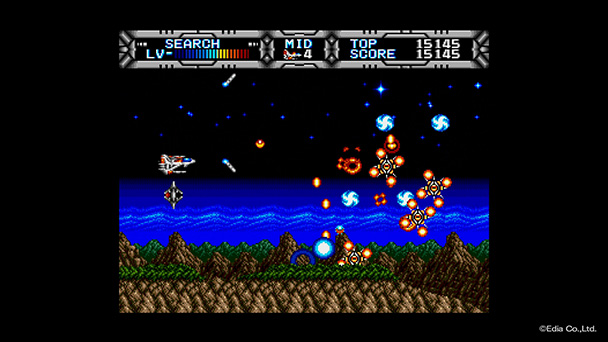
Gaiares is the crown jewel of the Shooting Collection and one of the developer’s most celebrated shooters, that’s known for its inventive TOZ weapon system. Instead of collecting standard power-ups, players latch onto enemy ships with a tractor arm to grab their weapons, harnessing their offensive capabilities. This mechanic creates an engaging risk-reward quandary where aggressive positioning can put you in the path of enemy bullets. The game’s speed, density of dangers, and escalating difficulty curve remain unforgiving while the layered parallax backgrounds and massive mechanical bosses continue to be visually stunning decades on.
Time, the Most Merciless Foe
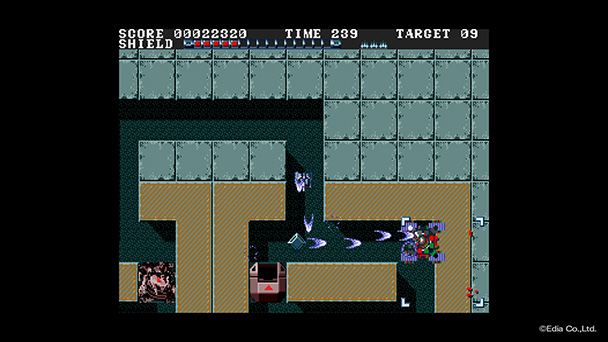
Granada takes a sharp turn from the high-flying chaos of the other entries by focusing on top-down, freely scrolling mech combat. Players control a heavily armored tank that’s tasked with navigating labyrinthine stages filled with roving enemies, turrets, and generators. Combat emphasizes strafing, ricocheting shots, and heavy use of secondary weapons like missiles and mines. The slower movement contrasts against the raw speed of the other shooters in the collection. But navigating the tiny walkways on the second stage remains a liability. Regrettably, the unforgiving timer is Granada’s most precarious foe.
Fly High, Solar Butterfly!
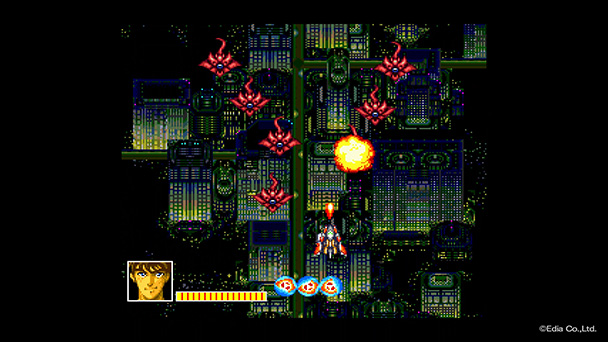
Rounding out the collection is Psychic Storm’s blend of traditional vertical shooting, where you’ll confront waves of biomechanical enemies across a series of tightly designed stages. The game’s most defining feature is its transformation system, which allows the four different playable ships to temporarily evolve into different insectoid forms. This shift alters both offense and defense, providing access to high-damage, screen-clearing psychic weaponry. The transformation is limited by an energy gauge, and you can extend the length of assault by collecting icons that are flung around the screen. Largely, this signature mechanic breaks up traditional pacing with bursts of overwhelming power. The result gives Psychic Storm a distinction that contrasts with more conventional CD-ROM² shooters.
Preserved, But Not Fully Remembered
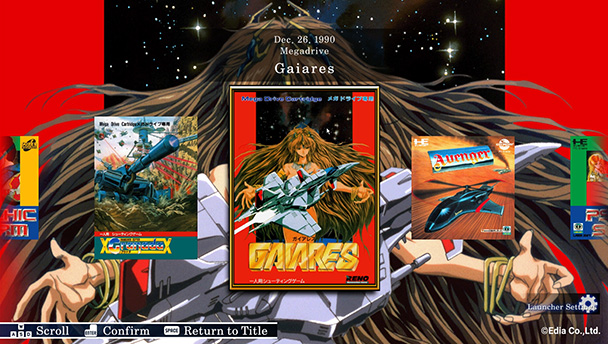
Telenet Shooting Collection’s quartet of titles can be purchased piecemeal alongside a free launcher or as a complete set. Save for a bug where bringing up the system menu on the Steam Deck changes the aspect ratio, the game emulation is competent. There are options for rewinding and fast-forwarding play, key remapping, a handful of CRT filters and the ability to look at control layouts and the original instruction booklets.
That said, translation of some Japanese in-game text is absent. Building on that, the collection delivers the original games with just a modicum of context. As such, Telenet Shooting Collection feels like a barebones preservation project rather than a compendium that truly celebrates the developer’s efforts.
Telenet Shooting Collection was played on PC with review code provided by the publisher.
Overview
GAMEPLAY - 75%
CONTROLS - 70%
CONTENT - 70%
AESTHETICS - 70%
PERFORMANCE - 65%
VALUE - 70%
70%
OK
The Telenet Shooting Collection delivers a quartet of standout shooters that still sizzle with speed, challenge, and mechanical ingenuity decades later. Unfortunately, the rather barebones presentation and missing historical context don’t provide a worthy celebration of Telenet’s legacy.