Sektori review
Pure Twin-Stick Intensity Plays Flawlessly on Switch 2

Undoubtedly, Sektori is a descendant from the golden age of arcade shooters. The game’s maniac intensity and vibrant particle effects can be traced all the way back to Robotron: 2084, through Geometry Wars’ mainline entries, and right into Housemarque’s Resogun and Nex Machina. As such, it’s not surprising that solo developer Kimmo Lahtinen spent 13 years at Housemarque’s Helsinki-based headquarters, before branching off to pursue his own creative ambitions.
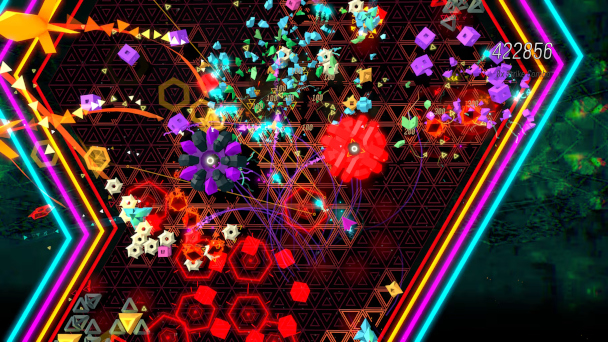
What is unexpected is just how expertly intertwined the solo developer’s own work is. Like its inspirations, each run in Sektori requires uninterrupted concentration as you evade dozens of on-screen foes, wearing down their numbers with a steady stream of firepower. But Lahtinen’s hook is just how gradual the intensity escalates. At the start of each playthrough, the challenge is manageable. But almost imperceptibly, the level of adversity creeps upward, thrusting you into the eye of Sektori’s chaotic storm. Like some of the best arcade-style outings, that can be a euphoric place to be, especially when you’re given some freedom over your loadout.
Calm Before the Bullet Storm
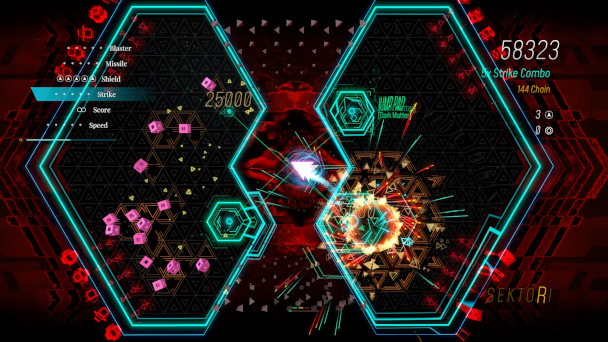
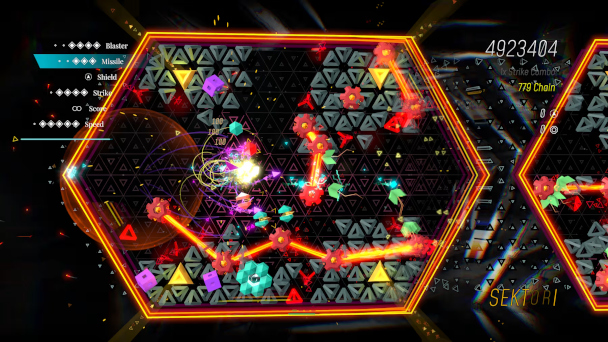
On a surface level, Sektori doesn’t veer too far from twin-stick tradition. You move your ship with the left analog stick, aim and fire with the right one, navigating a top-down arena where waves of geometric enemies continually spawn in. But like many skillful efforts, virtue is rooted in the systems stacked on top of these familiar foundations.
Undoubtedly, you’ll rely on the strength of your ship’s Strike ability. Here, a tap of the bumper rockets your ship forward, decimating any enemies caught in your path. While you’ll usually be limited by a cooldown timer that refreshes the ability after ten seconds, if you collide into one of the upgrade power-ups scattered around the playfield, you can instantly Strike again. With a bit of practice reading the arena, you’ll be chaining Strikes together, resulting in a gratifying, score-multiplying rush as you careen through crowds of enemies. Likely, you’ll grow overconfident, and Sektori has a lesson lined up for you.
Originality Meets Some Borrowed Concepts
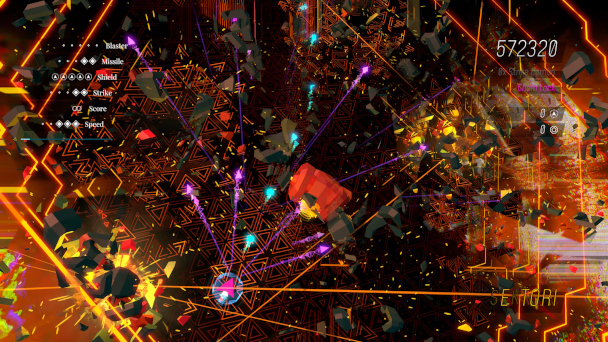
The game also boasts has a Gradius-style upgrade system (borrow from the best!) letting you collect these power-ups and spend them on improvements to your speed, firepower, missile, Strikes, shielding, and scoring. Layered on top of that is a roguelike Evolve system where you get to select from three cards that augments elements like your mobility, output, and ability to magnetically pull in pips left by defeated enemies. Cleverly, gathering ties Sektori’s gameplay systems, together providing power-ups as you risk your ship chasing down the floating blips.
These interlocked components are what elevates Sektori above many of its peers. You’re not just improving the ferocity of your firepower. Instead, the game provides quite a bit of freedom in how you customize your shape, and effectively shape each run. Pleasingly, you even get to select your starting deck, choosing from sixteen different options, eight of them unlocked through in-game achievement.
Bosses That Hit Like a Battleship
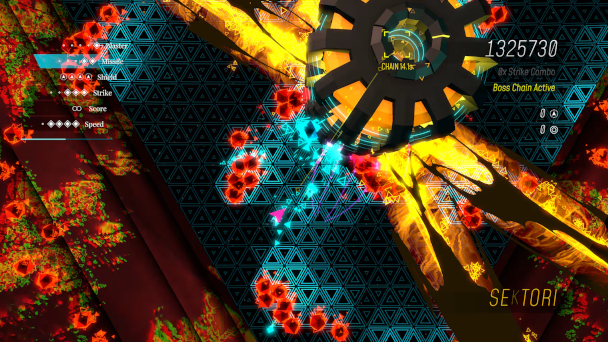
Expectedly, the main campaign is at the heart of the experience, with a succession of five stages that each culminate with a boss battle. These showcases provide plenty of spectacle as you face off again screen-sized foes that dispense plenty of projectiles and truly test your evasion skills. But these fights are exponentially tougher than tackling the hordes of foes that lead up to these counters. Sure, these showdowns are supposed to be a consummate text of skills that carry the threat of a quick ‘game over’. But Sektori truly kicks the difficulty up, and the first adversary you confront will probably humble you several (dozens?) times. It’s not a deal breaker, but just be aware of the escalation in intensity.
Fortunately, the campaign’s boss battles aren’t a progress blocker and you can unlock different modes outside of the main game. Here, six additional modes round out Sektori’s rather robust package. Classic keeps things lively with a wide array of mutators, while Surge shifts you between underpowered and overpowered states. In Crash, adversaries can only be defeated with Strikes, while Assault has you manually triggering enemies waves against a ever-advancing countdown clock. In Gates, adversaries can only be eliminated as you cross rotating laser posts, while Boss Rush rounds things out, with a succession of end-of-level fights. The latter is especially helpful in mastering Sektori’s toughest constituent.
A Switch 2 Showcase
Switch 2 owners will be happy to know that Sektori’s port was handled with deligence. Across more than ten hours of playtime both in docked and handheld more, I don’t recall witnessing a single blemish on the game’s 60 frame-per-second framerate. For a game where the screen is habitually filled with particle explosions, enemy swarms, shifting arena geometry, and cascading colors, that level of stability is truly impressive. Meanwhile, the game’s integration of HD Rumble 2 technology offers a subtle but tangible tactile detail while the loading times are near-instantaneous.
At $14.99 USD, Sektori represents the kind of value proposition that’s becoming increasingly harder to find. Beyond a campaign with variation across multiple difficulty tiers there are six distinct alternate play modes each with their own global leaderboards. With all this atop a title with plenty of mechanical depth and nuances to master, Sektori has a lot to offer. Best of all, Kimmo Lahtinen provides the kind of polish and attention to detail that the best games in the genre are remembered for, making Sektori an easy recommendation for anyone craving a relentless arcade-style shooter.
Sektori was played on Switch 2 with review code provided by the publisher.
Overview
GAMEPLAY - 85%
CONTROLS - 80%
CONTENT - 85%
AESTHETICS - 80%
ACCESSIBILITY - 70%
VALUE - 90%
82%
VERY GOOD
Sektori captures the rush of classic twin-stick shooters while adding enough customization and clever mechanics to keep every run exciting. Tough boss fights occasionally spike the difficulty, but the game’s silky-smooth Switch 2 performance and wealth of playmodes make it hard to put down.


Most other sites are scoring this in the 90s not the low 80s.