R-Type Dimensions III review
A Flashy Remaster that Betrays the Original Game’s Virtues

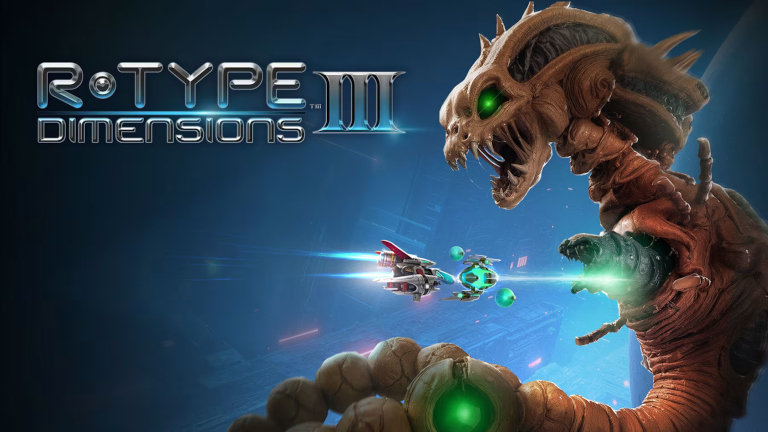
If a remaster isn’t going to be handled with obsessive care, it probably shouldn’t be undertaken at all. That’s especially true for a series like R-Type, a franchise built around precision and stage memorization. The series isn’t just something you can give a fresh coat of paint and some flashy lighting effects. No, every pixel, enemy pattern, and collision matters. Undoubtedly, IREM’s series is a seminal STG franchise, and deserves to be treated with respect.
Of course, 1993’s R-Type III: The Third Lightning on the SNES wasn’t just another shooter. Alongside Axelay, the cartridge was one of the more technically impressive efforts, with a multiutude of mechanics that made it one of the best console shooters of the era. At least part of that reputation stems from a design approach that was often brutally challenging, but always always fair. In order to maintain the balance, any kind of remake has to be meticulously made. And this is precisely what makes R-Type Dimensions III a frustrating disappointment. Underneath the flashy presentation is an update that doesn’t feel right. I can’t even speculate how the game made it out of quality assurance and wonder if testers actually played through the Fire Cask Factory and all the way through to the Galaxy of Abyss.
Is an Inadvertently Changed Game Still a Remaster?
In theory, Dimensions III should have been a slam dunk. 2018’s R-Type Dimensions EX showed reverence for its double-bill of shmup source material. Certainly, The Third Lightning had all of the essential ingredients for a modern remaster. From iconic stages, a trio of different Force mechanics, memorable and sufficiently tough bosses, the third mainline entry deserves a shot at engaging old and new fans. Undoubtedly, the ability to instantly swap between classic bitmapped visuals and modern 3D graphics helped justify the existence of Dimensions EX. It’s also one of the selling points of R-Type Dimensions III.
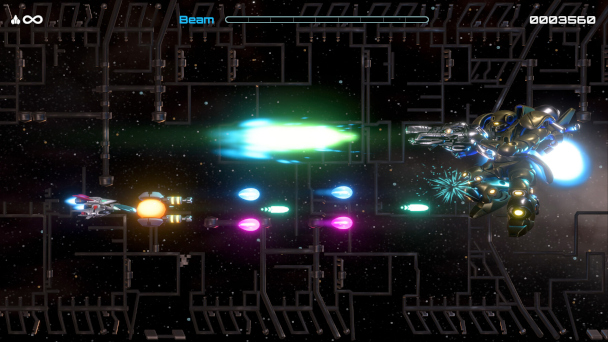
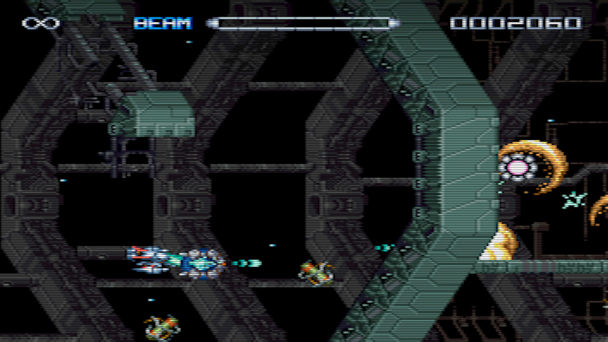
At first, the remake’s new textures, lighting, enhanced backgrounds, and rearranged soundtrack give the impressions that this just might be the definitive edition of The Third Lightning. Swapping between the two versions, there’s definitely some impressive work, with the update delivering a sheen that showcase how far gaming technology has advanced across 33 years. Harnessing wave cannon charges and the weaponry associated with the Shadow Force and the Cyclone Force (accompanying the traditional Round Force) produces a light show of neon streaks. But if you know the original well, imperfections start showing almost immediately and continue to plague the six-stage campaign.
Flashy Presentation Can’t Replace Exacting Design
Fundamentally, the main problem is that R-Type Dimensions III lacks the kind of exactitude that made the SNES game special. 93’s R-Type III was quite demanding, but it was precise, with each death from an enemy, bullet or environmental collision feeling justified. You learned enemy behavior through memorization, moving your R-90 fighter with the dexterity of a seasoned pilot. Here, something feels off almost all the time. Hit detection lacks consistency, environmental hazards aren’t as readable, and enemy interactions aren’t always correct.
Yes, I know this will probably sound petty to players who aren’t devoted to STGs. But for a game like R-Type, all these little issues can be devastating. When a collision feels suspect or a gap suddenly doesn’t act the way decades of practice have taught you, the sense of flow breaks apart. There were multiple moments where I found myself moving into spaces that were safe in the original game. But there, I found myself fuming from wayward bullets or terrain that didn’t conform to the original. The core problem here isn’t necessarily that the remake is harder. It’s that Dimensions III is inconsistent and relearning everything feels unfair.
Precision Lost Beneath the Visual Overhaul
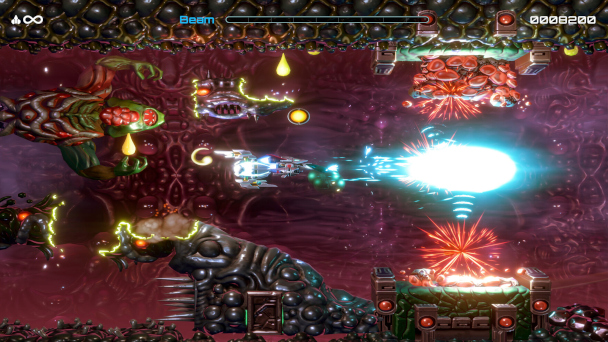
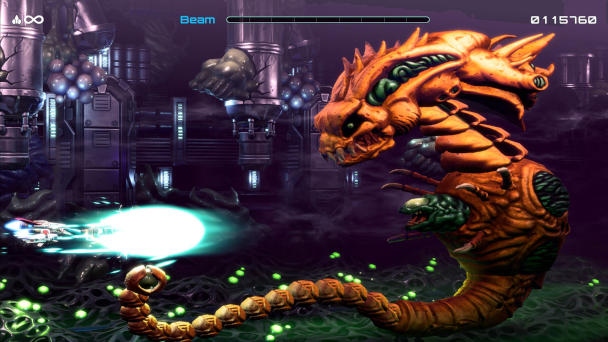
Sadly, the 3D presentation also creates some problems. Make no mistake, some stages are visually impressive with glistening metallic corridors and Bydo monstrosities with texture work that dial up on the disgusting. But R-Type wasn’t designed around this much visual spectacle. The original sprites boasted readability, which is essential given the game’s split-second, pixel-perfect R-90 positioning required to navigate fields of fire and claustrophobic corridors. With Dimensions III, enemy bullets, environmental hazards, and background effects can blend together into a busy mess. There’s some solid artistry but it feels undermined when it’s hard to read the action.
Stage 4 offers one of the most glaring examples of this. What was once a tautly constructed memorization challenge on the SNES, now suffers from the kind of visual muddle that impairs readability. The enhanced effects, layered backgrounds, and environmental detail scan make hazards and safe spaces harder to perceive during some of the stage’s more demanding stretches. I repeatedly found myself switching back to the original pixel mode not just out of nostalgia, but because it was cleaner and easier to read. In a precision shooter built around exact positioning, that shouldn’t happen in a remake.
Readability and Fairness Take a Hit
When the original game arrived, some critics noted how well The Third Lightning minimized slowdown. Sure, there was some, but the game fared better than most of its SNES-based rivals. Meanwhile, Dimensions III introduces several new instances of uneven performance, affecting both timing and responsiveness. Sure, you could argue that it doesn’t completely break things, but in a precision shooter, messing with the pacing can undermine the carefully crafted flow of dodging and taking down enemies. 33 years should bring nothing but improvement.
And that’s a recurring issue; it feels like a remake was created by people who might have admired R-Type III’s biomechanical aesthetics and thought that a modernization was needed. But they didn’t take the time to understand how the original game once captivated us. And that’s the thing; an update needs to truly appreciate the nuances of the source material. You shouldn’t notice tiny inconsistencies because there shouldn’t be any. Muscle memory from the original game should transfer seamlessly. Instead, R-Type Dimensions III reminds experienced players that they’re playing a sloppy rendition rather than a faithful recreation. This feels like listening to a cover band who doesn’t truly understand the allure of the songs they are trying to recreate. Unless Dimensions III gets a serious reworking, stick with the original. Hopefully, in another 33 years, we won’t have to endure slapdash reissues like this anymore.
R-Type Dimensions III was played on PC with review code provided by the publisher.
Overview
GAMEPLAY - 50%
CONTROLS - 70%
CONTENT - 55%
AESTHETICS - 75%
ACCESSIBILITY - 50%
VALUE - 20%
53%
LACKING
R-Type Dimensions III modernizes The Third Lightning with some flashy 3D visuals and enhanced effects. But inconsistent hit detection, readability issues, and altered collision behavior undermine the precision that made the original SNES shooter a classic. Visually impressive at times, the remake ultimately feels like a sloppy reinterpretation that neglects to preserve the exacting gameplay of the 1993 original.