Pool Room Billiard review
A Budget Break Shot that Mostly Sinks

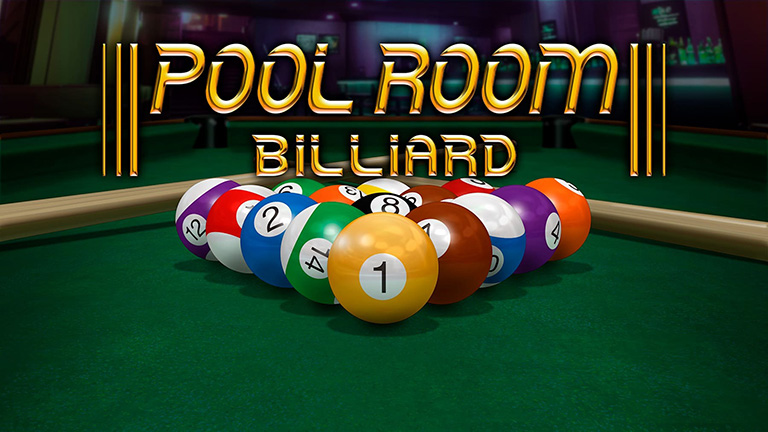
Pool Room Billiard recalls D3 Publisher’s old Simple Series titles. These modest, low-cost games were often built around familiar hobbies, as indicated by their unassuming titles. Like The Solitaire, The Billiards, or The Mahjong, Pool Room Billiard is designed to be affordable and accessible, offering a straightforward adaptation of the game rather than anything resembling a deep simulation.
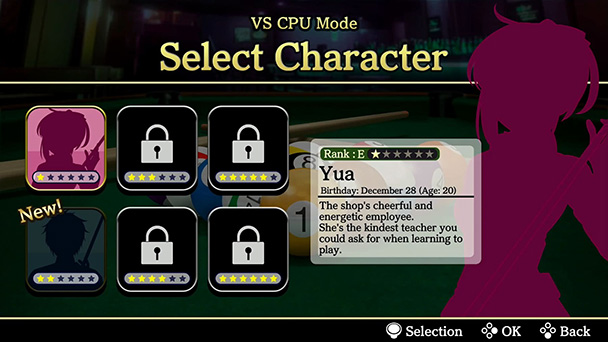
Undoubtedly, Billiard sinks its opening shot by delivering perks like multiple play modes, motion controls, and an attractive presentation set in a moody bar room. But it’s soon evident that the developers favored breadth over polish. Rivals are little more than names with anime portraits and single-player difficulty can only be adjusted by expanding your highlighted shot trajectory. Buy, hey, it’s a ten-dollar game on a platform where seventy-dollar titles are common.
Strong Opening Shot, Scratched on the Motion Controls
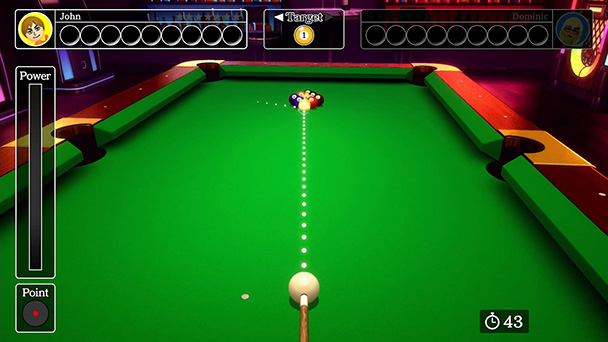
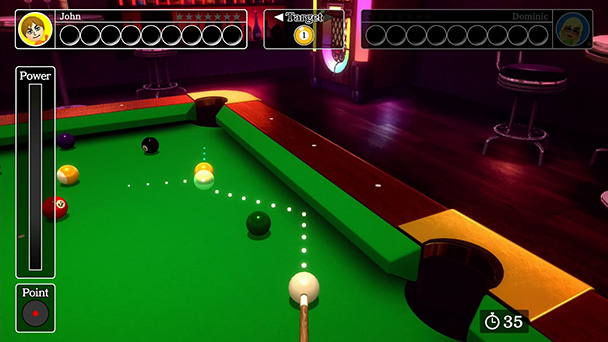
At the heart of Pool Room Billiard are the 8-ball and 9-ball rule sets which are rendered on fully 3D tables and balls that aim for convincing physics. Largely, roll, collision, and cushion behavior are realistic, although I did witness some incredulous physics during a multi-ball impact twice. Replays employing dynamic camera cuts strive to add a bit of drama, but whether they enhance the game or just break the flow might be a contentious issue. Unquestionably, Developer ITL should trim the chore of having to watch those last few sub-millimeters of movement.
Billard’s different control schemes can utilize either standard Joy-Con 2 input or mouse controls. Ether way, you’ll line up your cue, adjust your aim and optionally add some English, and then physically draw back and follow through on each shot. But after a few games, you might find physical controls to be a bit gimmicky. In execution, pushing the mouse forward doesn’t feel all that different from tapping a button, so don’t head into Pool Room Billiard expecting Wii Sports-style interaction.
Cue Up with a Button Press or Mouse Push
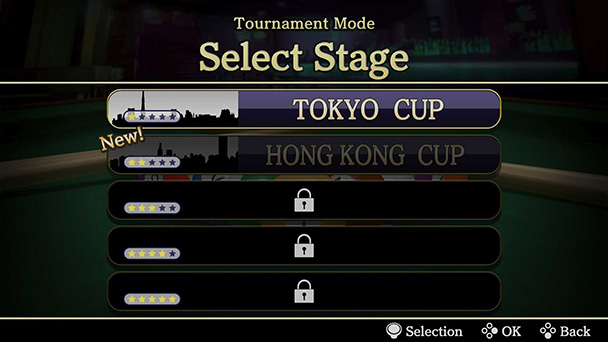
Beyond its digital recreation of perfectly maintained table surfaces, Pool Room Billiard also excels by giving players several different modes. Solo players can choose VS COM matches and a Tournament Mode that strings games together into brackets. But playing against the AI is an uneven experience than bounces between near break-and-runs and missing gimmes. And while it’s a budget title, I can’t help but long for some visual variety, especially as you’re climbing the ranks across a succession of tournament brackets.
Online play is one of Pool Room Billiard’s boldest promises, with Quick Match for instant games and Room Match for custom rules, private or public lobbies, and optional filters. The good news is that you can tackle the AI while you wait for matchmaking, which makes the waiting bearable. The bad news is that, at present, the game’s servers are empty. Four different instances across the day and night didn’t set up with a single challenger.
Racking Up Modest Fun for Pocket Change
Despite some rough edges and lingering complaints, Pool Room Billiard still manages to be an easygoing and mildly satisfying way to kill some time, especially when you keep its ten-dollar asking price in mind. It doesn’t aspire to be a hardcore simulation or a feature-stuffed online hub. But as a modest billiards experience it delivers enough charm and competence to justify a few casual racks. More importantly, it rekindles the spirit of D3 Publisher’s old budget lines, suggesting there’s still room on modern platforms for compact, affordable games that prioritize approachability over spectacle. If Pool Room Billiard is any indication, there’s reason to hope D3 will continue rolling out these unpretentious, wallet-friendly curios in the future.
Pool Room Billiard was played on Switch 2 with review code provided by the publisher.
Overview
GAMEPLAY - 65%
CONTROLS - 60%
CONTENT - 75%
AESTHETICS - 70%
PERFORMANCE - 70%
VALUE - 80%
70%
OK
Pool Room Billiard isn’t an abundant adaptation, but it offers a laid-back, competent take on 8-ball and 9-ball that’s enjoyable in short bursts. For ten dollars, its mix of decent physics, multiple modes, and old-school budget charm makes a few rough edges easy to overlook.





I remember the Simple 1500 and 2000 games. They should bring those back.