Monster Crown: Sin Eater review
A Darker, Smarter Monster RPG That Finally Raises the Stakes

Pokémon Scarlet and Violet were undoubtedly competent. And by most accounts, Legends: Z-A is a slightly more ambitious effort from Game Freak. But something has been missing from the mainline series for a long time. Recent entries struggle to convey a sense of tension, where the stakes feel real and there’s a lingering feeling on uncertainty. Instead, the franchise seems to have coasted on familiarity, diminishing the thrill for longtime fans.
Yes, I’d argue that the (official) series hasn’t felt fresh since the Game Boy Advance era. Unofficially, fan-made rom hacks like Pokémon Unbound and Pokémon Lazarus have revisited and remixed the franchise’s peak. And certainty, Monster Crown: Sin Eater injects enough good ideas to make Studio Aurum’s sophomore outing a worthy trek for taming fans. Best of all, the developer isn’t trying to merely copy Game Freak’s formula. Sin Eater is its own thing that’s darker in tone, more structurally ambitious, and built by people who’ve thought deeply about what makes the monster-genre work and what makes it ‘not very effective’.
Not Your Typical Saturday Morning Monster Taming Tale
Sin Eater’s opening introduces us to Asur, a young farmer whose older brother has been away for years working as a monster tamer. Pleasingly, there’s genuine warmth to the premise, with a larger text window helping to flesh out dialog between a worried mother and a reunion between siblings that feels overdue. In front of a campfire, Dyeus tells Asur of an imminent threat to Crown Nation that not even the authoritarian leader Lord Taishakuten can stop. The introduction ends with Taishakuten’s goons busting into the family home to seize Dyeus, killing his beloved monster, before propelling Asur to step up and take action.
Largely, it’s a more compelling set-up than most genre entries. And I appreciate how Sin Eater isn’t interested in lighthearted adventure. Instead, Studio Aurum channels some of the darkness of Digimon, offering a trek that’s more in line with contemporary RPGs. Yes, there’s a harshness in Crown Nation’s world that feels suited for contemporary audiences bored by cartoonish villainy.
So Long, Tall Grass Ambushes
Sin Eater also finds distinction with a branching structure. Rather than undertaking a linear quest, the game presents Asur with intriguing choices about who to trust and who to align with. Pleasingly, these aren’t the kind of window dressing of most role-playing games. Each character that Asur bonds with can push the storyline in markedly different directions, rewarding replays and giving the world a sense of complexity. Much like the real world, I wasn’t quite sure who to trust and who to revile and there’s enough character complexity to produce uncertainty about your decisions. I appreciated how Studio Aurum’s script doesn’t simplify personalities.
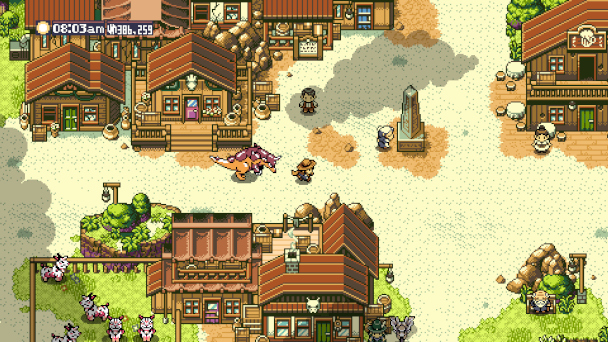
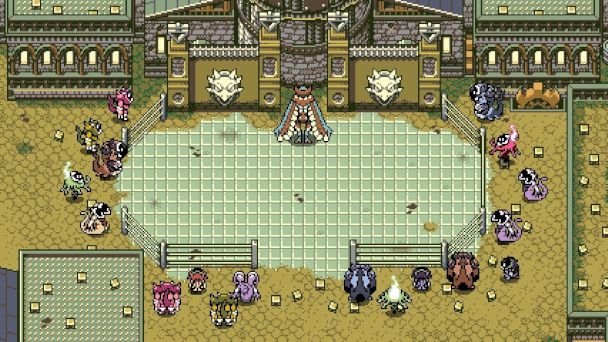
In a welcome departure from the genre’s random encounters, Sin Eater populates its world with visible monsters. Some are aggressive and will chase you down; others are passive and will be largely indifferent to your presence unless you provoke them. It’s a small thing, but it makes the world feel more alive and gives exploration tension. Navigating a field while watching a territorial creature patrol and protect it’s habitat feels quite different from stumbling on creatures hiding in patches of grass.
Freedom to Roam, and Occasionally Get Lost
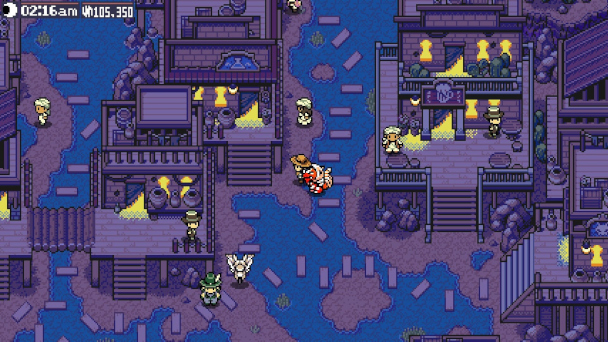
Gratifyingly, the world itself is largely open, complementing the game’s other divergences from creature-taming tradition. That said, Sin Eater could use slightly more subtle signposting. The freedom can occasionally flirt with a lack of direction and several times I was uncertain about where I should head to next. But know that this is a minor complaint against an otherwise well-designed overworld, worth noting for those accustomed to clearer direction.
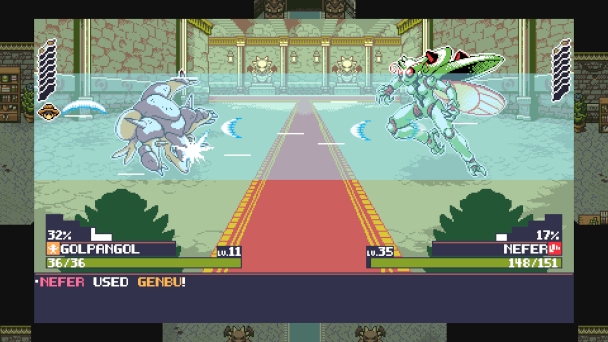
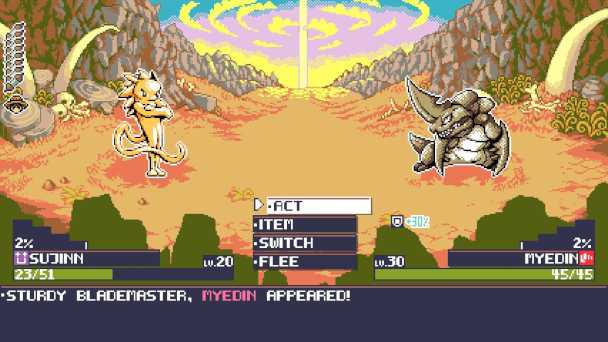
Combat builds on the familiar rock-paper-scissors foundations with five different elemental types, alongside the usual system of resistances and strengths. What lifts it above the genre standard is the inclusion of the Synergy system. Dealing and receiving damage builds a this meter. Fill it enough and you can unleash the game’s eponymous Crown, a state that dramatically boosts your moves and can shifts the momentum of battle. It adds a rhythm to fights that feels satisfying to manage, turning those basic encounters into something worth paying attention to.
Bosses That Bite Back
Bosses are where the combat system truly thrives. They aren’t stat-padded walls. Instead, they test your team’s composition, your understanding of the elemental system, and your willingness to have cultivated your monsters beyond their base forms. If you’ve relied on brute-force approaches, you’ll probably find yourself reconsidering your roster, at least on the highest of a trio of difficulty settings. If you’d rather not be challenged, the lowest one lets you follow Sin Eater’s story without too much burden.
Your roster can be assembled and refined through fusion and breeding systems. Basic fusion is available for players who want a streamlined experience: combine two monsters, watch parent qualities merge, and the result is a ready-to-fight monster. But for those willing to go deeper, the breeding system opens up into genuine complexity, with come control over inherited abilities that rivals dedicated mechanics in other titles. With over 200 base monsters that carry their own identities, few of which feel like Pokémon rejects or failed imitations, the pool you’re working with is both large and genuinely varied.
Retro Looks and Modern Clarity
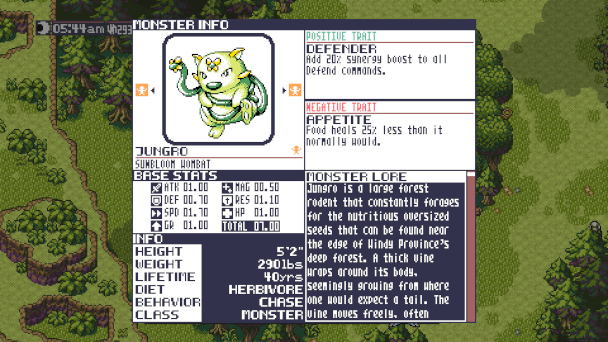
Visually, Sin Eater looks like an upressed GBA game rendered in widescreen. Depending on your disposition toward that era, could be either a charm or a limitation. For those who grew up on FireRed and Emerald, it’s unambiguously the former. The spritework is clean and evocative, and the wider aspect ratio gives battles and exploration some more room to breathe. The UI is generously stocked with on-screen data for stat-oriented players who want to know exactly what’s happening at every moment. Best of all, it’s thorough without being overwhelming.
Overview
GAMEPLAY - 80%
CONTROLS - 75%
CONTENT - 80%
AESTHETICS - 75%
ACCESSIBILITY - 80%
VALUE - 80%
78%
GOOD
Sin Eater brings real stakes and smart systems back to monster taming, with a darker edge that actually lands. It’s not perfect and you’ll probably get lost in it’s open world. But the game’s ambitions and depth land push it away from Game Freak’s familiar foundations.



Just want to chime in and ask if you’re played Pokemon Emerald Rogue? It’s another good rom hack.
Haven’t heard of this kind of bootleg Pokémon.