Dead or Alive 6 Last Round review
Definitive Edition Diluted By Some Publisher Decisions


Over the last three decades, Dead or Alive has earned a reputation as a fast and flashy fighting game franchise. Since its arcade debut in 1996, Team Ninja’s 3D fighter has forged its identify around a rather elegant interpretation of fighting, a roster whose personalities are as recognizable as their fighting styles, and some of the flashiest stage interactions around.
With its three button input system, the game was often compared to SEGA’s Virtua Fighter. But Dead or Alive sought distinction with a triangle system built around strikes, throws, and holds. At its best, the series is immediate and readable, with a volatile undercurrent that can flip a match at almost any moment. While a newcomer can bask in the thrill of reversing a punch after a few minutes, veterans can spend years learning advantageous techniques such as timing, spacing, and wall pressure. Few fighting games have both the approachability and nuance of Team Ninja’s series, even if modern entries have grown to a five-button control scheme.
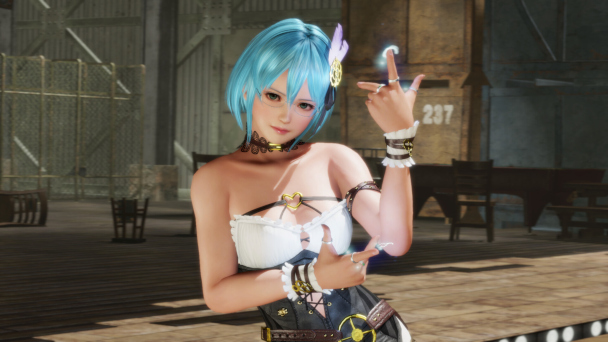
Expectedly, the release of Dead or Alive 6 Last Round strives to be the definitive version of Dead or Alive 6. And in many ways, the title deliver a fuller version of a already robust fighter. Unfortunately, it also inherits some of the original game’s problems while adding a few frustrating business decisions of its own. If you remember when the second release of a fighting game bundled everything and adding player-requested features into a requisite package, Last Round might disappoint. In 2026, greatest hits re-issues come with caveats. But let’s discuss some of the positive attributes first.
Kasumi and Company Still Kick Sinuously
The one thing I love about Dead or Alive is that the franchise isn’t built around long-distance zoning or elaborate quarter-circle inputs. Unsurprisingly, Dead or Alive 6 sustains that philosophy, emphasizing close-quartet reads, lightning-fast punishment, and understanding the elusive dynamic between offense and defense. Yes, the signature triangle is still at the heart of the game, with strikes beating throws, throws beating holds, and holding countering strikes.
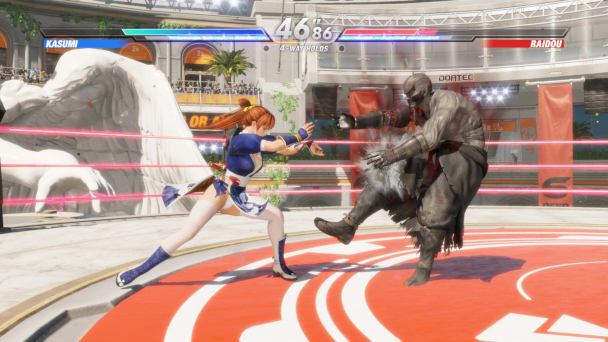
That rock-paper-scissors system might sound simple, but Dead or Alive 6 elevates things with the incorporation of timing windows, directional holds, stun states, environmental hazards, and character-specific launchers. The result is a fighter where momentum can and usually does swing, making every match feel dynamic. A player who’s too predictable can be caught with a clutch hold. A defender who stumbles with a hold can be easily thrown. And a reckless attacker will often find themselves bouncing off a wall, breaking through a floor in a multi-tiered stage. Thirty years on, it’s still humiliating.
Breaking Blows, Not Traditions
One of the biggest innovations in Dead or Alive 6 is the Break Gauge system. It’s a meter positioned below your health bar and that begins each match half-full and provides three new opportunities. The Fatal Rush is probably the most beginner-friendly option, where pressing a button multiple times performs a simple but effective combo, that ends with a Break Blow if your gauge is at capacity.
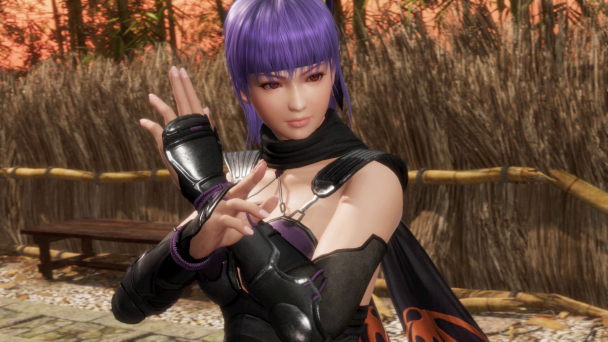
This Break Blow is a powerful strike that can parry your opponent’s attack, effectively making it DOA6’s super. Then there’s the Break Hold, which costs half your gauge and allows you to parry any type of strike: high, mid, or low. It’s a notable departure from the series’ directional hold system, where guessing wrong meant you’d be on the receiving end of a health-depleting combo. Taken together, these mechanics add additional possibilities on top of the series’ engaging triangle system. Best of all, they fit with the series’ school of thought, rewarding aggression while punishing recklessness.
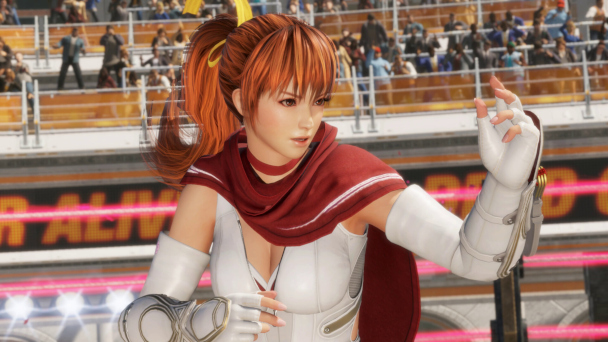
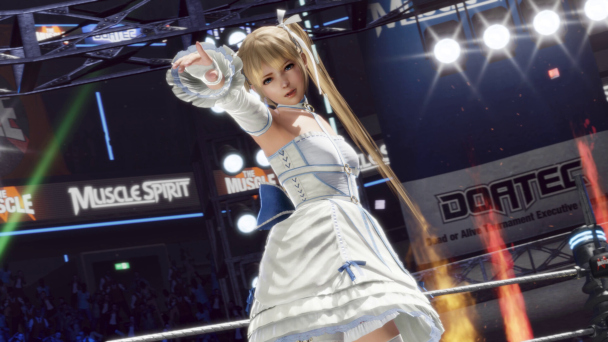
Beyond the Break system, DOA6’s engine received a overall that remains impressive. Fighters reveal visible damage across the course of a match, the sweat effects from Dead or Alive 5 return in more noticeable form, and blood effects can be adjusted or disabled entirely in the options. Clothing tears when performing a Break Blow, while hair might come loose mid-fight. Stages have the trademark Danger Zones, where knocking opponents into cars, transformers, and barriers flaunts shows off the game’s physics and animation components. Last Rounds doesn’t offer any real improvements to the visuals, but it’s still a gorgeous looking fighter.
Mai Oh Mai, Why Weren’t You Included?
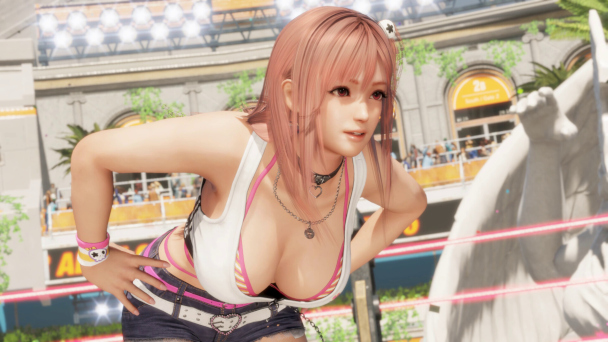
Last Round‘s flaunts 29 playable characters, adding five fighters who were originally offered as DLC for the original release Nyotengu, Phase 4, Momiji, Rachel, and Tamaki. The original 24 provide a pleasing cross-section of fighting styles with Kasumi and Hayate showcasing ninja agility, Jann Lee bringing Jeet Kune Do’s combination of adaptability and aggression. Christie rewards patience, Diego brings a bit of gruff, while NiCO’s electro-shock gloves and stun-locks make her a good choice for newcomers.
The five returning additions complement this roster well, with Rachel’s powerful mix of grapples and launchers, Momiji’s ninjutsu/aikijutsu-styled strikes. Phase 4 plays like Kasumi, but swaps precision for a higher damage output that perfect for high-risk/high-reward types. At 29 fighters there is no shortage of variety here, and the costume DLC carries-over from the original release. That said, paid hair color DLC doesn’t, which seems like it would have been an easy transfer.
Of Glamour and Greed
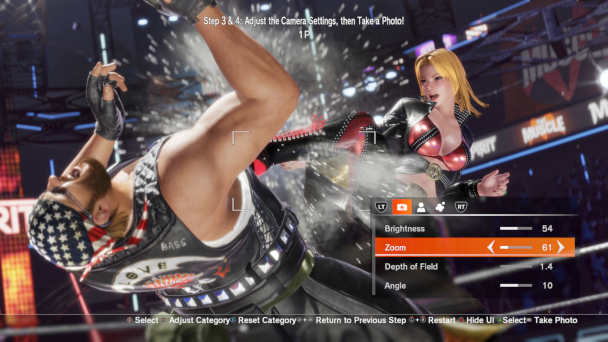
Photo Mode is Last Round’s new feature. The mode gives players a full suite of tools including character position control and pose selection, letting you freeze fights at any moment and create screenshots. There’s a lot of granularity involved, allowing you to adjust camera angle, depth of field, and lighting. Given the quality of DOA’s character models and the franchise’s rabid fanbase, Photo Mode is the kind of addition that should have come sooner. Best of all, it works seamlessly in practice, with an interface that provides shooting options without being convoluted.
Sustaining a worrisome trend, Team NINJA and Koei Tecmo have made some choices around Dead or Alive 6 Last Round that are genuinely difficult to defend. Owners of the original Dead or Alive 6 receive no discount or upgrade path to Last Round. If you bought the game in 2019, played it for years, and perhaps dropped money on DLC, you are starting from scratch at full price. That’s a bitter pill, and the lack of any acknowledgment from the publisher makes it worse.
Compounding this is the absence of cross-platform multiplayer. Yes, Dead or Alive 6 Last Round launches with no cross-platform play, further fragmenting a fighting game community that has never been enormous to begin with. What makes this particularly egregious on PC is the timeline: the Steam version of the original Dead or Alive 6 was delisted two weeks before Last Round‘s launch. PC players still play the original game cannot buy any DLC if they wanted to, and they also can’t play online against Last Round owners. These aren’t accidental oversights, but a snub for DOA loyalists.
Then there is the roster situation. While five previously-released DLC characters are included in the base package, the two most high-profile guest additions are not among them. Mai Shiranui and Kula Diamond will be paid downloadable content and are not included with the standard edition of Last Round. After nearly a decade, having to pay again for guest characters to fill out your definitive edition feels like the series’ longstanding DLC problems (that $1000+ DOA5LR DLC!) following it into the next chapter.
Definitive, But With an Asterisk
Yes, Dead or Alive 6 Last Round is the best way to play what remains an engaging and energetic 3D fighter. Its Break system holds up, its roster is deep, and Photo Mode is a welcome addition to a franchise that has always flaunted the fighting genre’s sexiest visuals. For players who are new to the series, this is an excellent entry point. For veterans who already own the original release, Last Round asks you to pay again, play in a smaller cross-platform pool, and pay once more if you want to play with its famous guests. I’m hoping, Dead or Alive 7 favors mechanics over monetization.
Dead or Alive 6 Last Round was played on PC with review code provided by the publisher.
Overview
GAMEPLAY - 75%
CONTROLS - 80%
CONTENT - 75%
AESTHETICS - 80%
PERFORMANCE - 70%
VALUE - 60%
73%
GOOD
Dead or Alive 6 Last Round is still a great fighting game, with its smart mechanics, deep roster, and a new Photo Mode. But as a definitive edition, the lack of any upgrade path, missing guest characters, and fractured online community make it harder to celebrate without some significant reservations.



I know they’re trying to entice new players but separating the online community was a stupid move. Not going to support them as much as I like DOA.
I used to love DoA. But the monetization made me jump off. Never came back and moved on to Tekken and SC, which are nearly as bad.