Demeo x Dungeons & Dragons: Battlemarked review
Crits, Clutches, and a Few Minor Complications

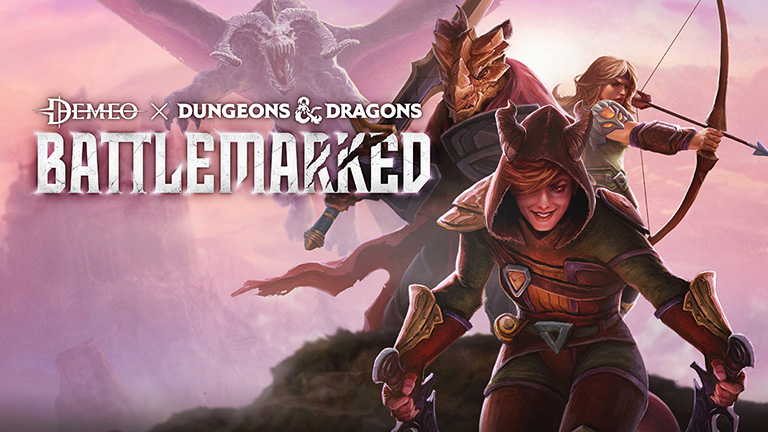
When Resolution Games released Demeo in 2021, the game felt like a welcome homage to tabletop dungeon crawling. The recreation of miniatures, dice rolls, and turn-based tactics stripped away intimidating elements like having to study a rulebook before you could play. In its place was a wonderfully tactile, almost toybox-like experience as adventurers moved across digital dioramas.
That foundation of accessibility, bite-size campaigns, and built-in support for multiplayer parties made Demeo an obvious candidate for a crossover, so it’s no surprise that Demeo x Dungeons & Dragons: Battlemarked builds directly on that blueprint. The game first launched on PS5, PC, and Meta Quest back in November 2025. Now, it’s made the jump to Nintendo Switch 2, letting you carry the Forgotten Realms around in your backpack.
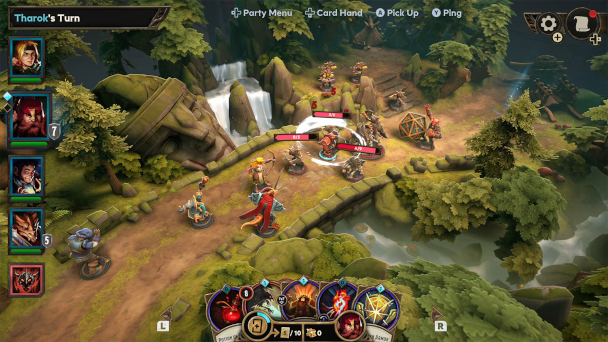
Six Heroes, Zero Custom Builds
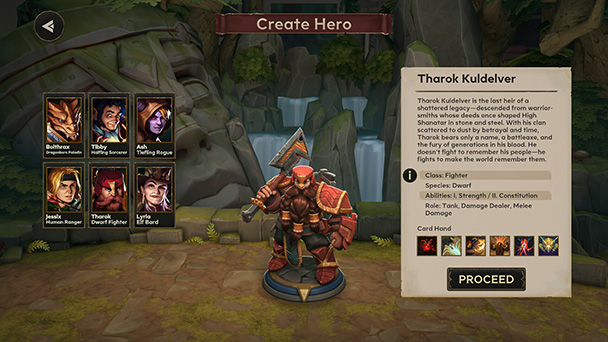
Demeo made the unconventional decision not to let players build their own party members from scratch, and that holds true here. Rather than assembling a hero from a stat block, you’ll draft from a roster of six classic D&D classes, Paladin, Fighter, Rogue, Ranger, Sorcerer, and Bard, at the start of each campaign. Players expecting the kind of granular character creation the Dungeons & Dragons name might imply will be disappointed; this is closer to picking a board game piece than filling out a character sheet.
Any seats not filled by human players get handed to AI-controlled heroes, and the game does a reasonable job balancing the party composition for you. Still, if you want to hand-pick your own four-person lineup, Battlemarked lets you. Just know that a mismatched party (say, three spellcasters and no one up front) is one of the fastest ways to a disheartening wipe.
Cards, Levels, and Yes, Actual Skill Trees
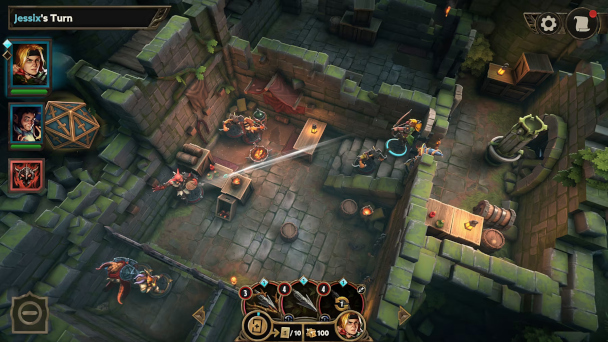
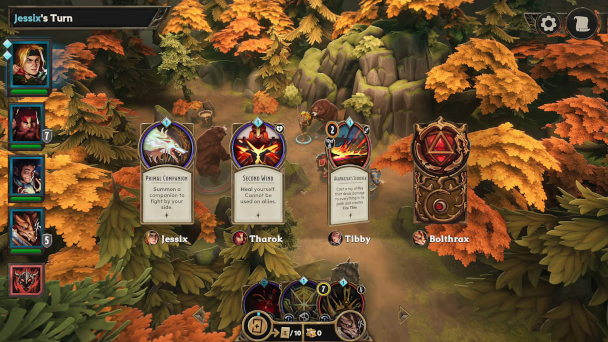
The combat system is still built around an ever-shifting hand of cards rather than a traditional ability tree, and that part hasn’t changed from Demeo. Each class has a deck that reflects its identity: the Paladin draws guard stances and smite-style attacks, the Rogue gets positioning tricks and backstab bursts, while the Sorcerer cycles through elemental blasts and buffs. On your turn you’ll spend two action points on movement, attacks, or skills. Because your hand refreshes gradually rather than resetting between fights, there’s a persistent sense of momentum that mirrors an actual tabletop session.
What’s new, and what the marketing highlights, is that Battlemarked adds genuine persistent progression on top of all this. Heroes now level up and put points into skill trees across a run, carrying that growth between sessions rather than resetting each time you start a new dungeon. It’s a smart fix for one of Demeo‘s longest-standing complaints (where your archer at the end of a run was identical to your character at the start), and it gives the cards more long-term weight: a failure-prone Rogue can grow considerably more reliable a few hours in.
Two Campaigns’ Worth of the Forgotten Realms
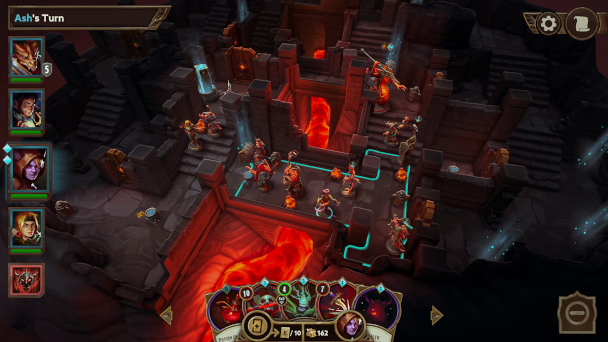
Battlemarked includes two full story campaigns, Embers of Chaos and Crown of Frost, plus a handful of shorter modules, amounting to roughly twelve hours of story content. Embers of Chaos sends your party into Neverwinter Wood to unravel a goblin conspiracy that leads down into the volcanic depths beneath Mount Hotenow. Crown of Frost picks up afterward in Icewind Dale, where a frost giant uprising has armies massing at Frost Keep, and your party treks from the settlements of Ten Towns into the Spine of the World.
Both campaigns include Forgotten Realms lore, from recognizable locations to references longtime D&D players will catch, while still being approachable enough for newcomers who’ve never opened a Player’s Handbook. Resolution Games proves itself a capable Dungeon Master here, with more narrative dialogue and voiced exposition between fights than you’d expect from a digital dungeon crawler, and each campaign feels like a self-contained legend rather than a loop you repeat for loot.
Solo, Co-op, and Crossplay
Battlemarked is playable solo, with the AI filling out your party, but it’s clearly designed with co-op in mind. There’s support for up to four players, with crossplay across platforms, so your Switch 2 party can link up with friends on PS5, PC, or even the Meta Quest. Going solo turns combat into more of a puzzle to be solved methodically. Meanwhile playing with friends brings the chaos and “wait, why did you do that” moments that make play an event. But just a heads-up for groups: there’s enough story and voiced dialogue here that everyone at the table needs a bit of patience between encounters.
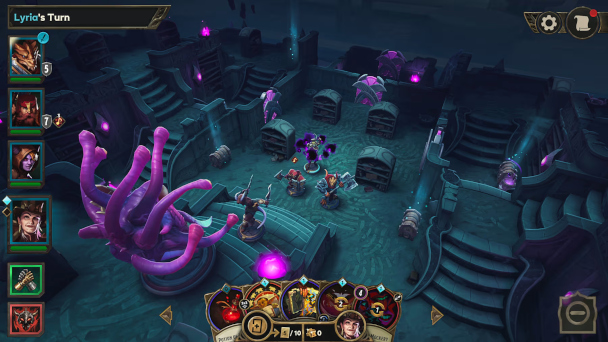
On Switch 2 specifically, the appeal is obvious. This is the kind of game built for handheld sessions, whether you’re playing solo on a commute or passing a Joy-Con around the living room for a local game night. The trade-off is that Battlemarked’s camera, which gives you full rotation and zoom control to frame each encounter, can be finicky on a smaller screen. Occasionally your view gets blocked by a wall, or the camera simply won’t swing around an object the way you’d expect. The same annoyances that were noticeable on PC and console and haven’t been fixed.
A Few Stumbles in the Dungeon
Another recurring issue is the dice. Battlemarked‘s D20 rolls determine everything from attack success to skill checks, and the randomization can feel punishing. Brutal runs of consecutive misses can sap the fun right out of the game. Specifically, I’ve encountered several stretches of critical failures that strained statical believability. When a failed roll can result in friendly fire or a wasted turn, a bad streak can ruin an otherwise great encounter through no fault of your own.
None of this sinks the experience, but it’s worth going in aware: Battlemarked is still Demeo wearing a Dungeons & Dragons armor. If you came in hoping for a full tabletop RPG experience with deep character building, you’ll find something more streamlined, but also faster, more replayable, and considerably more story-driven than Demeo ever was.
Rolling a Nat 20 on Fun, Despite a Few Fumbles
Demeo x Dungeons & Dragons: Battlemarked doesn’t try to recreate every dice roll of a real D&D session, but it delivers a dose of tabletop adventuring that’s fast, replayable, and fun. The new skill tree progression gives the card combat real staying power, the two campaigns are confidently written, and the Switch 2 port makes it easier than ever to gather a party. Camera quirks and the occasional dice-roll snafu keep it just short of essential, but whether you’re a longtime D&D veteran or a newcomer drawn in by Demeo‘s approachability, there’s a lot here worth rolling for.
Demeo x Dungeons and Dragons: Battlemarked was played
on Switch 2 with review code provided by the publisher.
Overview
GAMEPLAY - 80%
CONTROLS - 75%
CONTENT - 75%
AESTHETICS - 85%
PERFORMANCE - 75%
VALUE - 75%
78%
GOOD
Demeo x Dungeons & Dragons: Battlemarked swaps character sheets for card decks and delivers a quick, tactical dungeon crawl that thrives on clever teamwork and fast decision-making. Its streamlined design, diorama-style visuals, and strong storytelling make every run gratifying, even if the camera and fickle dice occasionally crit-fail your patience. That said, this is one digital adventure that routinely rolls with advantage.




Any additional or exclusive Switch 2 content?
Nope, same as the Steam version ASAIK.