Mexican Ninja review
Ninja, Narkuza, Naughtiness, and Some Numbing Repetition

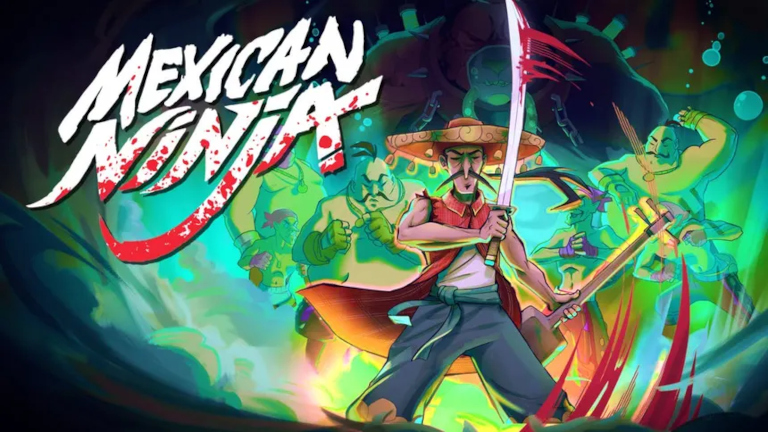
Grindhouse movies were rarely celebrated for their technical polish. All too often, their limited budgets were visible in the shoddy sets, awkward edits, and performances from second-string actors. But they were frequently fun and just a bit subversive. Best of all, they took chances that bigger productions didn’t.
Developer Madbricks understands that games should take more chances, too. Mexican Ninja certainly does with its setting. The game imagines an alternate history where Japan invaded Mexico with giant robots, blending the two cultures and transforming the capital into Nuevo Tokyo. Eventually, narcos merged with the yakuza to create the Narkuzas, a criminal ruling class that now controls the government and the streets.
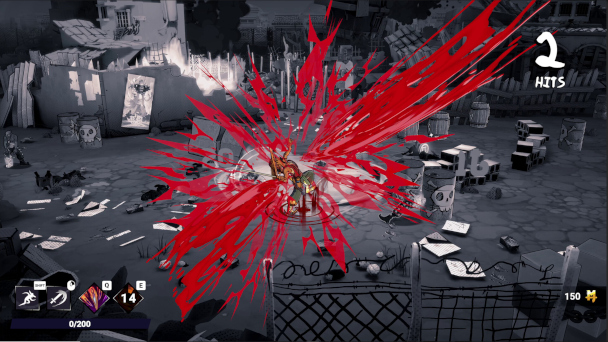
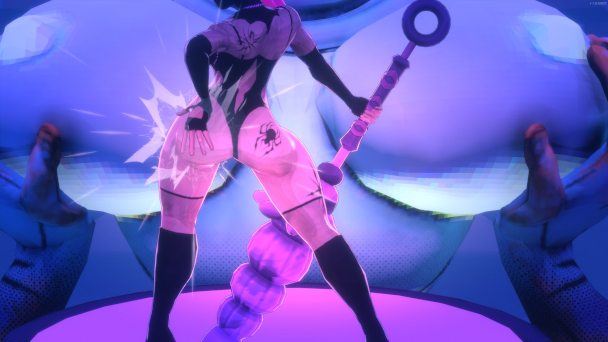
The writing is rarely worried about offending anyone. From using a butt plug as a weapon to jokes involving intoxication, sex, bodily functions, and insults in multiple languages, there’s an impishness that once playful franchises like Saints Row have largely abandoned. Unfortunately, its fighting doesn’t always exhibit the same fearlessness. Although roguelite systems inject a bit of variation, Ninja’s brawling eventually feels a bit too basic.
Welcome to Nuevo Tokyo, Pinche Cabrón!
You play as Juan, the game’s eponymous hero, although he fights more like a samurai than a stealthy shinobi. Armed with a katana and shamisen, the so-called “Chosen Juan” joins a small resistance determined to eliminate the five leaders of the Narkuza clan. Like any good grindhouse protagonist, he plans to topple an entire regime one mutilated henchman at a time.
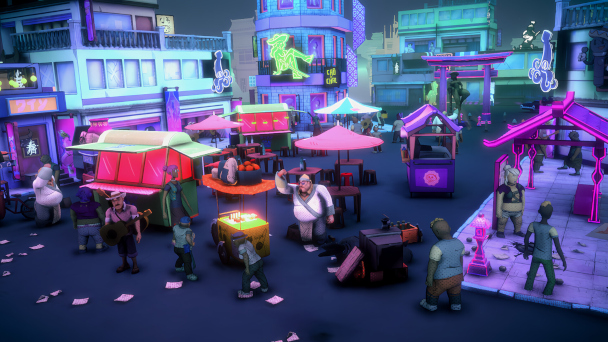
The lightweight story is told through animated comic panels, dialogue bubbles, and brief conversations that keep the pacing taut. There isn’t much depth to be found, and the opening drops you into the conflict rather abruptly. Still, the premise provides all the justification needed to cleave through gang members, cybernetic soldiers, robots, mutant pandas, and other Nuevo Tokyo oddballs.
The jokes are unabashedly juvenile, thanks to a script that finds humor in sex, drugs, flatulence, and some bilingual profanity. Some of the better gags rely on familiarity with Spanish slang. Other punchlines, including repeated jokes about Juan’s mother and bosses making sexual comments about his sister flirt with being crude. But given how overly sanitized many games feel, Mexican Ninja can still resemble a spicy plate amid a buffet of industry blandness.
Enter the Chingadazo
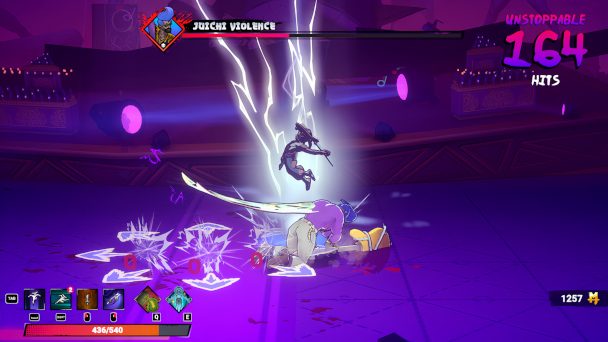
Combat starts with a modest set of tools: light strikes, a heavier chingadazo, jumping, dashing, and parrying. These become the foundation for launchers, rushing combinations, jumping slashes, aerial follow-ups, projectile deflections, and enemy juggling. The tempo is brisk without becoming uncontrollably fast, allowing you to prioritize ranged attackers, shield carriers, resilient lieutenants, and isolated low-level thugs.
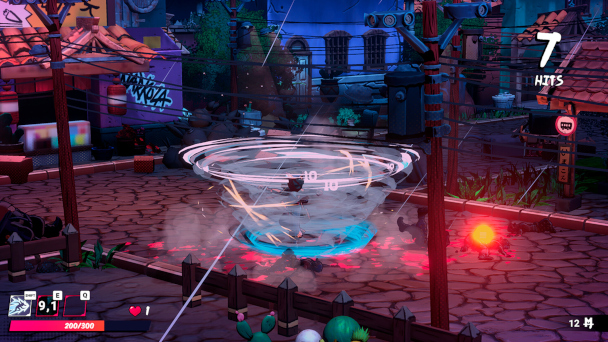
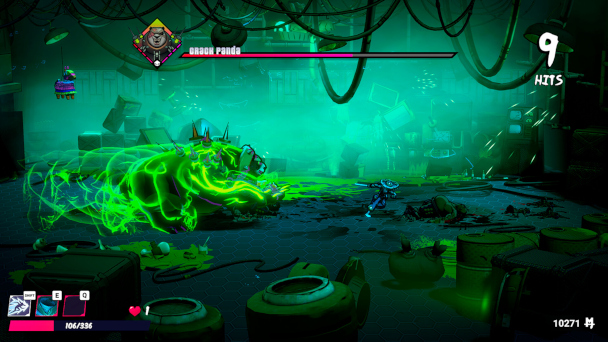
There’s gratification in sending an enemy skyward and then following them into the air for another string of strikes. Well-timed parries and reflected projectiles provide additional opportunities for mastery, while two equipped Mexican Jutsus can deliver crowd control or some last-ditch damage. These cooldown-based abilities range from spinning like a tornado and raining knives onto the battlefield to poisoning enemies with a huge green fart. More game need to include flatulence as part of your offensive moveset.
Two Parts Nigorizake to One Part Don Julio
Environmental objects can help as well. Vending machines can be smashed open for Sakila, a sake-and-tequila mixture that restores health, while explosive barrels punish anyone standing nearby. Food carts can even be pushed to run over adversaries. But some of these hazards can injure Juan just as easily, so confronting the street mobs with blind aggression is rarely advisable.
However, one perceptible problem is that hits don’t always convey much impact. Enemies can recover in the middle of an assault and immediately retaliate, while certain boss attacks arrive with insufficient warning. Combat is pretty fair once you learn its cadence. But cheap attack loops or abrupt counters can make a failed run sting.
Riding the Way of the Donkey
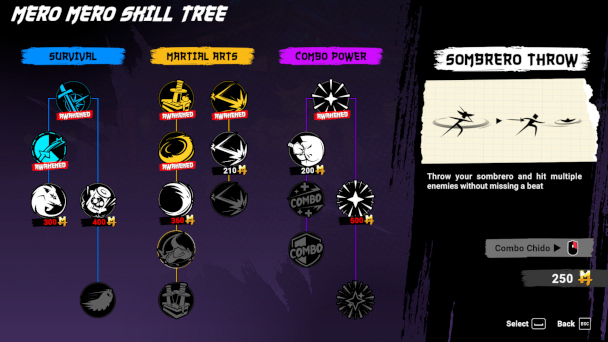
Mexican Ninja separates its progression into several different systems. Money can fund permanent improvements via the Way of the Donkey, upgrading your health, damage output, healing efficiency, and cooldown durations. Experience unlocks additional combos and fighting techniques, although its earned more slowly than cash. As a result, it can take too long for Juan’s basic repertoire to develop.
During runs, temporary blessings and modifiers can provide perks that range from fire, criticals, stuns, to counters. Three especially memorable deities, Virgencita Nee-San, Hachipotli, and Yokai Lloroña are some of the game’s more creative fusions. Their blessings can bestow some helpful perks, but they don’t always alter the fighting as much as some of the best roguelikes.
Curiously, unlockable costumes offer another form of build customization. They aren’t just cosmetic, either. Different outfits can do things like increase Juan’s health, strength, or income, while other skins modify Jutsu damage or trigger additional effects. Basic side missions provide some of these costumes, asking you to kill particular enemies, locate a boy hidden inside a barrel, or even collect condoms concealed in breakable objects. These additions are certainly welcome, but progression is too front-loaded. Later, you’ll unlock that tend to nodes provide statistical improvements instead of exciting new techniques, which hurts Ninja’s overall pacing.
Same Narkuzas, Different Street
The enemy roster doesn’t do much to hide repetition, either. Opponents require different offensive responses, but the game relies on recycled archetypes, just with altered appearances, additional health, or greater aggression. After several runs, distinction grow less noticeable, as the same attackers keep appearing in corridor-shaped combat arenas.
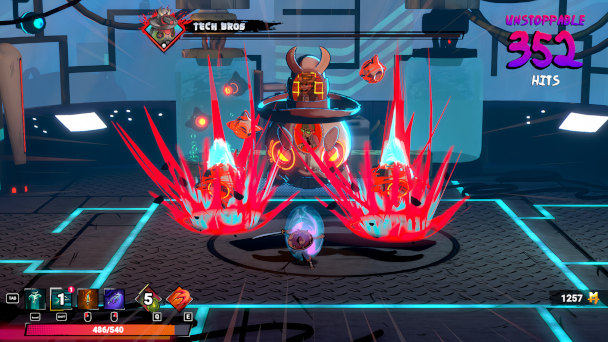
At least, boss battles fare a bit better. The six major encounters have distinctive personalities, attack patterns, and, in some cases, multiple phases. They also feature the kind of outlandish character designs you’d expect from Ninja’s cultural fusion. But these fights test pattern recognition just as much as mastery of Juan’s toolkit, and cramped arenas with oversized opponents bring their own camera problems.
There are more than 35 levels spread across five regions, with the subway transporting Juan between suburbs, markets, industrial areas, laboratories, and other districts. At some stations, you can choose between two routes, with rewards shown on each path before you commit. Hidden routes, secrets, NPC missions, and golden statues bestowing buffs encourage a bit of exploration.
Otro Día, la Misma Mierda
However, the major bosses still follow a fixed progression. Branching paths might change the journey leading up to these showdowns, but repeated runs inevitability return to familiar locations and the same confrontations. Largely, branching dialogue, the ability to create slightly different builds, and alternate stages soften the tedium, but they don’t eliminate it.
Busy environments are another problem. Crates, barriers, enemies, projectiles, traps, and effects can pile up onscreen, obscuring Juanito. Small character models and hazards that blend into the scenery can worsen this the issue. Sure, the cel-shaded artwork is colorful and distinctive, but readability isn’t as clear as other brawlers. And sporadically, I encountered a bit of stutter on some lower-end PCs. This made an otherwise lively presentation feel a bit unfinished.
More Attitude Than Technique
Mexican Ninja is at its best when Madbricks commits completely to the premise. By mixing cel-shaded comic-book visuals, multilingual trash talk, religious iconography, anime references, street markets, cyberpunk signage, and unapologetic humor, Nuevo Tokyo becomes a place unlike almost anything else in gaming. Even when the punchlines don’t land, it’s difficult not to appreciate the studio’s willingness to take a chance.
Yet it’s equally difficult not to wish that the combat took the same kinds of risks. The spirit blessings, Jutsus, unlockable costumes, and branching routes provide some welcome variation, but repeated enemies and slow-moving progression keep the fighting from matching the creativity of the setting. Visual clutter and occasional cheap attacks only make that repetition more noticeable.
Like the grindhouse movies that inspired it, Mexican Ninja is rather rough around the edges. It also has enough personality, and more than a few deliciously lowbrow moments, to make its imperfections forgivable. I’d suggest a bargain-price matinee rather than a full-priced ticket.
Mexican Ninja was played on PC with review code provided by the publisher.
Overview
GAMEPLAY - 75%
CONTROLS - 70%
CONTENT - 70%
AESTHETICS - 75%
PERFORMANCE - 65%
VALUE - 85%
73%
GOOD
Mexican Ninja slices together Mexican and Japanese culture with the kind of crude humor most modern games won’t touch. Its roguelite brawling doesn’t share that same kind of creativity, so it eventually becomes a grind. But Nuevo Tokyo has enough personality to make this bargain-priced matinee worth catching.


That last screenshot is a spicy one.