Ariana and the Elder Codex review
A Well-Cataloged Adventure with Spellbinding Synergies


Quite possibly, we are living in the golden age of metroidvanias. The past twelve months alone have witnessed some noteworthy highlights. Hollow Knight: Silksong finally arrived in 2025 largely living up to the lofty expectations that had built up around Team Cherry’s long-awaited sequel. Both Gigasword, with its massive blade that doubled as a mobility tool and Laika: Aged Through Blood’s blend of bullet-time shooting and motorcycle stunting pushed back at accusations that the genre was facing stagnation.
So where does that leave HYDE’s Ariana and the Elder Codex? Tucked somewhere in the middle of the pack, to be perfectly candid. This is not the kind of game with jaw-dropping set pieces or the kind of mechanical innovation that inspires a throng of clones. No, Elder Codex isn’t trying to reinvent metroidvania formula. But spend a few hours with Ariana and something rather curious is likely to happen. Yes, the game might just win you over with an assortment of modest virtues. There have been some strong metroidvanias published in the past year, but Ariana managed to captivate me far more often.
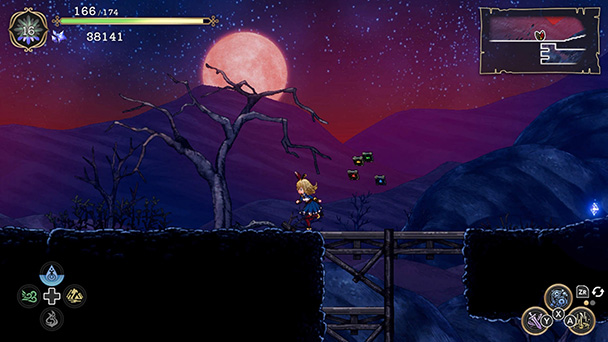
Spells, Synergies, and the Joy of Combustion
One of Elder Codex’s most conspicuous strengths is its combat system. Where most genre entries arm their protagonists with swords, whips, or guns, Ariana fights entirely with elemental magic. Largely, the offering of 30+ spells is genuinely impressive. From instant infernos, winds gusts that slice like spinning scythes, to eruptions of earth that can send enemies falling, our librarian hero has a number of impressive incantations.
However, what elevates the system from conventional elemental variety is how these spells interact with one another. Foes subjected to a floor full of flames burst when their health is depleted, creating explosive chain reactions that can annihilate any of their adjacent allies. And while there are elemental advantages against certain affinities, Elder Codex doesn’t make you constantly switch your spellbooks. Instead, holding the right trigger provides access to three more spells, should you want to optimize your offensive output. This design decision truly endows Ariana with a distinct feel compared to the sword-swinging or dash-reliant combat found in contemporaries. Best of all, cooldowns are merciful enforced, allowing you to cast simultaneous spells, which keeps the pacing taut.
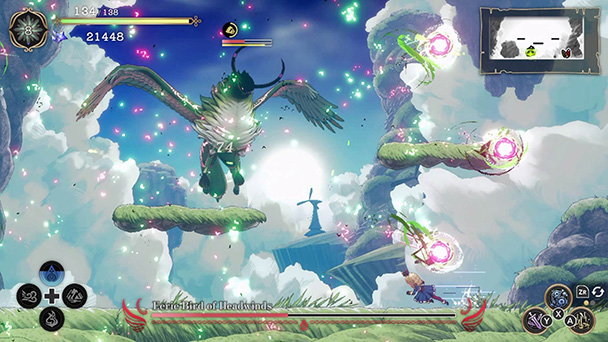
A Stacked Shelf of Challenges Including a Few Dusty Ones
Periodically, exploration is interrupted when you enter Repair Points, sealed chambers where Ariana must complete a specific challenge. The combat-focused variants of these are some of the more enjoyable moments in the game, pitting you against waves of enemies and tiered time limits that are tied to rewards. As such, you’ll have to think about the quickest way to dispatch foes, encouraging you to review your loadout of spells.
While there’s a bit of variety offered by navigation-based Repair Points. These aren’t as gratifying, tasking Ariana with threading her way through increasingly fiddly obstacle courses. Here, failure is likely to occur with mistimed jumps or unclear telegraphs, leading to the rare instance of frustration in an otherwise enjoyable expedition.
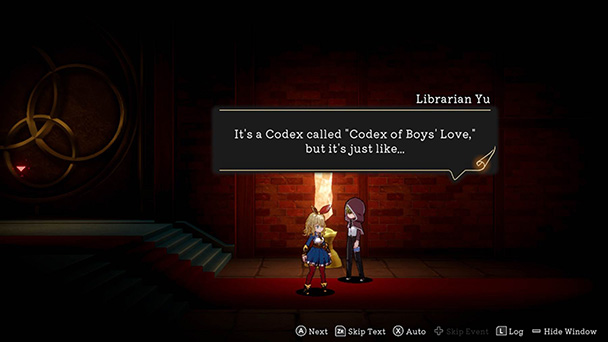
Building Your Own Spellbook
Progression in Elder Codex provides a welcome sense of autonomy. As Ariana treks through the Codices, her friend Divina can unlock new spells, passive skills, and equip stat-boosting magical items. Each ability can be slotted into Ariana’s compact but flexible spell system, allowing for some creative customization. Just don’t forget to stock some healing into her arsenal, which will come in handy in the game’s tough-but-fair boss battles.
The game’s anthology-style structure offers just a bit of emotional motivation. Ariana’s parents were both Librarians who vanished when she was young, and clues to their fate are woven throughout the codices she explores. Both the overarching narratives and the tales injected into each codex are handled with restraint. There’s incentive to learn more, but the expositional interludes aren’t long enough to break momentum.
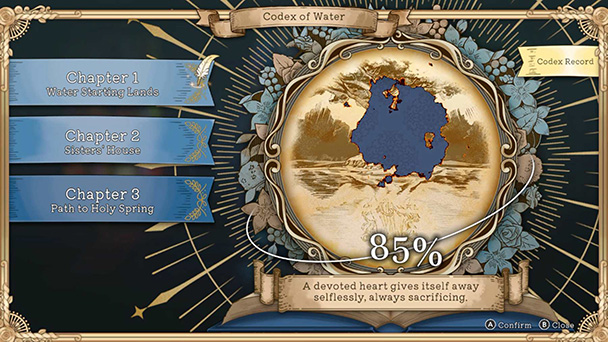
Particle Dreams and Performance Realities
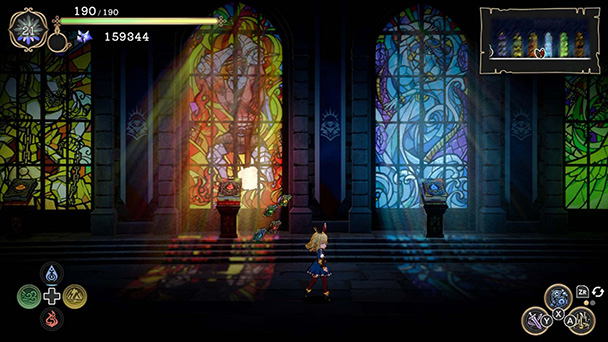
Undeniably, Ariana and the Elder Codex particle effects are extraordinary. Spell impacts blossom with layers of color and light that you find in a full-priced production. Watching opponents burst into neon-colored, circular explosions that emerge through the wind, fire, water, and earth is enduringly eye-pleasing. These effects are complicated by effective environmental design, bulky enemy sprites, and a downright adorable lead.
That said, performance is contingent on your hardware. On the original Switch, the game runs at a middling 30 frames per second that holds reasonably steady in tranquil areas but dips perceptibly during the more explosive spell exchanges- which are precisely the moments you’d least want it to. The Switch 2 version offers a choice between a visual mode capped at 30FPS with enhanced resolution and texture work, and a performance mode that targets 60FPS. The latter is where the combat truly shines, with spell-weaving demonstrating a striking fluidity on Nintendo’s new hardware. But the trade-off is a noticeably softer, more pixelated output that might be a bit grainier than you are used to.
Not a Groundbreaking Book, But One Worth Reading
Ariana and the Elder Codex is a reminder that not every metroidvania needs to redefine the genre to be worth your time. HYDE’s adventure thrives on the strength of its spell-driven combat, accommodating progression, and consistently satisfying action, even if its platforming stumbles and technical performance occasionally hold things back. Sure, it might not reach the towering highs of the genre’s recent heavyweights, but the game’s shrewd design choices and engaging combat are easy to underestimate. For players willing to look past a few rough edges, Elder Codex proves that refinement, rather than reinvention, casts a pretty compelling spell.
Ariana and the Elder Codex was played on Switch with review code provided by the publisher.
Overview
GAMEPLAY - 80%
CONTROLS - 75%
CONTENT - 80%
AESTHETICS - 75%
ACCESSIBILITY - 85%
VALUE - 85%
80%
GOOD
Ariana and the Elder Codex doesn’t reinvent the metroidvania playbook, but its clever spell combos and flexible builds make it easy to get hooked. It can stumble with platforming and performance, yet the satisfying combat, steady sense of progression, and forty-dollar MSRP make this a welcome page turner.





How long is it?
Performance mode on Switch 2 looks like shit.