Aggelos 2 review
Angel, Demon, and an Improvement on its Predecessor

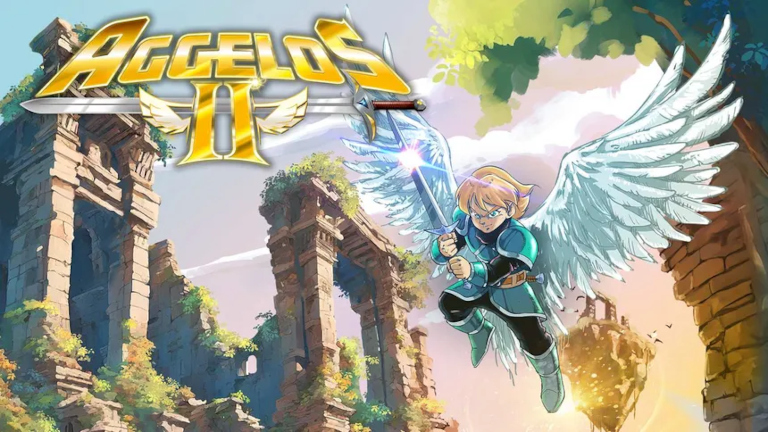
I approached Aggelos 2 with a bit of indifference. After all, metroidvanias aren’t exactly scarce on Steam. Even a quick scan of Valve’s storefront will probably reveal several of them. Similarly, pixel art now seems like the genre’s default art style rather than an identifying choice. As such, the sequel to 2018’s Aggelos might not immediately grab your attention. But if you’re looking for a game that feels like Wonder Boy was let loose across two absolutely massive maps, Aggelos 2 just might win you over with its confidence and design decisions.
The original Aggelos was a compact action-platformer that was modest in scope and novelty. But the simple swordplay was engaging and bolstered by a succession of additional abilities. Smartly, the sequel sustains those foundations while providing a larger world, less linear exploration, and traversal that’s just a bit more engaging. Much like some of Inti Creates’ sprite-powered series, such as Blaster Master Zero and Azure Striker Gunvolt, I’m seeing the potential for an Aggelos franchise.
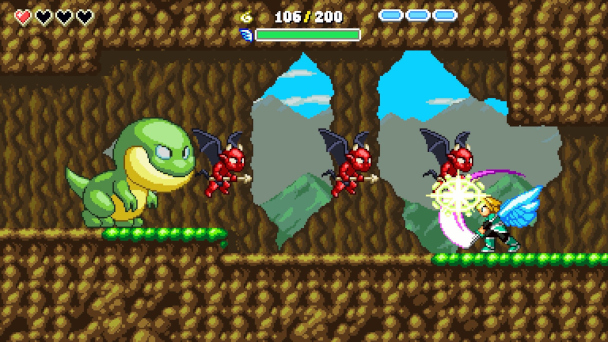
Normie or Emo Angel?
You play as an Aggelos, a member of the highest order of angels chosen by Balro to venture through the Kingdom of Lumen. With the gods of light losing their war against the Army of Darkness, our hero is forced to embrace a demonic form. Although the succinct storyline provides some motivation for the realm-hopping, it rarely strives for anything more. The dialogue is brief, the mythology isn’t fully explained, and the characters don’t have a lot of depth. The focus here is on play, not plot, and that’s OK. Sometimes, filling in a map while cleaving through corridors of enemies is enough.
Aggelos 2’s dual-form and dual-realm systems could have easily felt like gimmicks. Fortunately, the game ties them together quite cleverly. Portals transport you between overlapping Light and Dark versions of the world, where routes, obstacles, and environmental features can differ. Meanwhile, certain enemy projectiles can only be safely countered while using the corresponding Angel or Demon form. As a result, an apparent dead end in one realm can become a viable route in the other. Navigation gradually becomes a process of thinking about two places at the same time.
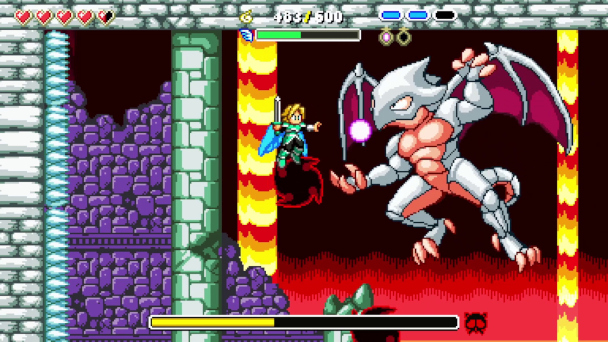
Move Lithely and Swing Mightily
Naturally, the different forms have their own approaches to combat. The Angel is more deliberate and defensive, while the Demon is faster and suited for quick aggression. However, both wield a sword and share several movement options, so the distinction isn’t overly pronounced. There are still meaningful advantages to each: the Angel can use energy vials to heal and counter light projectiles, while the Demon can convert those vials into temporary speed and power boosts while countering dark projectiles. Best of all are the hectic moments that have you quickly swapping forms, giving Aggelos 2’s boss fights a cool rhythm.
Arguably, movement is the sequel’s biggest improvement. The ability to hover comes early, although a stamina gauge limits how long Aggelos can remain airborne. Touching the ground or clinging to a wall restores it, creating sequences where you need to find quick moments of contact to navigate extended sections. Wall grabs, dashes, and other upgrades gradually expand your traversal options. And while the abilities are all fairly familiar, they fit together organically, making movement feel refined. Developer WONDERBOY BOBI isn’t stingy with save points, which also encourages exploration.
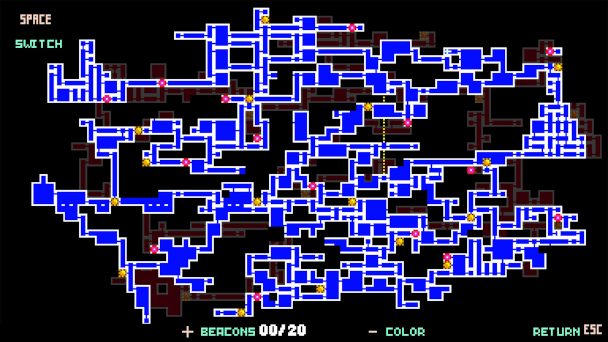
The Map Can Also Be a Monster
Unfortunately, finding the proper route is often harder than the platforming. Regions aren’t clearly differentiated on the map, while the inability to zoom makes it difficult to read. An objective icon might suggest where to go, but you’ll still need to figure out how to get there. Add the overlapping realm, and things can become confusing.
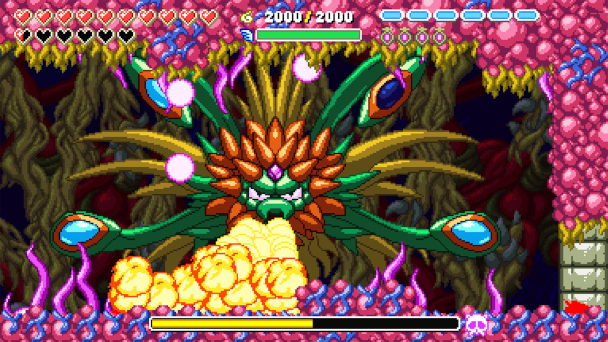
Initially, fast travel is restricted to certain save points. As such, accidentally taking the wrong route can mean a lengthy return journey. This improves later, but your early hours can involve a bit too much legwork if you’re not careful. Another issue is that the game’s difficulty can be uneven. Standard enemies are manageable. But when screens fill with flying creatures, projectiles, and environmental hazards, things can become overly hectic, especially in the Dark Realm. Naturally, the game’s thirteen bosses up the stakes, but ranged attacks, healing, and a bit of patience can be immensely helpful.
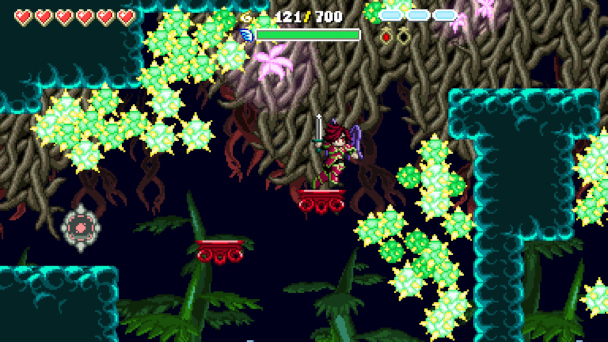
Largely, Aggelos 2‘s sense of progression is satisfying, with orbs, swords, armor, health extensions, and magic upgrades all providing benefits. Yes, collectible eggs are slightly less rewarding, mainly providing currency. And speaking of money, a wallet capacity means enemies shower you with orbs before you can carry enough to buy desirable upgrades. Yes, that’s an odd design decision but at least caps are upgraded at regular intervals.
Old-School Charm Meets Complicated Controls
Visually, Aggelos 2 strives to recreate the allure of classic 16-bit adventures. With a bright palette, expressive, well-animated sprites, and plenty of distinctive biomes spread across its two worlds, there’s plenty of retro-minded goodness. Meanwhile, the soundtrack is catchy enough, while solid sound effects give actions like a sword strike some snap. Expectedly, performance is smooth, and the PC version is Steam Deck Verified.
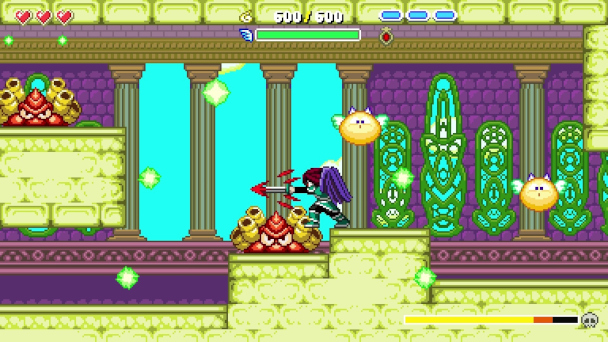
That said, the controls can grow cumbersome in Aggelos 2’s waning hours. Spells, healing, flight, dashes, and form-switching all compete for inputs, making accidental actions increasingly common. Part of the problem is that the same button can perform different functions depending on your active form. For instance, an input that heals Aggelos in Angel form activates a speed-enhancing spell in Demon form. A more consistent layout would have alleviated some of the frustration.
Fly High, Aggelos!
Overall, Aggelos 2 never quite escapes the sense that it is borrowing from other notable titles. And while it might lack a strong identity, the sequel offsets this with plenty of exploration, satisfying progression, and a moveset that grows quite nicely. Sure, a confusing map and crowded controls might chip away at some of the fun, but none of these issues spoil the adventure. Aggelos 2 doesn’t redefine the metroidvania, but there’s enough polish in the execution to give this angel its wings.
Aggelos 2 was played on PC with review code provided by the publisher.
Overview
GAMEPLAY - 80%
CONTROLS - 60%
CONTENT - 80%
AESTHETICS - 75%
PERFORMANCE - 75%
VALUE - 80%
75%
GOOD!
Aggelos 2 doesn’t try to reinvent the metroidvania, but its dual-realm exploration, satisfying progression, and retro looks make it easy to enjoy. A confusing map and crowded controls occasionally clip its wings, but this charming adventure still manages to soar.