Lost Eidolons: Veil of the Witch review
Turn-based Tactics with Roguelike Replayability?

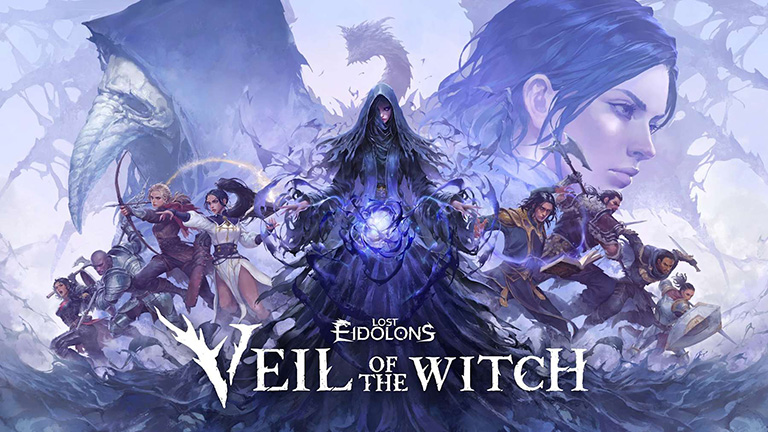
Lost Eidolons: Veil of the Witch is a leaner spin‑off that reimages 2022’s Lost Eidolons’ as a run‑based roguelite. Instead of the sprawling maps, protracted preps, and linear chapters, you’ll find concise encounters, a smaller party, and an emphasis on replayable runs as well as meta‑progression. Where the original game focused on a fundamentally scripted, cutscene‑driven campaign, Veil of the Witch delivers its story and character moments in quick snippets that mesh with the loop‑centric structure found here.
Likewise, the game revisits some of the ideas of the original universe but adjusts to for a more compact and cyclical-driven structure. Runs begin with Ashe and a small group of companions being revived on a mysterious island overrun by the undead. A godlike Eidolon named Sable is behind your repeated resurrections, offering to save you from the Sisyphean struggle if you become her champion.
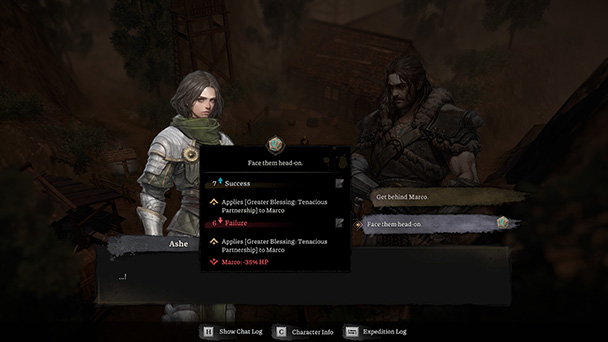
Yes, Veil of the Witch has an amnesiac hero, as well as dialog that can be either quippy or ambiguous. But these qualities are deliberate and intended to arouse your curiosity, as Ashe seeks out his long-lost-brother, gradually regaining fragments of his memory in the process. On the upside, you’ll receive a steady supply of expositional payoffs, with encounters, victories, and even death providing a succession of hints on what Sable’s motivations might be.
Streamlined Tactics Help Encounters Feel Lively
On the battlefield, Veil of the Witch keeps the grid‑based, turn‑based tactics of Lost Eidolons but streamlines them for Fire Emblem-style accessibility. Design decisions like reduced party sizes, smaller maps, and speedy animations help keep turns feeling brisk. Yes, details like unit positioning, weapon choice, and skill usage ensure that encounters rarely feel trivial. Units can move a fixed distance, then attack or use skills without worrying about fiddly action‑point accounting, making the game approachable to players who normally bounce off more complex tactical systems.
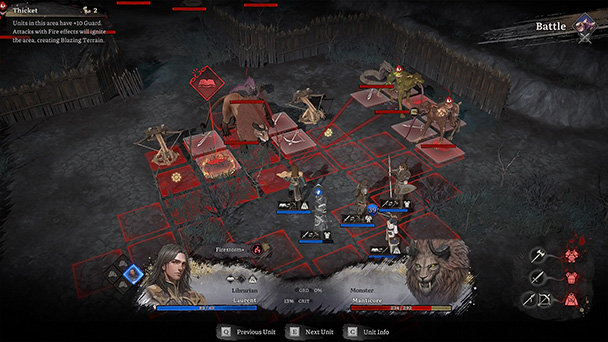
Yes, the real hook is how the game balances accessibility, user interface responsiveness, and depth. Dual‑weapon loadouts let characters shift roles mid‑turn. Mages can swap to bows, axe wielders can switch to spears, and different armor types respond differently to swords, magic, and other tools. Bosses and large enemies often feature weaknesses tied to these weapon types, encouraging coordinated turns where you line up the right characters, hit multiple susceptibilities in one round, leading to a massive finishing blow. Factor is the ability to thwart counterattacks and there’s a respectable tactical foundation across Veil of the Witch.
A Versatile Witch
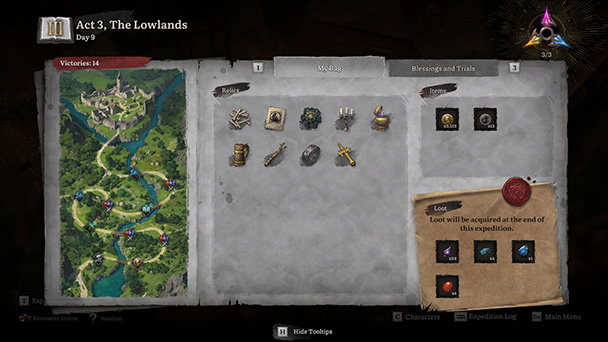
Roguelike structure is at the center of Veil of the Witch, distinguishes the game from its predecessor. Each run sends your five‑person squad through a branching series of nodes that range from battles, shops, camps, recruitment events, with death kicking you back to the start. Fortunately, failure never feels like a penalizing reset, because meta‑currencies and unlocks are given out across runs, opening new relics, skills, and upgrades that can alter the feel of your next attempt. Naturally, you’ll probably wish there was more variation, but that’s often the case for almost all roguelikes.

But Ocean Drive Studio should be commended for injecting long-tail mechanics into the loop. Altar‑style stat upgrades, shop improvements, and class promotions all gradually transform early‑run fragility into a late‑game power fantasies, inspiring experimentation with different builds and party compositions. Additional characters, relic synergies, and upgrade cards continue to appear past the initial acts, providing a sense of reward and assistance against the intermittent difficulty spike.
Bosses That Push Your Prowess and Occasionally, Your Patience
Boss battles punctuate each act. Thankfully, they are more than just oversized damage‑sponges. Multi‑tile bosses with powerful area attacks and encounter‑specific gimmicks will test everything you’ve learned about positioning and weapon swapping. The difficulty can frustrate, particularly around the second act. But the combination of quick retries, meta‑progression, and flexible builds makes finally slaying a boss feel like a hard‑earned victory.
Veil of the Witch might be more visually modest than Lost Eidolons but uses its resources smartly. Story segments use visual novel-style portraits with solid voice acting. Meanwhile, the game’s camera can be quickly moved around to frame the action, offering a showcase for high‑level skills and abilities. The smaller scale and faster animations make Veil of the Witch’s ideal for portable play, and it’s easy to tackle an encounter or two on your daily commute. Best of all, the game runs flawlessly on Steam Deck.
Death, Resurrection, and the Enigmatic Eidolon
Act Four is the game’s biggest structural twist, and unlocking it essentially changes how runs feel. Once you’ve cleared the initial ending, future runs gain a fourth chapter that introduces new bosses while remixing the original ones with different scenarios and upgraded abilities, effectively expanding the endgame. This extra layer keeps long‑term play interesting and emphasizes that Veil of the Witch isn’t designed as a one‑and‑done campaign. Instead, this tactics sandbox is meant to be revisited for dozens of runs, giving Veil of the Witch a longevity and accessibility uncommon with its peers.
Lost Eidolons: Veil of the Witch was played on PC with review code provided by the publisher..
Overview
GAMEPLAY - 80%
CONTROLS - 80%
CONTENT - 75%
AESTHETICS - 80%
PERFORMANCE - 75%
VALUE - 80%
78%
GOOD
Lost Eidolons: Veil of the Witch swaps its predecessor’s slow-burn campaign for fast, flexible tactical runs. It doesn’t reinvent either the tactics or roguelike genres, but the streamlined combat, consequential meta-progression, and replay-ready structure make it a surprisingly satisfying spin-off for fans and newcomers alike.