4PGP review
A high-speed tribute to SEGA's classic arcade racers

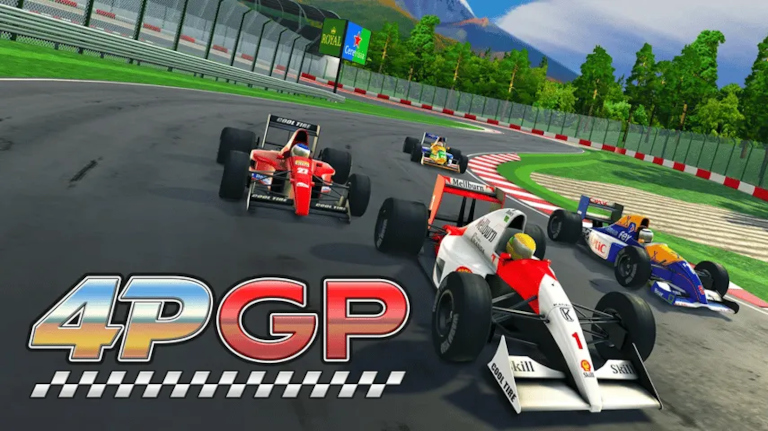
The racing genre has largely moved on from the arcade era. Where once you could drop a quarter, grab a simulated steering wheel, and feel like Ayrton Senna for a few minutes, the genre gradually drifted toward simulation and complexity. And while worrying about gear ratios, suspension tuning, fuel loads, and weight transfer undoubtedly has its merits, I often miss the simplicity of games like Daytona USA, Virtua Racing, or Sega Rally Championship. There’s something deeply satisfying about driving like a world-class professional after just a few laps.
Thankfully, the developers of 4PGP remember that feeling. The trans-continental collaboration between French developer Vision Réelle and Japanese publisher 3goo understands the allure of immediate gratification. Directed by Jonathan Marole, whose efforts includes work on Test Drive Unlimited and The Crew, the project also benefited from the involvement of arcade-racing veteran Kenji Sasaki, known for directing Virtua Racing and Sega Rally. Honestly, it’s refreshing not to spend an hour in tutorials and menus before entering your first competition. You know, like the old days.
Start Your Engines, No Tutorials Necessary
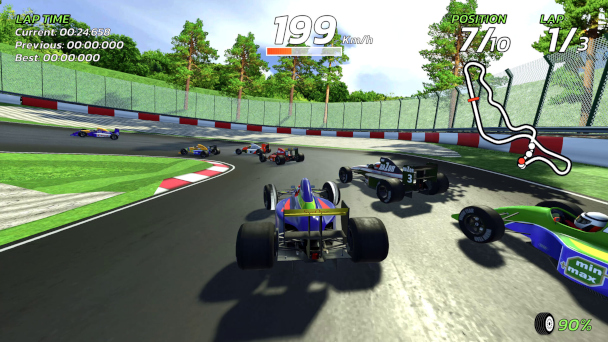
From the moment the signal light goes green, 4PGP feels exactly as you’d hope. The controls convey a sense of weight without relying on the kind of anticipatory steering that belongs in a flight simulation. Hugging the inside of a curve feels rewarding, and there’s genuine satisfaction in entering an apex cleanly. More importantly, the tracks do their part. Visual cues are frequent throughout each of the game’s fourteen circuits, helping you anticipate upcoming turns without requiring an intrusive racing line. A generous draw distance (depending on camera choice) also lets you read wide-open stretches of road and prepare for tighter corners that demand a bit of braking.
Car-to-car contact is handled with welcome leniency. Collision models can make or break a racing game, and 4PGP wisely favors the forgiving side of things. Nudges and bumps typically push cars apart rather than launching them into barriers. This keeps races feeling competitive and fair, since there’s little reward in treating every event like a demolition derby. Aggressive driving remains viable, but reckless driving doesn’t pay off here.
Speed Kills (Lap Times)
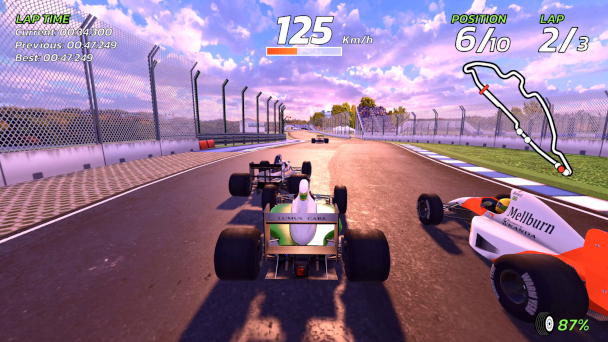
Nicely, there’s just enough nuance to ensure the experience never feels overly simplistic. Pressing the left bumper activates your boost, and managing that resource becomes a persistent worry throughout each race. Pit stops allow you to replenish your boost supply and replace worn tires. These sequences are built around brief quick-time events, and while they’re not particularly challenging, they’re far more engaging than passively watching a canned animation. The component adds a welcome layer of strategy without disrupting the game’s pacing.
Best of all, 4PGP delivers an excellent sense of speed. Track-side details blur past in your peripheral vision, and corners can arrive surprisingly quickly if you’re unfamiliar with the circuit or neglecting the mini-map. Like any respectable arcade racer, 4PGP constantly tempts you to drive faster than you probably should. That’s a quality shared by many of the genre’s greatest classics, and it’s clear the development team studied them closely.

The Beauty of Human Error
On the normal difficulty setting, CPU opponents offer an approachable challenge. Increase the difficulty, however, and they become legitimately tough competitors. Better yet, the game avoids the excessive rubber-banding that often plagues modern racing games. If you’re looking for a fair challenge, 4PGP can certainly provide one. That said, AI drivers adhere so strictly to their racing line that squeezing past them can occasionally feel more difficult than it should. There’s also a driver-assist option, though it isn’t quite the helping hand you might expect. In practice, it often puts your vehicle on the same racing line as the AI drivers, which can make races feel a bit restrictive.
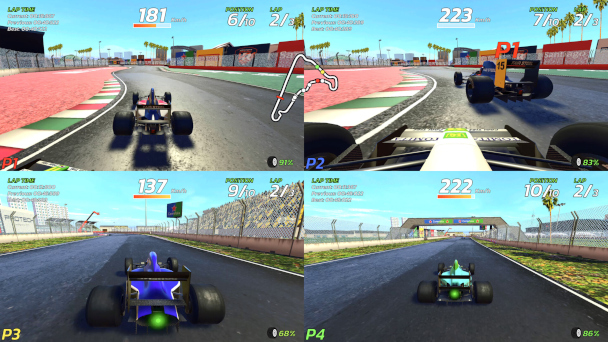
Fortunately, multiplayer offers an excellent alternative to battling computer-controlled rivals. Racing against human opponents creates the unpredictable moments that arcade racers thrive on, whether it’s a last-second overtake, a daring boost-fueled charge, or a costly mistake in a final corner. 4PGP also offers replay value through unlockable cars and tracks, giving players a reason to keep racing after their first championship. win Pleasingly, the game’s fourteen circuits are loosely inspired by real-world locations, providing a sense of geographical variety without the burden of expensive licensing agreements.
Pop the Digital Champagne
Ultimately, 4PGP earns a podium finish by capturing the spirit of classic arcade racing. With its responsive controls, excellent sense of speed, forgiving collisions, and just enough strategic depth to keep races engaging, the game successfully rekindles the excitement of the genre’s golden age. While many modern racing titles chase ever-greater realism, 4PGP serves as a reminder of why arcade racers became beloved in the first place: they’re fast, accessible, and tremendously fun.
4PGP was played on PC with review code provided by the publisher
Overview
GAMEPLAY - 80%
CONTROLS - 80%
CONTENT - 75%
AESTHETICS - 80%
ACCESSIBILITY - 80%
VALUE - 75%
78%
GOOD
4PGP is a welcome throwback to the era when racing games prioritized accessibility and fun over endless tuning menus and simulation-heavy mechanics. With responsive handling, split-screen multiplayer, and a great sense of velocity, it successfully captures the spirit of arcade classics like Sega Rally and Virtua Racing, even if its AI can occasionally be a little too artificial.





How’s SD performance? I know they said 60 but do you have to put in in low?