Destroy All Humans! review
Crypto is Volatile as Ever, and Still Holds Value

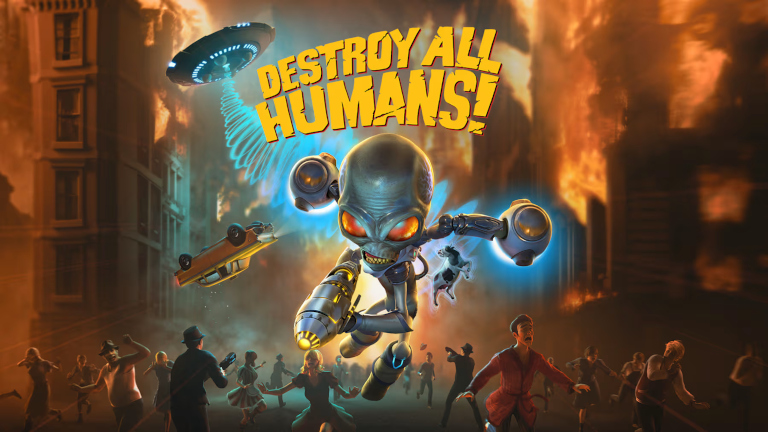
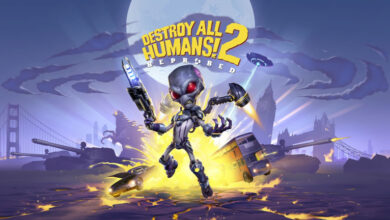
Black Forest Games’ remake of Destroy All Humans! remains a compelling reminder that playing the villain can be far more entertaining than saving the world, especially when you’re flinging civilians across farmland with telekinetic force. On Switch 2, the experience benefits from improved hardware, but it still carries some of the technical compromises and design relics of its mid-2000s origins.
At a time when open-world sandboxes are ubiquitous, spanning everything from Assassin’s Creed to Cyberpunk 2077, it’s easy to forget how foundational Pandemic Studios’ work was to the genre. Mercenaries: Playground of Destruction helped define player-driven chaos, and Destroy All Humans! followed up that effort by shifting that freedom into a more irreverent, sci-fi backdrop. Rather than militaristic spectacle, Pandemic leaned into subversive destruction, letting players loose as the invader in a B-movie landscape.
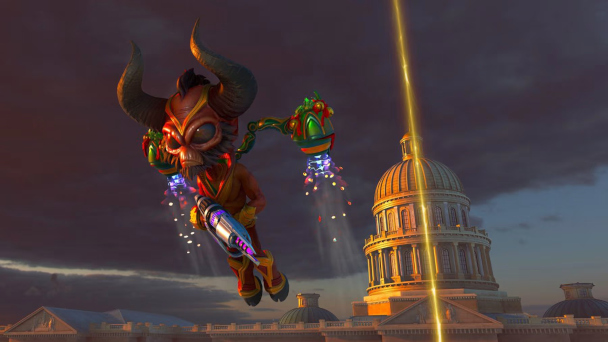
Black Forest Games’ remake, originally released in 2020, continues to hold up remarkably well in 2026. Its core systems remain intact, with visual upgrades and quality-of-life improvements helping it feel closer to a modern release than a straightforward remaster. On Switch 2, that foundation is largely preserved, though not without a couple of caveats.
Cold War Satire That Still Bites
Players step into the role of Cryptosporidium 137, an alien invader who’s tasked with rescuing a captured clone and harvesting human DNA to preserve his species. The narrative embraces pulpy 1950s sci-fi, blending paranoia, government conspiracy, and exaggerated Americana into a satirical playground. Best of all, you get the be bad guy, which offers a welcome change of pace from having morality forced on you.
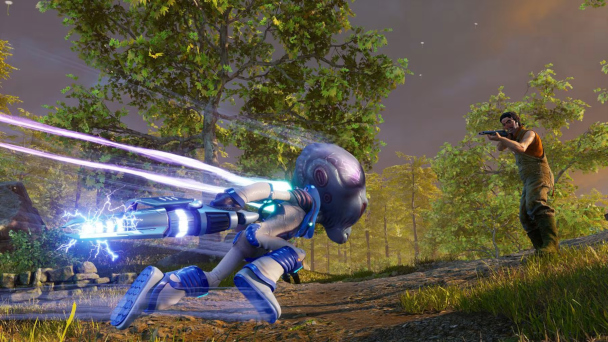
What continues to stand out is the game’s equal-opportunity mockery. Politicians, suburbanites, military figures, and conspiracy theorists are all targets, and the script rarely pulls its punches. In today’s more risk-averse, triple-A landscape, that edge feels increasingly rare. Not every joke lands by modern standards, but the remake wisely preserves the original tone rather than trying to water things down.
Chaos First, Structure Second
Mechanically, Destroy All Humans! is still at its best when it lets players off the leash. Early missions act as extended tutorials, gradually introducing Crypto’s abilities, with telekinesis serving as the immediate highlight. Tossing NPCs into buildings or each other remains as satisfying as ever, thanks to responsive physics and exaggerated animations.
As Crypto’s arsenal expands, so does the game’s sense of playful cruelty. Weapons like the Zap-O-Matic and Anal Probe reinforce the game’s cartoonish brutality while feeding into its upgrade loop. There’s a consistent reward cycle at play, cause chaos, collect DNA, enhance your abilities, that keeps the pacing brisk. Pleasingly, you’ll get the opportunity to upgrade Cypto and his ship.
However, the game’s age shows in its mission design. Disguise mechanics and light stealth segments can feel restrictive, often hinging on narrow solutions that punish experimentation. Difficulty spikes, particularly in later missions and boss encounters, can feel abrupt. Still, the game typically compensates with new tools or narrative payoffs that reward you for making it through this sequences.
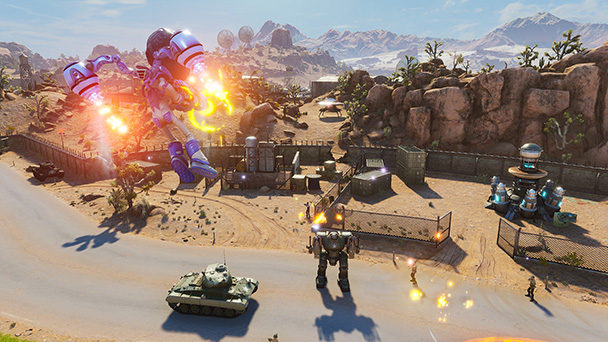
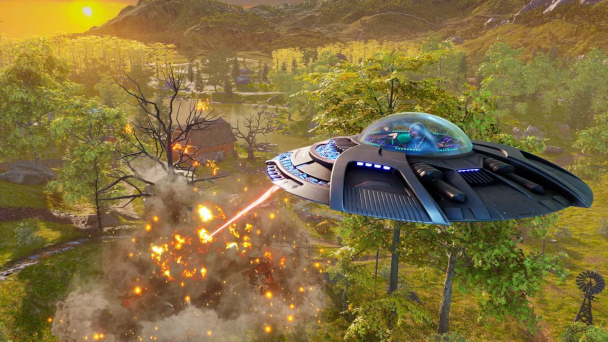
Flying saucer sequences offer a strong complement to the on-foot gameplay, offering large-scale destruction with a different tempo. While these segments are mechanically simpler, they showcase the remake’s upgraded visuals, with explosive effects and environmental destruction adding spectacle. Twenty years on, turning a tank into a giant puddle of molten metal is still enjoyable. Even in 2026, these moments hold up visually, save for a few issues.
Switch 2 Performance Breakdown
On Switch 2, Destroy All Humans! benefits from a generational uplift, but it stops short of feeling fully optimized for the newer hardware. The remake’s visual presentation is sharper overall, with improved image fidelity and cleaner texturing that brings it closer in line with the PlayStation 4 and Xbox One releases. Environmental detail holds up well in most scenarios, and the game’s cartoonish art direction continues to mask some of its underlying technical limitations.
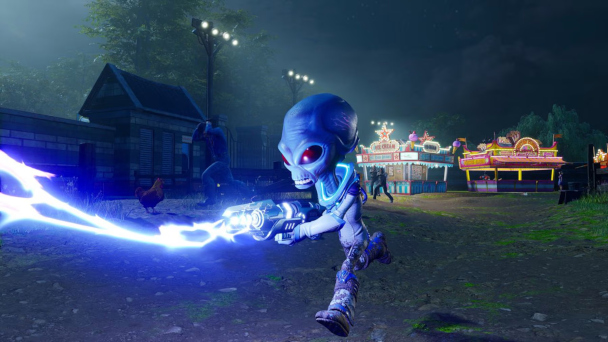
Performance, however, is where the port reveals its inconsistencies. The game appears to output between a rather wide 30 to 60 frame-per-second range. Lighter moments of enemy-free traversal and smaller encounters lean toward the upper end of that range. But once the action escalates, particularly during large firefights or destruction-heavy saucer sequences, the frame rate can dip noticeably closer to 30 fps. While these fluctuations aren’t severe enough to impact precision, they do introduce a degree of unevenness that can be felt during the game’s more chaotic moments.
Naturally, frame pacing is more stable than the original Switch release, resulting in smoother overall motion even when performance drops occur. Load times have also seen a improvement, making mission restarts and area transitions less pesky. That said, some of the original port’s shortcomings persist. Occasional pop-in and reduced environmental density are still present, particularly in larger maps, and moments of intense physics interaction can trigger minor stutters.
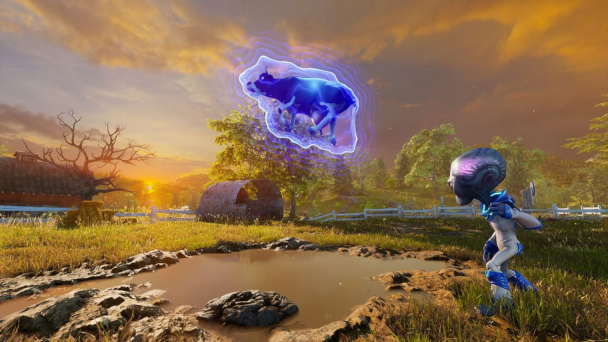
The lack of any kind of graphical/performance options ultimately limits how much players can tailor the experience. Without the ability to prioritize a locked frame rate or enhanced visual fidelity, the game settles into a middle ground that is improved, but it’s not entirely consistent. Even so, this is the most stable portable version of Destroy All Humans! to date, offering a solid way to experience Crypto’s chaos on the go.
Destroy All Humans! was played on Switch 2 with review code provided by the publisher.
Overview
GAMEPLAY - 80%
CONTROLS - 75%
CONTENT - 75%
AESTHETICS - 75%
PERFORMANCE - 65%
VALUE - 70%
73%
GOOD
Two decades on, Destroy All Humans’ humor might feel dated. But its satisfying alien powers and destructive sandbox provides just as entertaining, at least when the game’;s not attempting stealth. The Switch 2 version delivers sharp visuals, and slightly faster loading, but solid, but not exemplary performance.


Cool. The original ran at 30fps, right? Is there a setting to lock it at that?
Wow, I played this as a kid. Just remembers when I saw the screenshots.