Star Overdrive review
Sailing the Sandbanks of Mediocrity

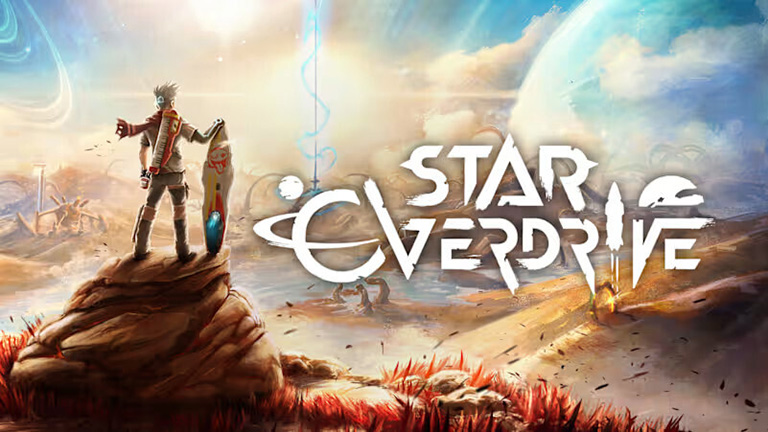
Star Overdrive opens with a cinematic that suggests players are in for a bold and engaging experience. The first few minutes depict protagonist Bios receiving a distress signal from his girlfriend, setting the stage for an urgent rescue mission. The sequence shifts between frantic moments aboard Bios’ doomed vessel and a striking image of the ship streaking across the sky above the planet Cebete. It’s a compelling but familiar setup that recalls Guardians of the Galaxy’s retro-futurism, harnessing the same kind of emotional urgency of a summer blockbuster.
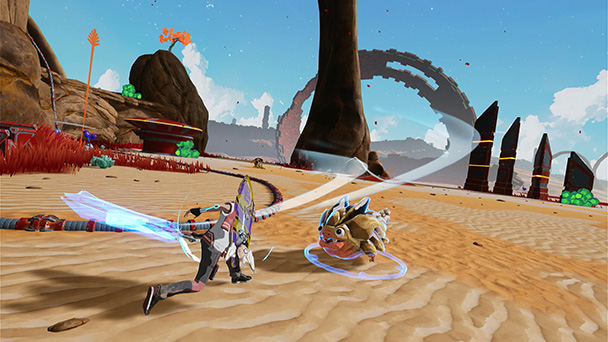
Initially, Star Overdrive delivers on its potential. After crash-landing on the alien world, Bios retrieves his keytar, using the musical weapon as a makeshift weapon. Like much of what follows, it’s a quirky concept, but developer Caracal Games doesn’t always make good on the execution. While it might seem like the game is about to become one of those genre-bending experiences where movement, music, and taut combat intermingle, every swing of your keytar delivers a generic light saber sound effect rather than any kind of musicality. Sadly, this isn’t the only missed opportunity.
Hover-bored
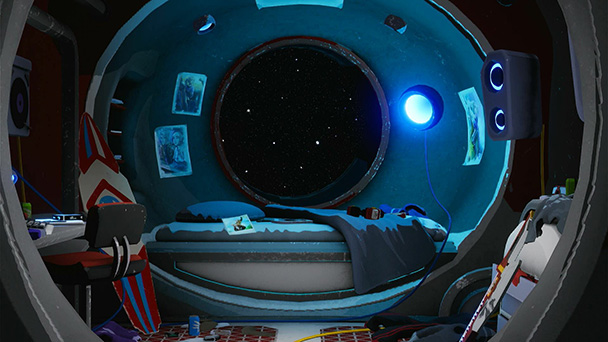
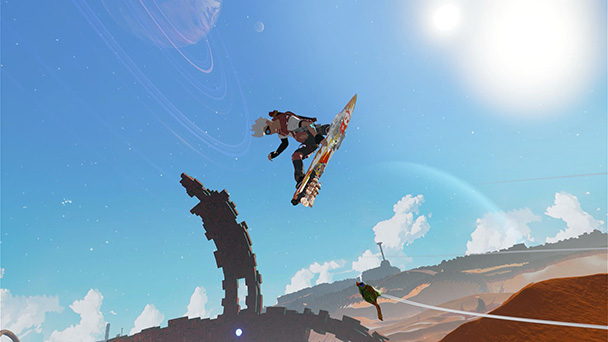
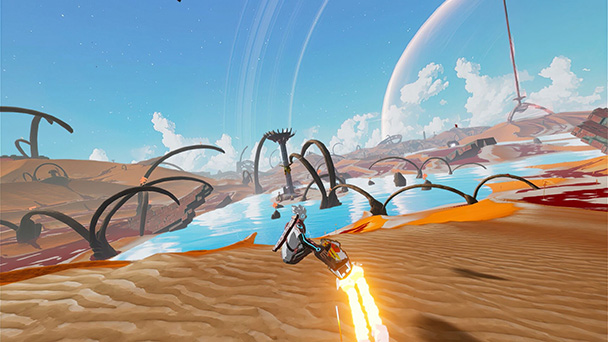
When your hoverboard is retrieved a few minutes later, it feels like Overdrive might redeem itself. No longer burdened by Bios’ leisurely walking speed, movement becomes energized. The lead catches air from ridgelines, soars over dunes, and under the planet’s stone archways with ability and speed. The responsive controls and reactive physics modeling hint at Tony Hawk Pro Skater but set on an alien planet.
When it works, it’s absorbing. You’ll likely spend ten minutes or so zipping through the game’s open world, looking for places to launch Bios’ skyward before using the right analog stick to pull off a spin or flip to earn a short boost. The moments are invigorating and if the game could have harnessed this momentum, Overdrive could have been an exhilarating adventure.
Desolation Plagues Another Open World
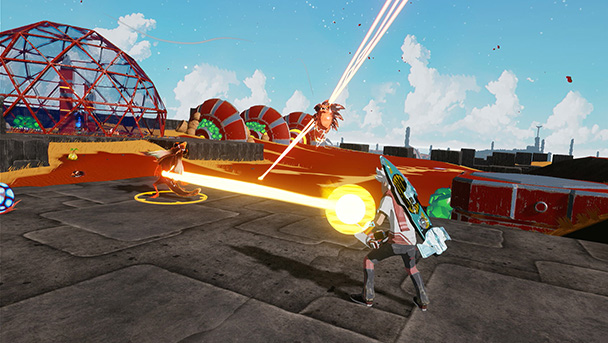
Unfortunately, the game’s execution can’t match its ambitions. Exploration is hindered by empty environments without much interaction or even reward. Worse, missions are mostly basic fetch quests or offer unremarkable combat, where enemy tells are difficult to read. When they do deviate from formula, the prize can feel like a punishment: you get to explore a new, equally desolate area as your map opens up. Boss battles are floaty and usually revolve around spamming the same attack repeatedly. And these aren’t the only tedious components. Timed hoverboard challenges feel like a punishing throwback to some of the sadistic games of the PlayStation 2 era.
Perhaps Overdrive’s worst attribute is the sense of hope the game habitually cultivates before letting players down. While I thought the game’s nod to Beath of the Wild’s temples might deliver some much-needed redemption, the dungeons routinely riff on a single idea for too long. As such, there’s little sense of fulfilment from figuring out the solution to a puzzle, since you’ll sporadically have to execute the solution repeatedly.
Wearing Down the Item Collection Button
Expectedly, the game’s vacant world leans on crafting in an attempt to fill a void. You can collect scrap, minerals, and alien flora scattered across Cebete, which can be used to build new gear or upgrade your hoverboard. And in theory, the mechanic should provide enough incentive for you to scour the planet.
But in practice, the system is rather unsatisfying. You’ll have to complete dull side quests to acquire blueprints while crafting stations are sparse enough to require a commute. Worse yet, the upgrades feel inconsequential, with minor damage boosts and confusing hoverboard augmentations that don’t feel worth the effort. Like so much of Star Overdrive, the task routinely feels like busywork.
Postcards from Downtown Cebete
That said, calling Star Overdrive a complete washout isn’t accurate. The port from Switch was competently coded, resulting in fluid framerate and impressive draw distances even on modest hardware like the Steam Deck and ROG Ally. Undoubtedly, Cebete has some visual appeal, whether it’s the eccentric geometric structures that dot the landscape or the ubiquity of chipped paint that reminds you that this is a sandy planet. From alien bugs that flitter about to interesting enemy designs, Overdrive’s visuals are one of the sole highlights.
Sadly, Star Overdrive’s bold ideas rarely convert into compelling gameplay. Although the game’s attractive visuals and hoverboard navigation show potential, several fundamental issues prohibit the game from becoming a becoming a rousing adventure. From having to perform repetitive tasks for negligible rewards to requiring players to commute through stretches of empty wasteland, Overdrive feels stuck in the sand.
Star Overdrive was played on PC with review code provided by the publisher.
Overview
GAMEPLAY - 35%
CONTROLS - 65%
AESTHETICS - 75%
ACCESSIBILITY - 60%
PERFORMANCE - 75%
VALUE - 20%
55%
Tedious
With its striking visuals and stylish traversal, Star Overdrive makes a promising first impression. But the fun slowly descends into frustration as you face repetitive design, shallow mechanics, and a desolate world that offers little reward for exploration.





The best thing about the Switch version was the performance. The missions got boring really quick though.