Shuten Order review
Murder, Faith, and Satire at the End of Days


Few game writers are as consistently creative as Kazutaka Kodaka. Habitually blending social satire, gallows humor, and a succession of dumbfounding plot twists, his perceptions have fueled the success of Danganronpa, Death Come True, and The Hundred Line: Last Defense Academy. Kodaka’s latest effort is an audacious, genre-hopping visual novel that plunges players into a city on the brink of apocalypse. Beyond the peculiarity of Shuten Order’s eponymous death cult, Kodaka dispenses his customary dose of existential mystery.
The storyline revolves around Rei Shimobe, the amnesiac founder of the Shuten Order, who’s resurrected into a temporary body for four days to solve her own murder. As Rei reconnoiters a city teeming the apocalyptic countdowns, she is accompanied by an eccentric pair of angels, the unruffled Mikotoru and impulsive Himaru. Beyond offering a welcome bit of manzai comedy, the pair also guide the protagonist, as she explores five ministers suspected of her murder. Between the banter, Shuten Order somehow offers a journey that examines faith, morality, and even the consequences of power. And that ability to fluidly shift between slapstick and societal commentary is why Kodaka is one of our medium’s best voices.
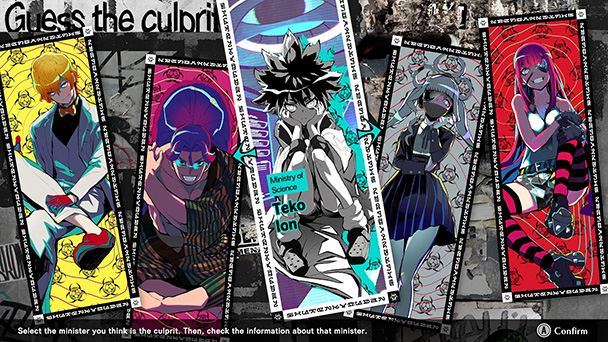
Come Join the The Cult of Kodaka
Shuten Order is split into five intersecting storylines, each one centered on one of the Order’s ministers. Curiously, each route delivers its own set of mechanics has offers an idiosyncratic tone. One revisits Danganronpa-style crime scene investigation, another tale morphs into something a bit like a frantic dungeon crawler, while others veer into romance, stealth horror, or even satirical sci-fi.
And while the genre shifts could make for a bewildering experience, each route is built around each minister’s personality and their relationship with Rei. This design decision helps keep the narrative engaging, offering novelty as you visit the different routes. Smartly, the art team uses a vibrant Studio Trigger-style aesthetic to help maintain cohesiveness.
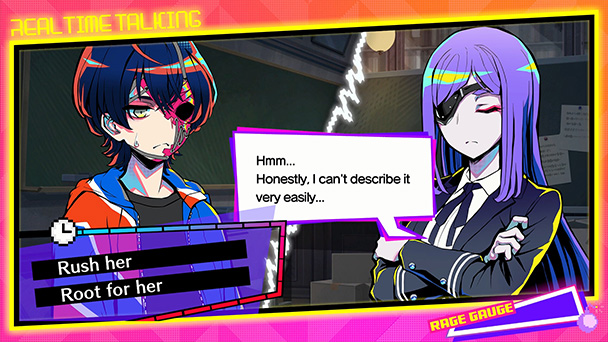
Five Ministers, Five Genres, Yet Cohesion
Deftly, Shuten Order’s different paths all contribute to Rei’s principal whodunit. Although each minister’s story offers its own exposition and predicaments, collectively they all fit together. Expectedly, the main murder mystery gets solves and the ambiguity of the death cult is clarified. But here’s the odd thing: usually when visual novel delivers these kinds of solutions, I have little interest in revisiting the mystery. But Shuten’s storylines are intertwined so meticulously, I was lured into revisiting the game’s routes, in search of details I might have overlooked.
Yet, a few elements discouraged a revisit. Some segments are slightly inferior to others, like Ushitora’s dungeon-crawling route. With a few overwhelming moments and the occasional pacing issue, I was content with just a single playthrough.
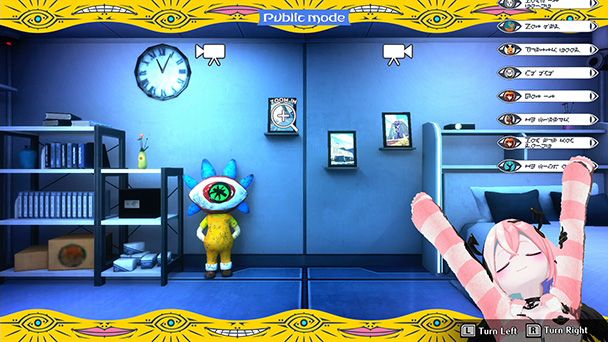
And while that’s subjective, Shuten Order localization issues aren’t. Sure, some are more compassionate towards typos and misplaced line breaks, especially with a script this large. But at times, Shuten’s sloppiness can cause confusion, when it’s not clear who is speaking or phrasing that’s so awkward I had to read the on-screen text multiple times. Sure, Rei’s body switching might cause some confusion with pronouns. But the lack of editing is conspicuous, undermining the emotional impact and unsettling humor that Kodaka’s works are known for.
Dread Drenched in Neon
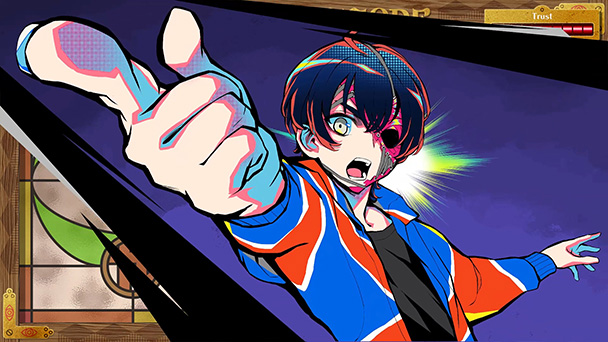
Visually, Shuten Order dazzles with bold lines, saturated colors, and attractive character designs that make every conversation a delight for the eyes. But it’s not just neon-colored eye candy. There’s a bit of stylized grit present to match the game’s darker themes, making sure the graphical style doesn’t clash with the subject matter. Meanwhile, Shuten’s soundtrack delivers brooding bass lines and spiky beats that help to either escalate a sense of tension or signal imminent dread.
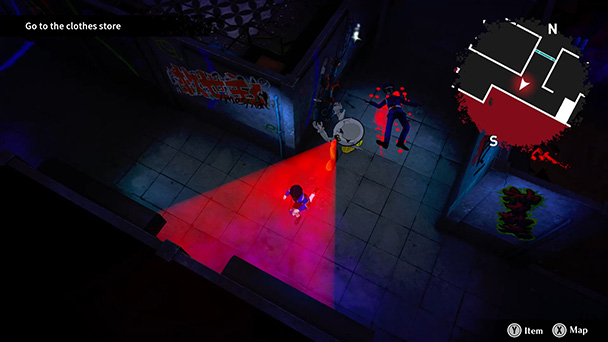
When compared with Kazutaka Kodaka’s previous titles, such as Danganronpa and Master Detective Archives: Rain Code, Shuten Order manages to feel both familiar and experimental. While some might differ, I’m glad he’s moved on from killing games and school settings. Instead, Shuten Order demonstrates Kodaka tackling larger, more philosophical topics and eschewing stagnation. Yet, there’s still that spirited sense of cynicism and well-crafted personalities. The writer has repeatedly stated that he won’t create characters he doesn’t like. As a result, every member of Shuten’s cast is intriguing, making the experience one of the best character studies to arrive this year.
Have Faith in Experimentation
Shuten Order is a flawed but unforgettable adventure. It’s an experience that grapples with ambitious ideas and a multitude of different mechanics. For fans of narrative novelty, it’s undoubtedly a rewarding journey even if the localization can be intermittently irritating. But ultimately, Shuten’s willingness to experiment compensates for any of its imperfections. While the game might not outshine any of Kodaka’s more celebrated works, it’s still a worthwhile rumination on belief and memory amidst the end of days.
Shuten Order was played on PC with review code provided by the publisher.
Overview
STORY - 90%
INTERFACE - 80%
AESTHETICS - 80%
ACCESSIBILITY - 80%
PERFORMANCE - 60%
VALUE - 80%
78%
GOOD!
Shuten Order is smart, stylish, and a bit messy. It’s a visual novel that bounces between genres and tones, striving for freshness as if the world will end in four days, and Kazutaka Kodaka still has some points yet to make. Look past the clunky localization and relish five routes penned by one of gaming’s most audacious storytellers.





Really looking forward to this. I’d say that Kotaro Uchikoshi is my favorite writer, but Kazutaka Kodaka is up there.
What’s the price going to be?
$49.99 in NA.