Blightstone Forces You To Live with Your Imprudent Decisions
Rewarding Patience, Planning, and a High Pain Tolerance

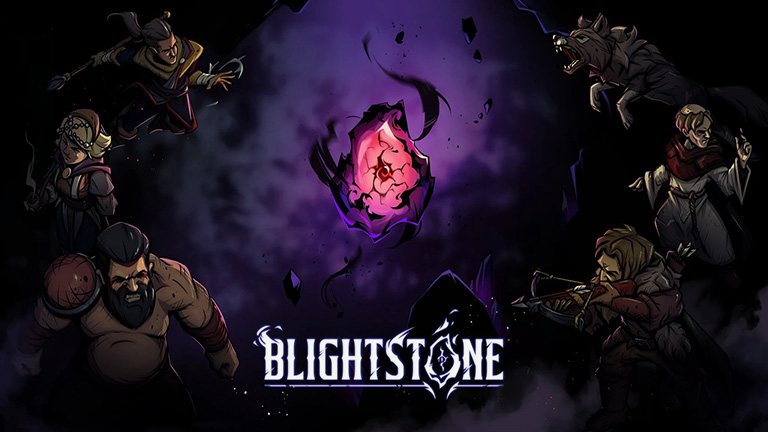
Blightstone is one of those uncommon tactics games that lures you with familiarity, before it begins to impishly defy your expectations. Set in a decaying fantasy world, Barcelona-based indie Unfinished Pixel latest effort tasks you with escorting a delicate crystal through hostile territory. Remarkably, the game blends turn-based strategy with roguelike structure in a way that forces you to live with your decisions.
Sure, encounters might be small in scale, but they are high in stakes. Typically, Blightstone’s systems are tuned so that a single careless choice can result in disaster. While that design decision is going to contentious, turn-based masochists like me will appreciate the rare thrill of toppling astronomical odds and coming out on top.
Small Oversights Can Lead to Catastrophic Consequences
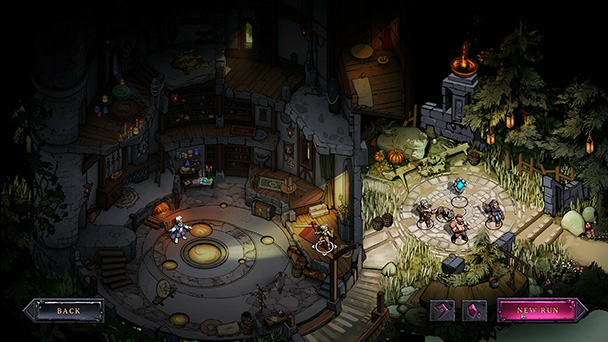
At heart, Blightstone is a squad-based game where you protect the Earthglass crystal as you push across procedurally generated maps. Rather than focusing on a single hero, you assemble a party drawn from several distinct classes, each with its own skill pool, items, and campfire abilities, and then guide them through a branching overworld of combat nodes, merchants, mini-bosses, and events.
Layered on top of this is a remarkable roguelike loop. When your expedition inevitably falters, time rewinds, your fallen companions return, and most of your progress is wiped. But hidden far in Blightstone’s backstop is a meta-progression system that strives to make the next run a bit more feasible. This results in short but intense plays that feed into long-term upgrades. While that roguelike approach is common, it’s not often applied to turn-based tactics.
No Grids, No Mercy
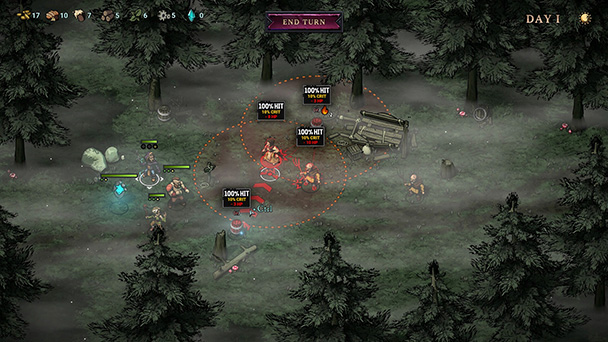
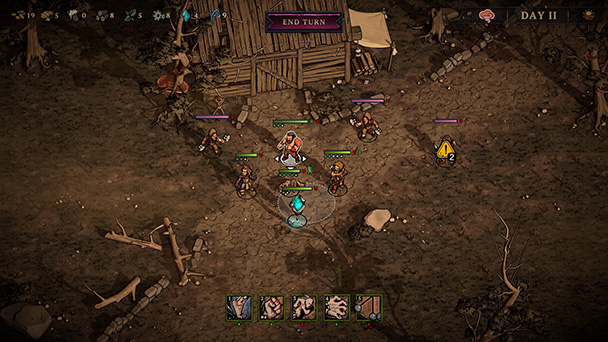
Undoubtedly, combat is where Blightstone distinguishes itself from its grid-based peers. Instead of confining units to tiles, the game uses a free-movement system where positioning, line of sight, and cover matter as much as raw stats. As such, you are constantly nudging characters around boulders, ruined walls, and environmental hazards, trying to eke out better angles while not leaving your backline exposed.
However, enemies enjoy the same capability, so careless advances are quickly punished with flanking attacks or area-of-effect abilities that reprimand clustering. It’s a procedure that rewards prudent spacing and planning over brute forcing your way through encounters. Yes, damage numbers matter. But leaving a unit in a vulnerable state can quickly lead to your downfall.
Explosive Solutions to Tactical Challenges
I like how Blightstone embraces environmental interaction, and this is where some of the game’s best moments happen. Explosive barrels can be detonated with ranged attacks to wipe out bunched enemies or break stalemates behind cover, and terrain features like pits, holes, and traps help to keep things interesting. Some classes, especially the more magical or brawler-style heroes, can use telekinesis or knockback to fling barrels and traps across the battlefield or straight into enemy lines. Things get thorny against flying enemies since they’ll elude basic ground-based hazards, providing Blightstone with some brain scratchers.
The game’s weather and status systems add another layer of detail without feeling like pure gimmicks. Combat arenas feature conditions like rain that might boost lightning magic while dampening fire attacks. On top of that, tactical staples such as bleeding and other forms of continuous damage can quickly spiral if you overextend or neglect your support abilities. Since your resources are intentionally constrained, deciding when to attempt high-risk, high-reward elemental combos versus safe, conservative action becomes a tension in most fights. Basically, Blightstone expects you to glean every single advantage that you can think up.
Losing Time and Health With Every Step
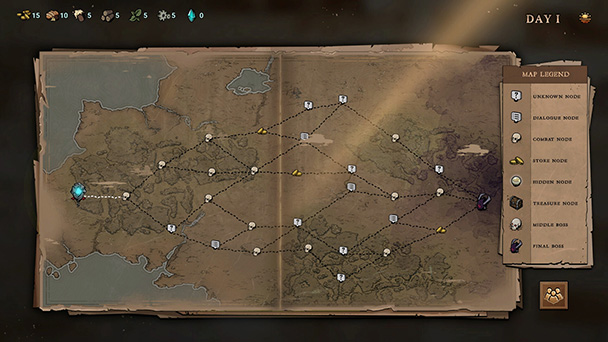
Blightstone’s overworld and time cycling inject a bit of variability. Each run offers a branching route toward a boss encounter, with icons marking combat, merchants, mini-bosses, and events. Expectedly, you’ll forge your path while evaluating your party condition and tolerance toward risk.
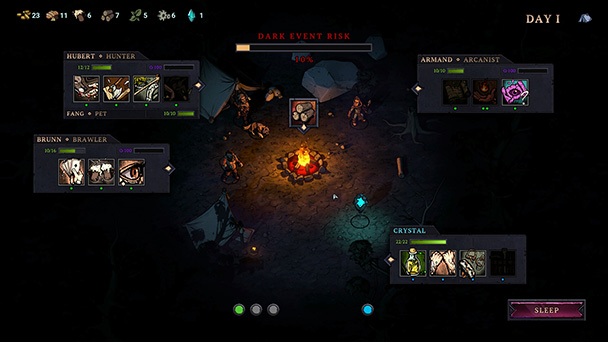
Meanwhile, time is divided into morning, midday, and nightfall, and each step forward on the map advances the clock, influencing what you might run into and how worn-down your team feels. Campfires are crucial waypoints where you can trigger class-specific campsite abilities, patch up the party a bit, or manipulate upcoming challenges, but they aren’t numerous. The result is a journey that feels precarious, and each successful encounter seems like a substantial victory.
Progress, Earned the Hard Way
Meta-progression is rooted in systems like Continuum Forge and Earthglass upgrades, which carry over onto future runs. As you gather resources like Strands of Time, you’ll unlock runes, and passive bonuses that provide perks like extra movement, more health, improved critical chances, or even the ability to revive a character.
These broaden your tactical toolbox and soften the sting of failure without compromising the underlying difficulty. Decisively, enemy AI does not scale down to accommodate you. Instead, it remains obstinately sharp, forcing you to improve your play rather than relying solely on stat inflation.
Adapt or Die
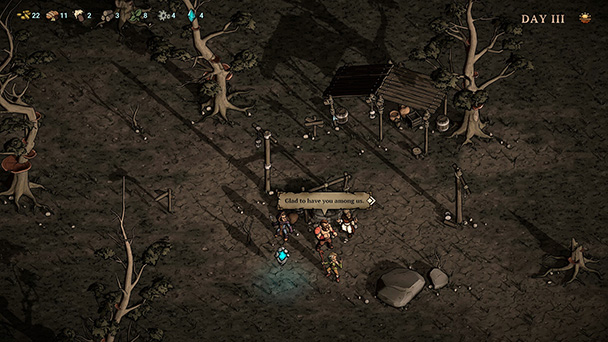
Class design and party-building are two more of Blightstone’s tactical highlights. You’ll typically begin runs by choosing three characters from a pool of five hero classes, with the druid and priest unlockable through play. Expectedly, each have their own distinct skills, item synergies, and campsite conveniences. As such, prudent party composition is crucial, since a team that’s too fragile, too support-heavy, or lacking mobility will be your Achilles’ heel. There’s something sadistically sinister about knowing what your downfall will be.
Protecting the Earthglass crystal turns out to be a persistent tactical constraint, shaping how you position tanks, controllers, and damage dealers so that the crystal is never an easy target. Here, Blightstone’s game’s philosophy becomes clear: it trusts you to live with your early decisions and learn from them, rather than always letting you fix things.
Punishment Is the Point
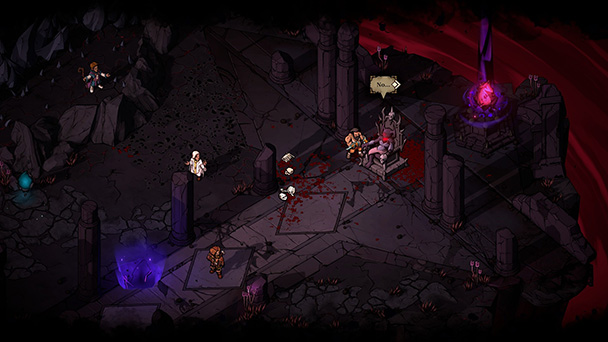
Yet, for all its strengths, Blightstone’s commitment to punishing design and complexity can also be a barrier. Runs can feel brutally unforgiving, especially early on, as the combination of smart enemy AI, limited healing, and unforgiving resource management punishes even small mistakes and may demand several restarts before you’re able to delve deeper.
Because so much is communicated via map icons, subtle weather cues, and class-specific nuances, the learning curve can be steep, and players expecting flashy, story-based progression may find the narrative framing thin compared to the mechanical focus. Some encounters flirt with feeling too punative, where a single bad environmental interaction like an explosion or misplaced knockback, can cascade into a full party wipe. Whether that feels thrilling or frustrating will depend entirely on your tolerance for roguelike mercilessness. I’d expect Unfinished Pixel to be driven into including accommodations for audiences expecting a bit of leniency as the title heads for a full release across the next six to twelve months.
Blightstone was played on PC with Early Access code provided by the publisher.




So, you’re saying I have to live with my bad decisions. So, like spending all my money on handheld devices?