Xenotilt review
A $20 Visual Acuity Test


The old idiom, “keep your eye on the ball” is pertinent when it comes to pinball. Here, success comes by vigilantly tracking the rolling sphere as it ricochets off bumpers, is flung upward by flippers, or careens toward the dreaded drain hole. Intriguingly, developer WIZNWAR and FLARB’s Xenotilt does everything it can to distract you from keeping your retinas on its whizzing sphere.
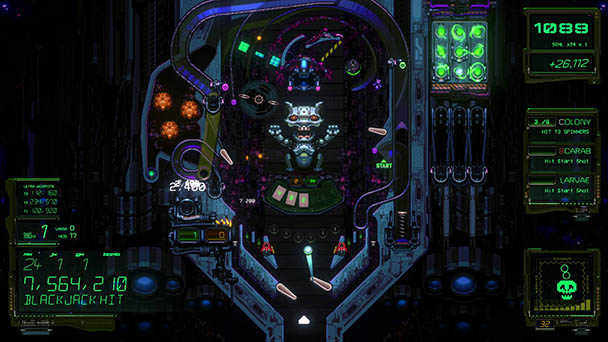
Most of the visual mesmerism is rooted in a brilliantly excessive use of visual effects. Like Jeff Minter and Housemarque, Xenotilt’s designers are chasing sensory overload. Expectedly, the game’s ball rolls sinuously across the game’s tri-sectioned, Compile-inspired table, whirling through habitrails positioned on the periphery. But sometimes the orb will get saved from exiting through the gobble hole and be carried in a silky animation that liquifies the sphere before reassembling it. The entire transition completes in a fraction of a second. Well, if you actually see it happen.
Can Xenotilt Revive Dead Pixels?
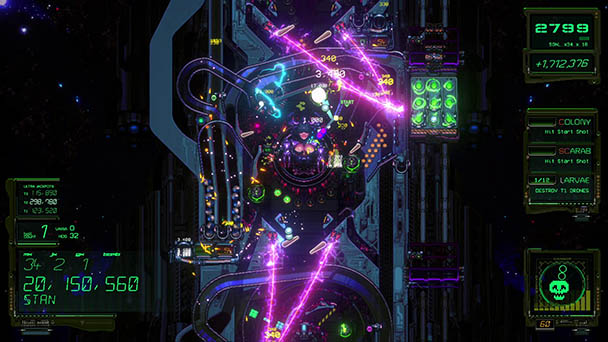
Now here’s the wild thing: Xenotilt’s playfield is absolutely packed with features like this. The result is an experience where neon-hued ball trails, overlapping explosions, silky lasers, and targets all around dance simultaneously, resulting in a memorizing maelstrom of activity. Hostile Pinball Action is probably like seeing the Las Vegas Strip at night for the very first time. Under the influence.
It’s well known that movement is a powerful visual stimulus. Once a plunger hurls a ball into play, dozens of different table features are spinning, juddering, jerking, and flashing. But if you’re like me, the ocular overload feels like a warm drip-feed of dopamine, the “happy hormone”. Not even bullet hell games exercise your eyeballs quite like Xenotilt. It’s remarkably hypnotic on a sizeable television screen capable of delivering inky blacks and luminous hues.
Underneath the Imagined Glass
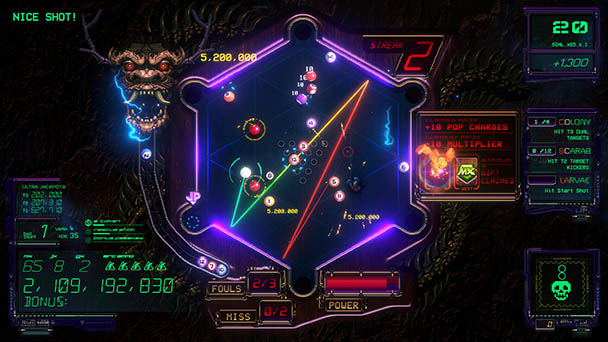
But once you’re able to peer past the visual pandemonium, Xenotilt delivers several noteworthy innovations. Most remarkable is the inclusion of turrets on the playfield which can lock on and fire at enemies with a downward press of the analog stick. But before clearing the table of any pesky opponents so you can aim that skill shot, you’ll need to secure ammo by colliding into medals adorned with an “A”.
Another cool innovation is the Multiball Matrix, a three-by-three holding chamber that moves vertically on the right side of the playfield. If you’re proficient enough to enter the Matrix, you can select which column you want to place it. Satisfyingly, each spot provides a different perk, like additional ammo or an airlock that sucks out enemies. Stack a trio of balls, and you’ll earn a shot at unleashing multiball, which flings Xenotilt’s graphical overindulgence into absolute overdrive. If you can follow the action, you’ve probably evolved into a higher life form.
Groans and Moans
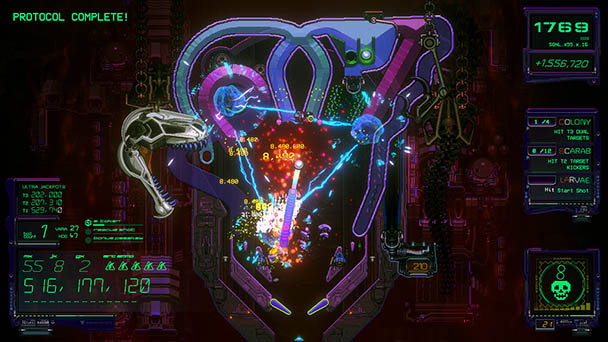
Like the inclusion of multiball, Xenotilt offers several other rudiments. Occasionally, you can use the analog stick to give the ball a nudge to prevent a disheartening drain. But given the amount of activity on the table, it can be difficult to feel the influence when you give the orb a bump. The presence of a trio of opponents on each level function as the game’s boss battles. If you do manage to defeat these baddies, they leave behind a pulsating red core that can be bashed for a tidy bonus.
But instead of just a succession of skillshots obstructing each takedown, the enemies here push back, filling their region with bullet hell-style hindrances to protect themselves. Whereas Demon’s Tilt embraced the occult, Xenotilt unsurprisingly takes on gritty sci-fi, resulting in the obligatory bot who emits suggestive utterances, much like Bally’s Xenon table.
A Crew of Passive Bonuses
Outside of the main game, EX-Mode provides meta-game progress. Here, you can use earned tokens to unlock survivors, who can then be hired to apply new perks. But as much as I favor Xenotilt’s eschewing of reality over the staunch simulation of Pinball FX 3, Zen Studios has the edge with its more granular upgrades. It’s a worthwhile incentive but undoubtedly needs additional depth.
Fortunately, that one shortcoming is counterbalanced by two additional game variations. Hardcore Mode ratchets up the intensity with a nearly filled Matrix, a single ball, and smaller flippers. Meanwhile, Crisis Mode is the game’s interpretation of time trial, with target takedowns rewarding challengers with additional playtime time. Given these skill shots can put the ball in precious positions, Crisis is fueled by an absorbing risk-reward system.

Conclusion
Xenotilt is an unapologetic sensory onslaught. It’s a game that embraces chaos not as a consequence, but as a defining quality. Its relentless barrage of neon flares, particle bursts, and mechanical flourishes creates a kind of hypnotic challenge where simply keeping track of the ball becomes half the battle.
Beneath that visual storm is cleverly designed pinball experience, packed with inventive mechanics like turret fire and the Multiball Matrix that push the genre forward in bold ways. While its upgrade system could use a bit more depth, the sheer intensity of its modes and the intoxicating audiovisual design make Xenotilt an irresistible test of reflexes and focus that dares your eyes to keep up.
Xenotilt was played on PlayStation 5 with review code provided by the publisher.
Overview
GAMEPLAY - 85%
CONTROLS - 80%
CONTENT - 75%
AESTHETICS - 85%
ACCESSIBILITY - 75%
VALUE - 85%
81%
VERY GOOD
Xenotilt tests not just your pinball ability but also your visual acuity across its manic, multitiered table. As you’re chasing scoring opportunities and battling bosses the playfield springs to life with particles, plasma beams, and a procession of explosions.





Does this support 4K?