The Riftbreaker review
EXOR Studios Expands its Chaotic Sci-fi Survival Strategy Sandbox

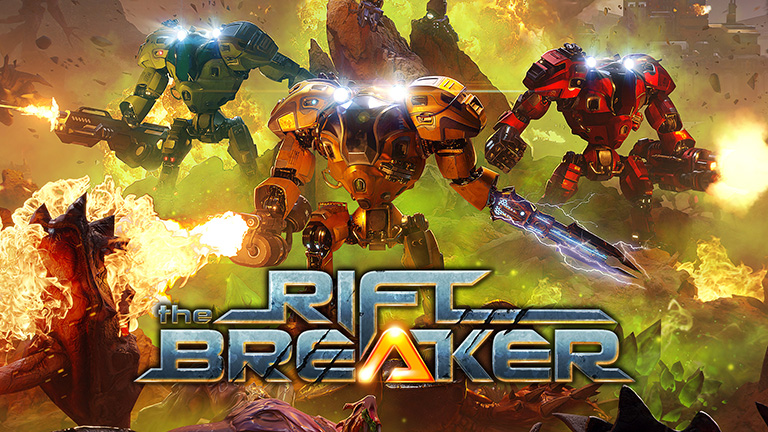
Immediately after landing on Galatea 37, intensity escalates for Captain Ashley S. Nowak. Tasked with building a portal that would permit travel between this undomesticated outpost and Earth, she’s assisted by a sentient mechanical suit she refers to as “Mr. Riggs”. While Galatea 37 is undoubtedly a beautiful planet filled with all kinds of wild flora and fauna, it’s also exceedingly perilous. Within moments of starting the campaign, you’re warned of an imminent attack by native aggressors who seem to despise your attempt at interstellar colonization.
Like many real-time strategy titles, you’ll need to hit the ground running. This entails either using your rig for leisurely resource collection or following tradition and constructing structures to mine Carbonium and Ironium for you. The first resource is essential for building power plants, the latter for constructing the eleven types of sentry towers that can help Captain Ashley and her mecha suit repel Galatea’s roving attackers. But you’ll need the deftness and dexterity of a globally ranked StarCraft player to follow Mr. Riggs’ initial request to build six defense structures in a few minutes.
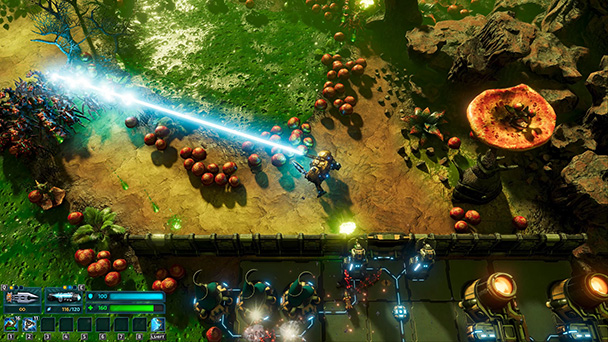
You see, each of your sentry towers require power. So, you’ll have to build an array of wind turbines and solar panels. Additionally, you might want to invest in a storehouse for your energy supply. Diversity is key here since turbines earn a relatively small yield, while the game’s day/night cycle can temporarily halt the accumulation of solar energy. Additionally, there is the requirement to drop power nodes to connect every structure. Know that you’ll be doing this across multiple bases spread out across different biomes. As such, you’ll probably wonder what Ashley did to receive this type of Sisyphean punishment. But don’t worry too much, advanced power sources means this only an issue for the early game.
Shoot Your Troubles Away
Riftbreaker, with its persistent warnings of imminent attacks, can be nerve-wracking, but it’s rarely torturous. What helps you keep your sanity are the moments of offensive might. Mr. Riggs, with up to three weapons on each arm, is a proverbial powerhouse. Whether using a flamethrower to exterminate crowds of weaker foes or a railgun to batter remote ones, the sweet taste of revenge balances against the acerbic tang of keeping your bases operational. Much like EXOR Studios’ previous effort, X-Morph: Defense, being able to blast foes on your own, rather than leaving all the work to turrets, can be gratifying.
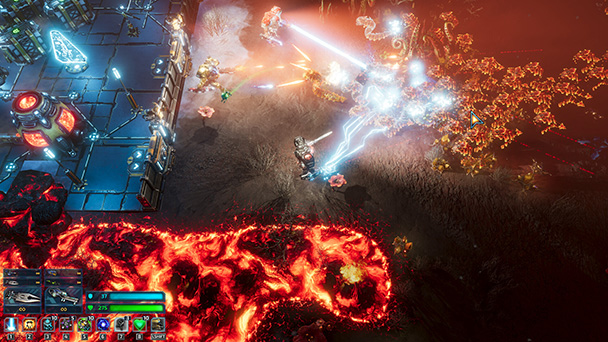
Expectedly, your loadout isn’t fixed, and The Riftbreaker provides plenty of options to complement your playstyle. Much of this is rooted in the game’s trio of research trees, which offer a myriad of variances. While the icons aren’t always immediately identifiable, experimentation produces an array of new artillery, armor, items, buildings, and special skills. Additional variance is rooted in the game’s weather system, where downpours will have you scrambling for a replacement for solar power and meteor storms can decimate your defenses. Yes, few things are more disheartening than an onslaught after a natural disaster, but The Riftbreaker wants you to feel the joy of clawing your way back from impending doom.
The game delights in tossing adversity at you, making you feel like Matt Damon in an especially masochistic reworking of The Martian. But unless you lose your base, you’ll be able to keep working toward your goal of building that interstellar portal. Mr. Riggs even respawns when he’s overwhelmed. Sure, you’ll have to reclaim your arsenal and likely patch up some structural damage, but defeat can often be thwarted by some defensive preparation. As such, Riftbreaker can feel like a war of attrition, testing your persistence and mettle across a campaign that can stretch past the forty-hour mark. For those who aren’t interested in such a lengthy conflict, the game allows you to tweak a multitude of difficulty settings.

How’s PC Performance?
Running on EXOR Studios’ own Schmetterling engine, Riftbreaker is a technical showcase on PC. Graphical options are delightfully granular, offering control over everything from resolution, texture, and shadow quality. If your graphics card permits, there are opportunities for ray-traced shadows and ambient occlusion as well as FidelityFX Super Resolution, Variable Shading, and Sharpening. Generally, framerates over sixty frames per second can be achieved with most modern cards but know that ray-tracing will present about a twenty percent reduction in fluidity. But, if you’re lucky enough to own an RTX 5080, know that Riftbreaker allows for some flexing of computational muscle.
But do be aware that a few rough edges remain. Some early-launch bugs, such as turrets wasting ammunition by firing into nearby walls, have largely been patched out, and the biome systems are generally more stable than they once were. The poisonous swamp and its aggressive flora still present a threat, but now more as an intended environmental challenge than a glitchy one. Where the game can still stumble is in its controls: while mouse and keyboard offer precise construction and management, the controller scheme can feel unwieldy, and placing buildings with pinpoint accuracy isn’t always easy.

The Riftbreaker has continued to receive steady post-launch support from EXOR Studios, and the World Expansion IV update represents one of the game’s most substantial free additions to date. The showcase feature is Open Campaign, a new mode that removes the traditional story-driven progression and lets players chart their own path across Galatea 37. Instead of following narrative missions to unlock new regions, players can choose their starting biome from the outset and expand outward at their own pace. The overall objective of constructing the Prime Rift Station to return to Earth remains intact, but the journey there is far more open-ended, making the mode appealing for experienced players who already understand the game’s technology tree and survival systems.
World Expansion IV also introduces the Cryo Fields, a frozen biome filled with glaciers, snow-covered terrain, and extreme temperatures. While hostile to infrastructure and energy production, the region contains natural deposits of Supercoolant, a resource that previously had to be manufactured through processing chains. The Cryo Fields are far from lifeless, however. Native Galatean fauna have adapted to the harsh climate, bringing new enemy types and attack patterns that require different defensive strategies than those used in warmer or more toxic environments.
The update further expands the player’s toolkit with several new defensive structures and utility options. New towers, such as the Icicle Tower, Inferno Tower, and Shredder Tower add specialized crowd-control and damage capabilities, while additional storage and infrastructure upgrades help players manage the increasingly complex logistics of multi-biome expansion. Open Campaign also allows outposts to be established across all available environments, meaning resources like Morphium from the Metallic Valley or Fungal Resin from the Fungal Swamp can be gathered without the strict narrative gating present in the original campaign. Perhaps most impressively, World Expansion IV is a free update for all existing owners of the game, further demonstrating EXOR Studios’ long-term commitment to support The Riftbreaker’s player base years after its initial release. It would be great to see more publishers show this kind of generosity.
Conclusion
Often, mixing this many genres together can result in a convoluted muddle. But The Riftbreaker skillfully balances its stack of responsibilities, resulting in an experience that is persistently engaging and habitually hectic. While a bit of recreation can be found in the game’s sandbox mode, EXOR Studios’ latest excels when you’re narrowly dodging attacks on multiple fronts.
The Riftbreaker was played on PC with review code provided by the publisher.
Overview
GAMEPLAY - 80%
CONTROLS - 80%
CONTENT - 90%
AESTHETICS - 85%
ACCESSIBILITY - 75%
VALUE - 85%
83%
VERY GOOD
While the banter between Ashley and Mr. Riggs might make you think this is a tranquil base builder, The Riftbreaker is much more. Encompassing everything from twin-stick shooting to crisis management, you’ll might just teleport from Galatea 37 with an improved sense of self-esteem after dealing with everything that’s thrown at you.