Gunning and Grazing with Bikkuri Software
On doujin development, genre democratization, and DoDonPachi II


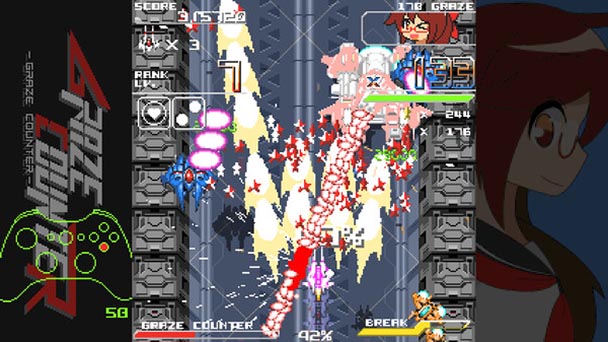
In the world of indie shoot-’em-ups, few names have earned as much quiet respect as Bikkuri Software, a small but remarkably consistent doujin circle known for refining the spirit of arcade-era STGs for a modern audience. Their works, from Graze Counter to the soon-to-be released Revolgear Zero, mix familiar bullet-hell tension with accessibility and style. Recently, we spoke with Necobi Shirogane, who has guided the circle for over a decade. Here, the founder and lead developer, pull back the curtains on Bikkuri Software’s development process, philosophy, and how they keep the joy of “blasting enemies to cool music” alive.
Tech-Gaming: Sadly, we don’t often get many behind-the-scenes glimpses of life at doujin circles.
We’d appreciate it if you could walk us through the production process of one of your titles. How does the team at Bikkuri come up with the concept for a new STG?
Bikkuri Software: Regarding our development process, first, I prepare a prototype that’s playable at a basic level, enough that you can move the player ship around, and share it with the team along with a simple plot outline. Some developers start by putting a lot of effort into building the story and world from the very beginning, but I feel that method doesn’t communicate what kind of game it should be to the rest of the team clearly enough. That’s why I always create a prototype that lets people experience the core systems firsthand.Around this time, I also provide a list of the type of background music the game will need with our music person.
Once the game becomes reasonably playable, we exhibit it at events or run closed tests to gather feedback. We don’t simply look at exactly what players say and make changes based on their comments at face value, but we do take it back with us as reference material. When we identify real issues among the feedback we received, we revise the game accordingly. By repeating this cycle over and over, we steadily refine the game and move closer to completion.
In the early to mid stages of development, we also hold weekly meetings every Sunday night on a dedicated development Discord server. We’d share schedules, discuss issues, and make sure our direction stayed aligned. Before Discord existed, we did the same thing using Skype. We’ve been working this way for over ten years now.
I handle most of the actual development myself, but even during periods without meetings, I try to provide progress updates as much as possible. If other members can’t see what I’m doing, they naturally start to get anxious. I want to show that I’m actively committed so we can continue working together with the same great team in the future. Trust is more important than anything.
As for coming up with concepts for new STGs, I guess you could call my approach a “democratization of the genre.” I want people of all generations to enjoy these games, so I aim to make games balanced in a way in which players can still have fun playing even as they get older.
To me, STGs at their core are all about the joy of blasting enemies to cool music. I want to share the experience of that sort of raw, primal type of fun with as wide an audience as possible. Also, since my games might be someone’s first STG, I do my best not to cut corners on how the game feels to play. From a developer’s standpoint, making the explicit goals in the game too difficult creates a risk that players may never actually see much of the content we worked so hard to create. Personally, I also find it tiring when a game I am playing starts to feel too difficult. In trying to avoid that sort of bleak situation, I build the game while always keeping in mind how I can make the experience feel welcoming.
I designed all my previous titles with this same philosophy, and the feedback from players so far has been very positive. This mindset is something I want to continue valuing in all future projects.

T-G: How large is the doujin circle, and what is everyone’s role?
BS: We’re a four-person team, and we’re all from the same university and student circle.
Nekobi Shirogane (白銀ねこび)
Circle representative; game design; all programming; all in-game pixel art; sound effects.
Background: Civil engineering.
That’s me. I handle overall development, and I’m the root cause of dragging everyone else into my ideas and all the trouble that entails.
Motchi^3 (餅々々/もっちもっちもっち)
BGM; some illustrations for Revolgear Zero; designs for the Stage 2 boss and final boss.
Background: Mechanical engineering.
In addition to being in charge of music, he supports the circle in many ways and has an incredibly versatile set of skills. In addition to providing fantastic tracks, he gave smart gameplay suggestions, takes meeting minutes, and even created demo illustrations during Revolgear Zero’s development. I like his music so much it’s even in my morning commute playlist.
Kei Hagamo (羽鴨 慧)
Scenario-related text management.
Background: Information engineering.
He has experience as a scenario writer in other genres and helps fine-tune in-game text. He’s very knowledgeable about IT and even taught me basic programming concepts like if/else when I first started using GameMaker. It wouldn’t be an exaggeration to say he changed Bikkuri Software’s fate. Recently, he’s also been a key figure in helping set up our Unity development environment.
Potato M (ポテトM)
Character design and illustration (support role).
The two others I mentioned were both in my same year at university, but Potato M was my junior. He handled the protagonist illustrations for Revolgear Zero and all character art in Graze Counter GM. The speed at which his art skills improved made me think: “This guy is usable!” and immediately pull him, perhaps a bit forcefully, into our circle. I don’t know anyone who could be better at bringing out the cuteness of our game’s characters than him.
T-G: Do members balance other full-time work in addition to your game development?
BS: Yes. Everyone works full time and develops the games in their spare time.
I usually had about two to three hours per day, and I focused on moving the project forward within that window. On weekends, I worked on core game systems; on weekdays, I handled tasks that required less mental load, like level design or adding graphics.
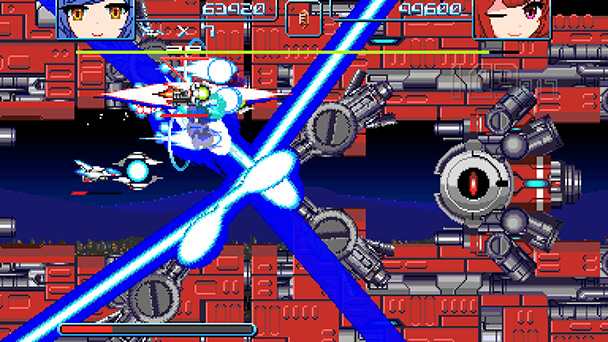
T-G: For a game such as Revolgear Zero, do any mechanics emerge through team suggestions? Or does the final product typically adhere to the original idea?
BS: In principle, development follows the original idea, but it almost never takes shape exactly as planned. Specifications that seem unrealistic often get cut. If about 60% of the original ideas survive, I consider that a good outcome.
As I mentioned, I frequently consult with our BGM composer about mechanics. He observes the game very closely and consistently offers the best improvement suggestions. For example, limiting the number of buttons to three to reduce control difficulty, and the marker-based Bit Shoot system (Psycho Bit), were his ideas. Without him, I don’t think the game would have reached its current form.
T-G: Your games build on STG foundations while pushing the genre forward through grazing and combo systems. What’s the key to balancing tradition and innovation?
BS: The key is encouraging players to take active action and truly participate in the game. Traditional STGs often push players into playing passively due to how easy it is to die, or other factors like that.
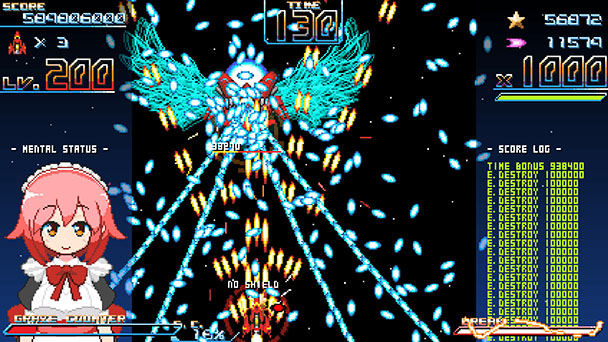
Just as parry-based systems have become popular in modern action games, offense–defense integrated systems are widely appreciated. Enemy attacks are intense, but players can trigger Graze Counters or Burst attacks at moments of their choosing, creating a chance to turn the situation back in their favor. I aimed to create an STG version of this offense–defense dynamic that produces a sense of “moderate stress.”
This type of gameplay also encourages improvisation. Even if players forget patterns or don’t memorize routes, they can reset situations at will. It’s similar to dodge rolls or step evades in action games. Classic STGs had bombs, but once you used them up, that was it. To keep the game flowing and reduce psychological pressure, powerful actions are tied to gauges that recharge easily.
(The core gauge system was inspired by the energy mode in DoDonPachi II. A fact I imagine gamers were sure to have picked up on.)
I also kept the scoring system from becoming overly complex, aligning optimal play with core mechanics. By simply using the systems as intended, players naturally earn higher scores, gain extra lives, and clear the game more easily.
T-G: The STG genre can be tough on newcomers. Where did your push toward accessibility come from?
BS: The decisive turning point for me was Taito’s RayStorm. I loved both its design and its game world, but it was so difficult that it took me two full years to achieve a one-credit clear. Sure, you can easily see the ending by using continues, but then the game ends very quickly, and then one gets this lingering sense of incompleteness from not clearing it in one run. High difficulty has always been part of arcade games and STGs, and I do acknowledge that overcoming that challenge can be rewarding. However, I felt it would be too harsh to impose that expectation on modern players. As a result, in my own games, aside from specific difficulty settings, I try to avoid extreme sudden spikes in difficulty.
Many STGs I know also lack a proper introduction, and don’t really feel like they’re inviting players in. That’s why I implemented a Mission Mode that allows players to learn the systems through real game play and have it be a part of completing the game. This is more a matter of my personal values, but achieving a one-credit clear is an incredibly satisfying accomplishment. Part of this approach was my attempt to see whether that sense of achievement could be shared more widely through my games.
In addition, Revolgear Zero allows players to change the color of enemy bullets, further expanding player choice. This was implemented as an experiment, but I hope it proves helpful to someone.
If we dig deeper into the topic of difficulty, there’s been recent discussion about whether difficulty selection should exist at all. Personally, I think that games having a single, unified difficulty, where everyone shares the same experience, is the most elegant approach. That said, I don’t feel the same way when it comes to STGs. Designing a single difficulty well also requires extremely high technical skill from the developer.
STGs are a niche genre, and with so many games out there, having someone pick up your title at all already feels like a miracle. Taking psychological barriers into account, we’ve also adjusted how difficulty is presented. For example, labeling the lowest difficulty as NOVICE rather than EASY, and positioning it as the standard experience.
I see games as a form of non-verbal communication, and if possible, I want players to leave feeling good after playing. If STGs ever reach a point where selling a million copies is normal, then maybe we can go back to provoking and challenging players more aggressively, but I don’t think that day is coming anytime soon.
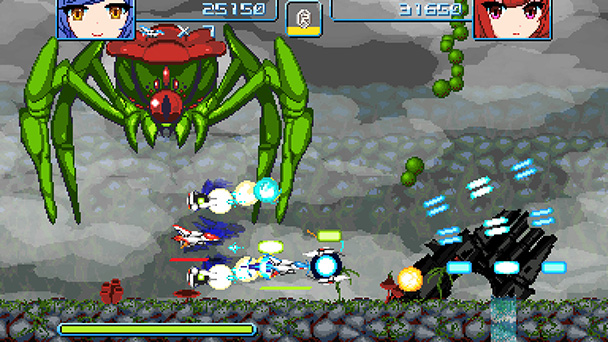
T-G: Revolgear Zero boasts an impressive weapon system. How important was balance?
BS: Players have standard weapons and always-available Burst attacks. Neither is allowed to become too overwhelmingly powerful. That said, if game balance feels too flat, discovering strong combinations ceases to be fun.
That is why some equipment is intentionally strong, others intentionally weak, and higher cost doesn’t automatically mean better performance. Perfect balance isn’t always necessary.
I encourage players to experiment using the Training Tool, which lets you test all combinations freely. If someone finds an interesting setup, I’d love for them to tell us. Initially, weapon options are limited by ship type, but once certain conditions are met, all ships can reach equivalent performance so I hope players try everything.
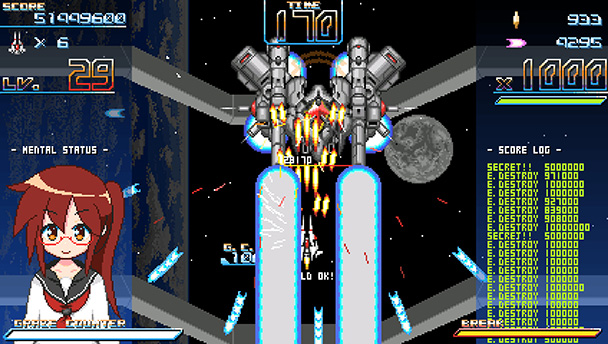
T-G: Bikkuri’s mascot is Ginyose Uzuki from Graze Counter. What’s something we might not know?
BS: Some characters contain elements tied to my real life friends and memories as easter eggs.
For example, “Ginyose” refers to a variety of chestnut that is a local specialty of my hometown, which also influenced his hair color.
In Graze Counter GM, the protagonists have more unusual settings, but they’re based on the idea that anyone has the right to save the world. By the way, Uzuki isn’t transgender, nor does that concept even exist in his world. He simply exists as himself in a society free enough that no such distinctions are even necessary.
T-G: Is there any chance of revisiting KIRISAME BLADE 2?
BS: There are no plans to revisit it, but I’m currently developing an action game starring Kiriko Kirisame, a character born from KIRISAME BLADE 2. She also appears as a playable character in Graze Counter GM.While the visuals and systems are completely different, the core, offense–defense gameplay, risk-reward tension, and exhilarating action, will remain.
There’s no clear release window yet, but I hope people look forward to it.
T-G: What makes a STG special?
BS: A game that makes you want to return to it after already playing it. Sometimes I revisit games from my childhood because I want to hear that music again, or hear that character’s voice one more time. A “special STG” is one that becomes part of someone’s memories or emotional support even if it doesn’t necessarily have anything to do with the game ‘s gameplay mechanics. That’s my current goal.
T-G: What’s one of the most gratifying remarks the team has received?
We’ve heard stories from players that say they started playing 2D STGs because of Graze Counter GM. We’ve even heard of pro fighting game players and FPS developers, people seemingly unrelated to STGs, enjoy our games too. We didn’t expect to hear stories like that, but I hope that my games continue spreading like a meme and positively influencing others.
Tech-Gaming would like to thank Necobi Shirogane and the rest of the Bikkuri
Software Team, Piro, and Nate for their assistance with this interview.




Nice work! I read the whole thing. I’m glad you focus on smaller developers instead of just the big publishers.
I’ll be getting Revolgear Zero on release day!
STGS ROCK!!!!
Nice work. Keep these kinds on interviewing coming!
Hello Bikkuri circle,
Thank you for your games. I really love Graze Counter.
Love from Brazil,