Hermit and Pig review
A Quiet RPG Where Conversations Can Cut Deep

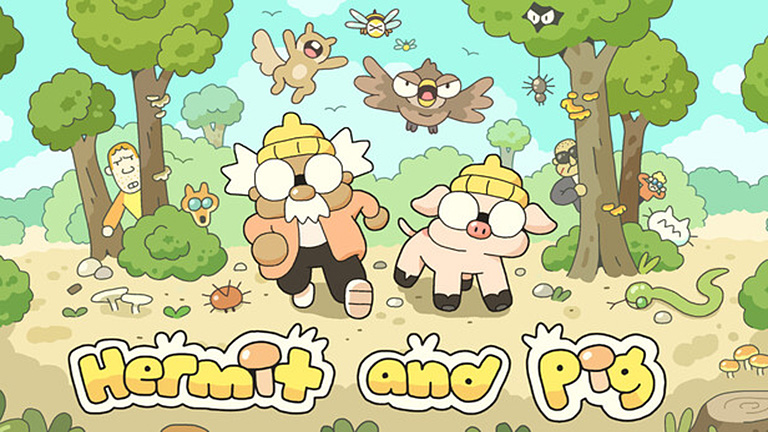
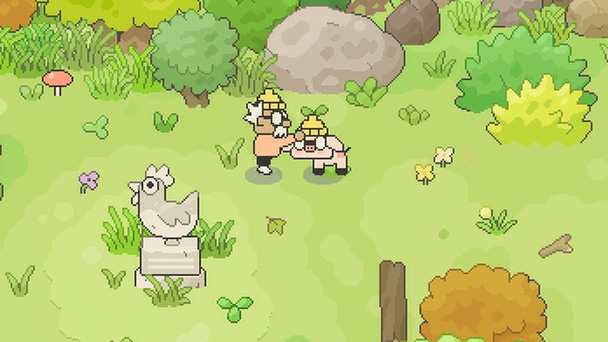
When you first boot up Hermit and Pig, the game kicks off with the kind of gentle confidence that’s unusual in the RPG genre. There are no sweeping orchestral fanfares or any kind of world-ending prophecy immediately pushed on you. Instead, you’re introduced to two unlikely role-playing companions: a recluse and his pet pig.
The pair are soon sent shambling into a world that’s alive with evocative details. You’ll trek across weedy grasslands, uncovering obscured pathways on your quest to forage mushrooms. You’ll come into contact with a mysterious blue haze, that launched you into Hermit’s hallucinogenic trip, as you float past clouds, hearing phone touchtone sounds.
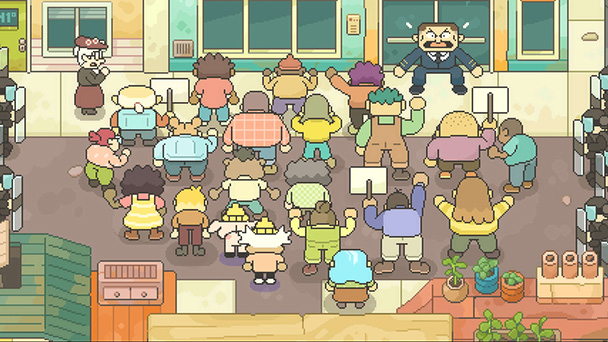
Yes, this isn’t the RPG you’re probably expecting. Hermit and Pig is quieter, stranger, and in many ways, more rewarding than your typical genre entry. The closest point of comparison might be something like Earthbound (aka Mother) series. But even that’s an indirect juxtaposition given some of the themes Hermit explores.
The Sting of Awkward Conversation
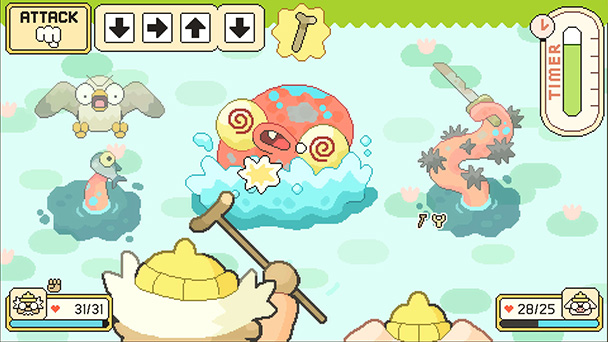
Most role-playing games treat combat as a core form of interaction. Whether you’re navigating a fantasy epic or a post-apocalyptic wasteland, battles habitually pit heroes against enemies, who’ll all trade blows until one team runs out of HP. And undeniably, Hermit and Pig adheres to that tradition, albeit with optional button command strings, and defensive showdowns with timing-based meters. Sure, it’s a bit clucky at first as you struggle to understand what developer Heavy Lunch Studio is trying to convey (combat is a struggle for an older recluse?). But before long, you’ll glean enemy weaknesses, study their habits, and feel like a warrior sexagenarian who spent some time with Paper Mario.
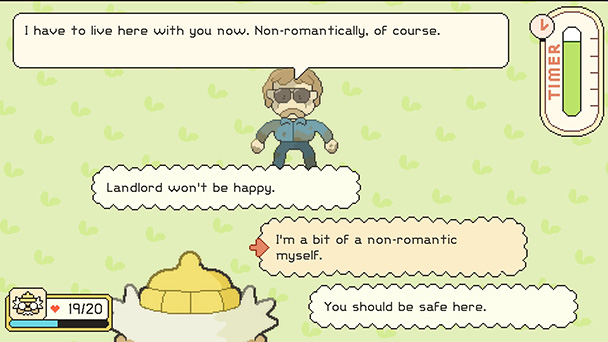
But then Hermit and Pig flexes its creative prowess by making conversations as critical as combat, challenging the old RPG convention of pausing the action for some exposition. Periodically, dialogues turn dangerous, as NPCs can wound you with words. Here, a tense negotiation with a suspicious village elder carries the same stakes as a brawl with bandits on a mountain road. Your health bar doesn’t care whether the damage came from a blade or a cutting remark, and that design decision alone elevates Hermit and Pig into genuinely original territory.
Listening, Not Just Hearing
Cleverly, each conversation is structured with its own rhythm of attack and defense. NPCs press arguments, make accusations, appeal to your pride or your fear. If you’re not careful, they’ll leave you worse off than a poorly managed sword fight. Of course, you have verbal “moves” at your disposal: deflection, appeals to reason, emotional honesty, and indifference. Choosing an unsuitable approach at the wrong moment costs you, and the game never lets you forget that the world is full of complex personalities. Interacting with them is thorny, at least for Hermit.
As such, you’ll be obligated to truly listen to others and occasionally infer what their intent is. Researchers refer to this as ‘high context’ communication- and while it fills our world, the practice is remarkably absent from most video games. As such, conversations feel like they really matter, making even transactional chats have weight in Hermit’s world. Another upshot if that you’ll pay close attention to what people have to say.
Power Through the People
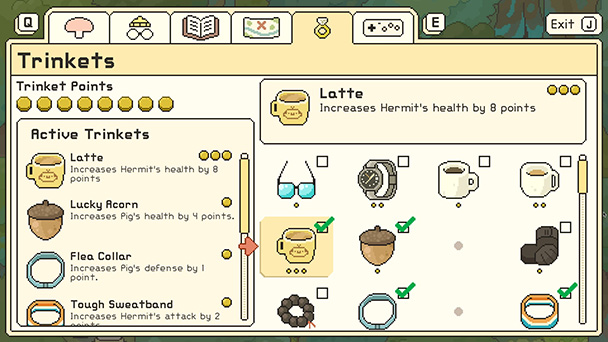
The ‘combat as conversation’ concept even carries over to how Hermit and Pig handles character building. Rather than leveling up through kills, Hermit grows through trinkets given to him by new acquaintances. Surviving difficult conversations, forming unlikely alliances, and actually listening are the activities that lead to stat improvement. As such, personal growth comes with engagement and connection to the world rather than the domination of it. Most RPGs give you experience points for slaughter; Hermit and Pig gives them to you for breaking out of your shell and associating with others. As someone who experiences little enjoyment from non-combat RPGs, I really appreciated this innovation.
The games narrative is an engrossing ecological fable. What begins as a simple mushroom-foraging errand gradually reveals a countryside poisoned by the remnants of a derelict defense contractor’s building. Crops are filing, waterways are clouded, and that strange blue haze has seeped into both the soil and the community psyche. Environmentalism here isn’t preached, with the game opting to reveal the impact through nuances such as people bickering from their mounting frustrations. In a genre that’s obsessed with saving the world through violence, Hermit and Pig suggests that conservation, care, and empathy can be just as heroic. That’s one of the most salient messages that games have told me in a long time. But if you’re just here for humor, Heavy Lunch’s wit is amazingly sharp.
A “Show, Don’t Tell” Approach to Loneliness
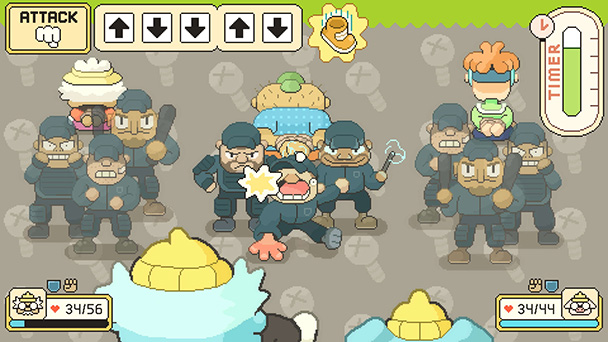
This message lands hardest when Pig is suddenly absent, forcing Hermit to lean on the community he has kept at arm’s length for so long. Without his stalwart companion absorbing blows, helping to forage for health replenishing ‘shrooms, and providing companionship, Hermit is both emotionally and statistically weakened.
Expectedly, combat grows harsher, conversations more brittle. In Pig’s absence, Hermit must confront the limits of self-reliance, and the game subtly argues that resilience is communal. When friends step in, sometimes awkwardly, the effect is deeply moving, transforming what could have been a lonely pilgrimage into a testament to connection. Best of all, Heavy Lunch doesn’t hammer the point home. Instead, they trust the audience will discern many of these details on their own. I really appreciate it when a game doesn’t constantly spoon-feed storyline, which is the dominant trend these days.
A Largely Linear Experience
If Hermit has a weakness, it is that the campaign itself moves along a fairly fixed track. The world is detailed and the writing is outstanding, but the story doesn’t branch in the way you might hope given how much agency the dialogue system otherwise provides. Major narrative decisions are predetermined, and while your conversations can shape the texture of interactions and the emotional undercurrents of scenes, they rarely change where the plot ends up. That said, it’s not a significant flaw and you the trinket system still provides plenty of ways to impact Hermit’s abilities as a character. But I would have loved to face some consequence-driven branching for the game’s eight-hour (or so) campaign.
Agreeably, Hermit and Pig‘s aesthetics are as delightfully idiosyncratic as its design. Heavy Lunch Studio employs an earthy palette of bushy greens, dusty yellows, and the occasional unsettling bloom of blue. It feels less like a game world and more like colored-pencil drawings found in a worn notebook. The soundtrack meshes with this sensibility, fusing folk-inflected melodies, ambient recording, and those strange touchtone telephone effects into something genuinely atmospheric.
Accessibility Options are Always Appreciated
When it comes to accessibility, the game offers adjustable text sizing and the option to simplify the timing-based combat meters for players who find the reflex-based challenges unnecessary. The dialogue system also includes a recap feature that summarizes previous conversations, which is a welcome option for players who take breaks across their gaming sessions.
Hermit and Pig demonstrates that games can be about poignant without being preachy, strange without being alienating, and gentle without being boring. The title takes the conventions of a genre built on conquest and reframes them around empathy, listening, and connection. It’s not perfect; a more consequential narrative might have made for a more memorable experience. But what Hermit and Pig archives is remarkable, especially for a small studio crafting something this confident, quirky, and heartwarming.
Hermit and Pig was played on PC with review code provided by the publisher.
Overview
GAMEPLAY - 85%
CONTROLS - 90%
CONTENT - 90%
AESTHETICS - 85%
ACCESSIBILITY - 85%
VALUE - 95%
88%
GREAT!
Hermit and Pig is an offbeat RPG where conversation is just as consequential as combat. Here, empathy, listening, and connection is the focus, rather than conquest. Although it’s a rather linear tale, an inventive dialogue system, salient themes, and a heartfelt exploration of loneliness make it a moving experience that shouldn’t be overlooked.





Sounded kind of cool at first But I saw someone call the game super liberal and honestly, I lost interest.