Dunjungle review
The Right Kind of Monkey Business

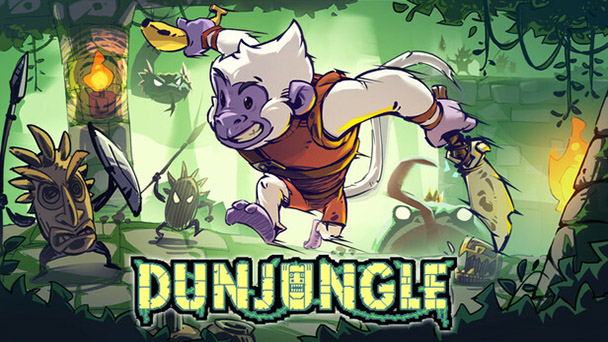
The first few minutes of developer Bruno Bombardi’s Dunjungle will probably feel familiar to action-roguelike fans. Each run begins with a loadout that includes a melee blade, a ranged magic weapon, and a relic that grants a passive perk. From there, progression begins opening up your options and revealing the game’s characteristics.
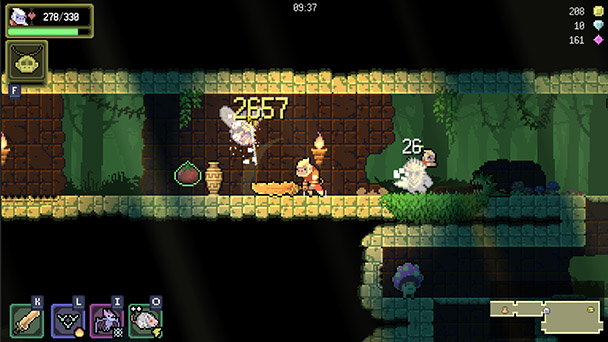
Two different in-game currencies unlock both equipment tiers and specific weapons, make sure that advancement feels gratifying rather than just a cosmetic variation. Like Dead Cells, you’re given five equipment slots, and when these are paired with elemental augmentations that can be applied to nearly any weapon, Dunjungle opens the door to a wide range builds for its primate protagonist.
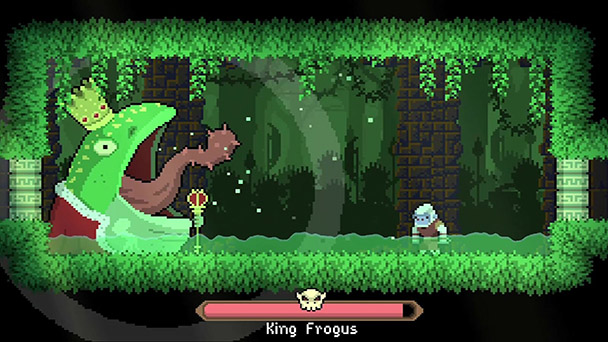
Undoubtedly, this approach to customization is one of the game’s greatest strengths. Elemental interactions, relic effects, and weapon behaviors combine in ways that reward experimentation, encouraging players to exploit roguelike synergies rather than chase a single optimal path. I’ve been playing Dunjungle since its stint in Steam’s Early Access and it remains one of my favorite 2D action roguelikes.
Let’s (Dodge) Roll
Pleasingly, the nameless monkey king at the heart of Dunjungle is both agile and responsive. He adheres to action-roguelike convention with a generous dodge roll that grants invincibility frames, and a navigational ability that includes a double jump and the ability to go from a jog into a full sprint. Survivability is bolstered by a partial self-heal, which becomes available once a meter is filled by defeating enemies, adding a subtle risk/reward dynamic that encourages aggressive play.
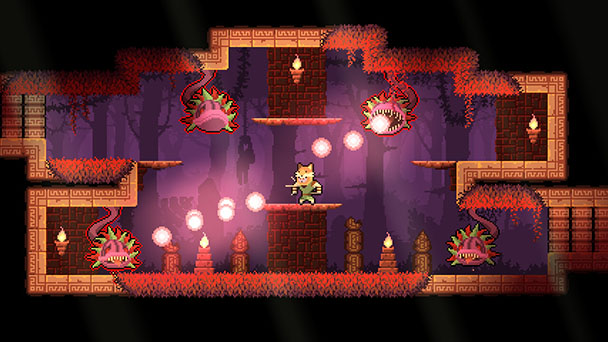
That said, Dunjungle is far from forgiving. Environmental hazards such as spikes and arrow traps can shred careless players, while enemies themselves are capable of stripping away a quarter of your health bar with a single, well-placed hit. Thankfully, attacks are clearly telegraphed: the game’s cell-shaded visuals cause enemy outlines to flash red just before a strike, giving observant players a fair chance to react.
When the Jungle Closes In
Success often stems from keeping enemies from getting too close, but Dunjungle prohibits players from completely relying on this tactic. Sporadically, the sides of the screen lock in place, transforming the battlefield into an arena where waves of enemies must be slain before progress resumes. These sections, alongside the game’s imposing bosses, represent Dunjungle at its most punishing.
Victory here often comes at a cost. Expect heavy health loss across successful treks and know that a single misstep can spiral into a run-ending disaster. The challenge is steep, but rarely unfair. Appropriately, these moments test mastery of the game’s systems rather than relying on raw luck. Most monkey murders were caused by my own recklessness as I pursued reprisal for any adversary bold enough to threaten me.
Mushrooms to Kill and Money to Make
Despite its difficulty, Dunjungle encourages players to keep diving back in. Meta-progression unlocks steadily enhance your chimp, from expanding your health pool to increasing the likelihood of shops appearing within a run. Best of all, the full releases builds on the already impressive variety of the Early Access version, with a wide selection of weapons, modifiers, and biome types. This helps ensure that runs rarely feel repetitive.
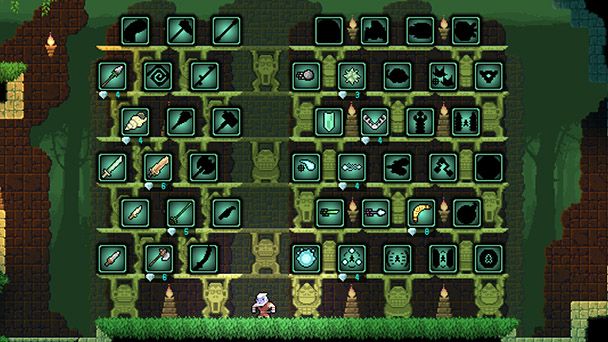
Dunjungle shines brightest when it leans into meaningful decision-making. Risk/reward mechanics pop up frequently, with one standout example being the blacksmith: your first weapon upgrade is free, but attempting to enhance a second carries a 25% chance of destroying it outright. In one ill-fated run, greed left me weaponless, surviving solely thanks to a perk that dropped bear traps whenever I dodge-rolled. And that’s exactly the kind of self-inflicted chaos I love in a roguelike, not to mention a reminder on greed.
Risk, Reward, and Regret
Dunjungle’s flexible builds, taut combat, and unapologetic difficulty work together to create runs that are as memorable for their triumphs as their failures. Whether you’re crafting elemental synergies or laughing through the fallout of a disastrous gamble, the game consistently makes you commit to every decision. For players willing to embrace this harsh jungle and learn from their own mistakes, this is a roguelike that rewards persistence with some delightfully chaotic monkey business.
Dunjungle was played on PC with review code provided by the publisher.
Overview
GAMEPLAY - 85%
CONTROLS - 80%
CONTENT - 80%
AESTHETICS - 75%
PERFORMANCE - 80%
VALUE - 80%
80%
GOOD
Dunjungle takes familiar action-roguelike ideas and juices them up with smart customization, brutal-but-fair combat, and enough risk/reward temptation to keep every run exciting. It’s tough, occasionally cruel, and constantly enticing you to make bad decisions, which is what makes it so hard to put down.





Sounds good. Is it better than Dead Cells, though?
Just picked this up. So good. Thanks for covering this kinds of smaller games.
Im liking it even tho I suck at this kinds of games.