Galactic Vault Review
A Vault Worth Cracking into, But Someone Already Beat You to It

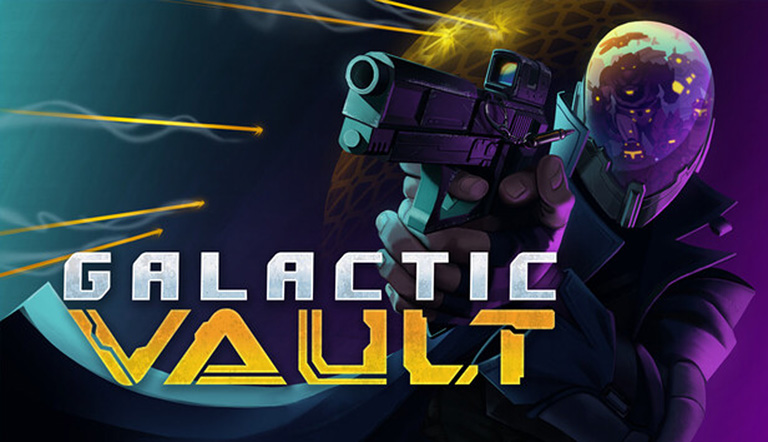
There are some ingenious delights buried within a well-designed first-person, roguelike shooter. Beyond the satisfaction of trying out different builds, the mounting momentum of a run, there’s the thrill of power fantasy. Habitually, you start off with the most basic of offensive weaponry and a minimum of defensive protection. But gradually, you’ll grow stronger, leaving vulnerability behind like a trail of bullet casings.
A few passive weapon mods and weapon upgrades can turn the tide. Enemies that once demanded attentiveness now succumb to sustained bursts of fire. Undoubtedly, developer MeepMeep Games understands this equation. Their inaugural effort Galactic Vault delivers enjoyment with moderate level of competence. But here’s the thing: there are at least four games that inject roguelike perks into an FPS a bit better.
From Peashooter to Powerhouse via Frequent Perks
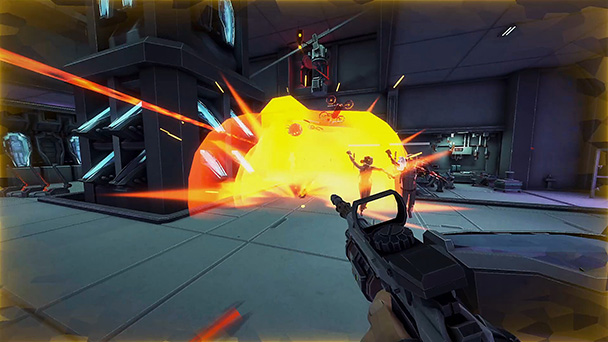
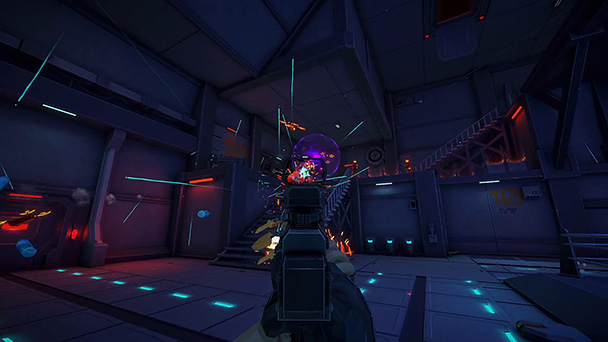
Like many of its peers, Galactic Vault’s firefights take place across a series of procedurally generated sci-fi arenas. Each run tasks you with clearing rooms, earning perks, and investing any acquired money into modifiers that augment your weapons and abilities ever further. Largely, the actual shooting is functional and somewhat satisfying. Most guns pack a decent punch, movement is responsive, and there’s just enough of a tactile feel to it all. Altogether, the gunplay is satisfactory, but if you’re reading this review, I’m sure you played better.
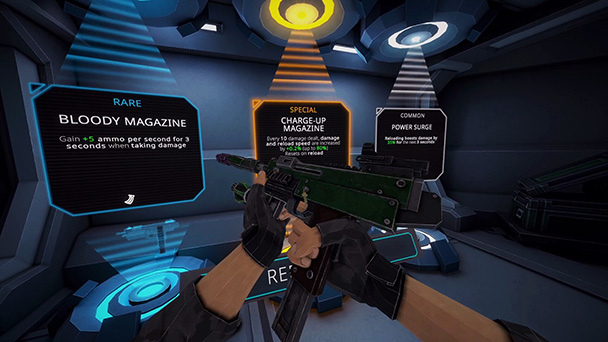
Certainly, Vault’s modifier system is one of its strengths. The game drip-feeds the conventional selection of three mods after you clear a room, letting you keep on of them. Pleasingly, rooms have multiple exits, with each door extending a different kind of part upgrade, that ranges from muzzles, sights, bullets, magazines to charms.
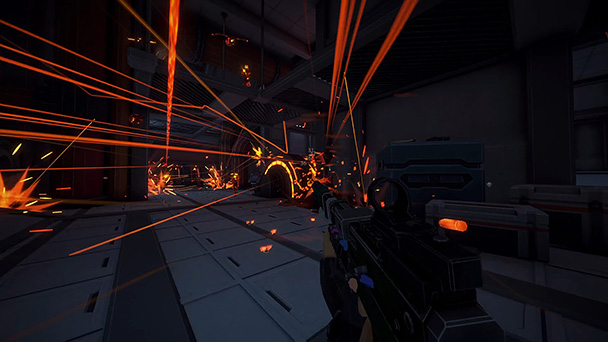
Each attempt starts with a standard (but selectable) loadout and gradually acquires new perks. Maybe you’ll regenerate health while sprinting, slow down time when you’re looking down the sights, or get extra ammo for hitting weakpoints. Undoubtedly, there’s a perceptible gratification when you begin stacking layers of perks.
Forceful Firepower Needs a Worthy Target
But as thrilling as a pile of perks can be, gunning down foes feels rudimentary. Enemies largely chase you around the arena, doing little more than absorbing bullets until their health is depleted. As such, encounters feel underdeveloped as you run from a procession or ground and air-based pursuers, sporadically turning around to dump ammo at them. Galactic Vault tries to mix this up with different room options, where you’ll face off against waves of opponents or seize control points, but these feel like a makeshift solution.
Given how enemies group together, capture rooms can either break the game’s sense of balance or just be bothersome, depending on your playstyle. All too often, runs start feeling mechanical, as a battalion of bots, drones, and turrets grow in number but not in acumen. At this point, Galactic Vault’s peers begin to look more enticing.
Outgunned by the Competition?
Among those rivals, Deadzone Rogue offers one of the more insightful comparisons. Prophecy Games’ mix of first-person firefights with a steady distribution of perks displays a bit more precision. Weapon handling feels just a bit closer to the triple-A shooters and adds an interesting tactical mechanic. Here, your first melee strike or gunshot breaks concealment, so every engagement opens with you studying the layout of enemies and considering a path of destruction. With Galactic Vault, I occasionally got rushed at the front door, immediately losing some health at shielding.
Meanwhile, Gunfire Reborn remains one of the genre’s high watermarks, with its varied character roster, even deeper build variety, and years of post-launch content. Roboquest brings faster, more kinetic movement making traversal a critical part of the action. Even Deadlink, which is perhaps the furthest stylistic departure of the four, earns some recognition for its blend of kill combos, fluid movement, and relenting tempo. Against this field, Galactic Vault doesn’t embarrass itself. But the game struggles to stand out from its competitors.
A Solid Vault in a Stacked Galaxy
On more modest hardware like Steam Deck, this gap widens. Sure, the game runs adequately in handheld mode, but reveals far more frame rate inconsistency than Deadzone Rogue or Gunfire Reborn. And that’s a shame because games like this with their modest install size (less than 2GB) are a welcome alterative to the bloated footprints of FPS games like Doom Eternal (which requires about 80GB). On the upside, the input scheme translates reasonably well to controller use and the interface is legible on smaller screens. Regardless of hardware, some of the title’s sound effects and explosions feel strangely underwhelming.
Galactic Vault isn’t a bad game. But it’s a title that has moved into an occupied neighborhood that’s packed with top-tier talent. The title’s core loop is functional, its meta-game upgrades might be paltry but help incentivize play, and there are moments where cultivating your build can feel fulfilling. But MeepMeep Games hasn’t equipped Vault with a distinctive trait that might push it in the pantheon of proficient first-person roguelikes. My blueprint for sequencing is this: play Deadzone Rogue, Gunfire Reborn, Roboquest, and then Deadlink. If you emerge from that catalog still hungry for more shooting and mod stacking, then make Galactic Vault your next stop.
Galactic Vault was played on PC with review code provided by the publisher.
Overview
GAMEPLAY - 60%
CONTROLS - 65%
CONTENT - 60%
AESTHETICS - 65%
ACCESSIBILITY - 70%
VALUE - 60%
63%
MEDIOCRE
Galactic Vault can be a fun shooter that lets you grow into a walking arsenal across each mod-filled run. But in a genre packed with sharper, more inventive rivals, it feels like it should be your backup plan, rather than being your main heist.





We need a Deadzone Rogue Switch 2 if you really love the game that much.